

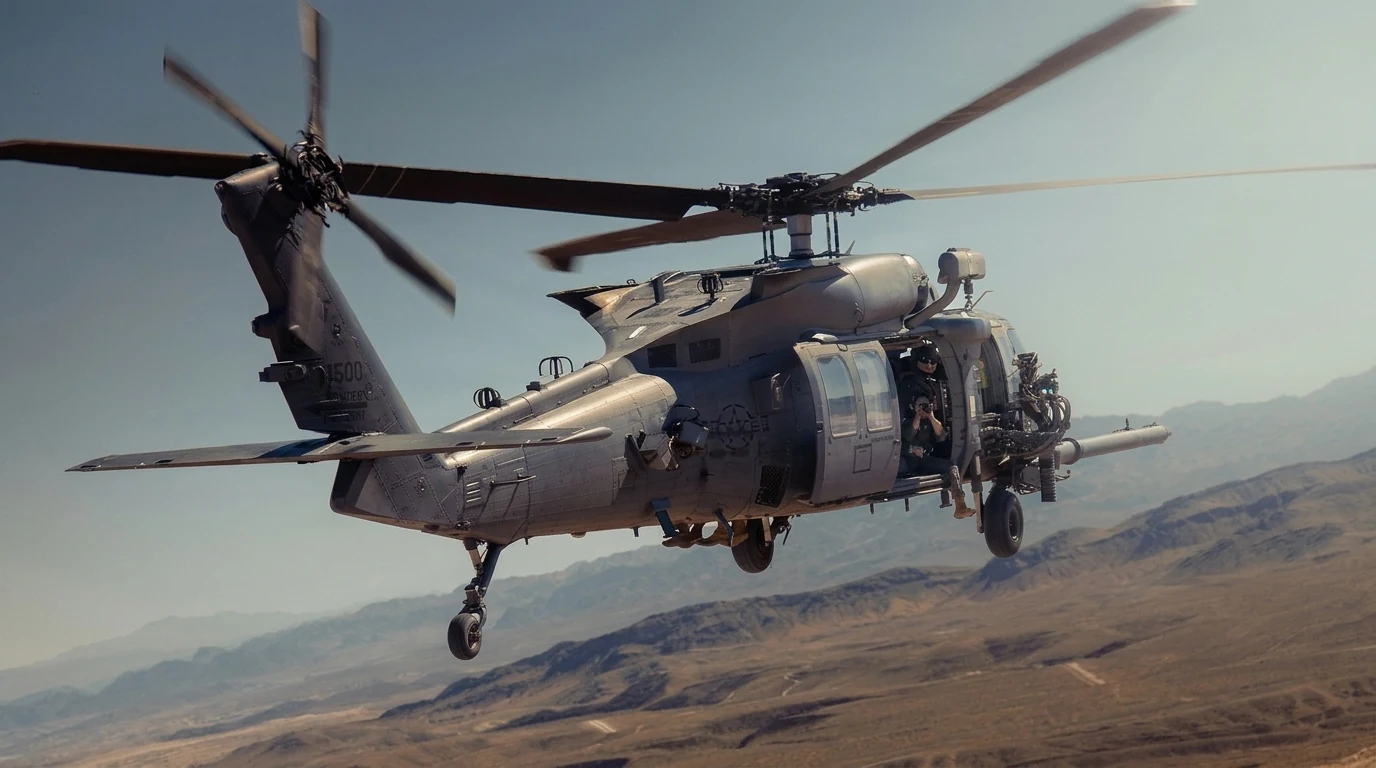
A downed pilot can be stranded deep inside hostile territory, with little time and few options. Getting that pilot home may depend on a helicopter flying into the danger zone.
That is where the HH-60W Jolly Green II comes in.
Operated by the U.S. Air Force, this specialized combat rescue helicopter is designed to recover isolated personnel under demanding conditions. It combines the familiar Black Hawk helicopter design with expanded fuel capacity, modern avionics, and equipment intended to improve survivability in contested environments.
But the HH-60W Jolly Green II is more than a helicopter with a rescue hoist. Its real value lies in bringing together aircraft performance, crew coordination, communications, and defensive systems for missions where delays can cost lives.
The HH-60W Jolly Green II first flew on May 17, 2019, and reached initial operational capability in October 2022. It was developed to replace the aging HH-60G Pave Hawk, which had served the Air Force’s combat search-and-rescue community for decades.
So, what makes this aircraft different? How far can it fly, what technology does it carry, and how does it help rescue personnel in hostile territory?
Let’s look inside the HH-60W Jolly Green II and examine the capabilities that make it central to modern U.S. Air Force combat rescue operations.
What Is the HH-60W Jolly Green II?
The HH-60W Jolly Green II is a dedicated combat rescue helicopter operated by the U.S. Air Force. Its primary mission is straightforward but dangerous: recover isolated personnel from hostile or difficult environments and bring them to safety.
Imagine a fighter pilot ejecting over enemy territory. The pilot may have limited supplies, unreliable communications, and hostile forces searching nearby. Recovering that pilot requires more than a transport helicopter. It demands an aircraft equipped to locate survivors, withstand threats, and coordinate with other military units.
That’s precisely what the HH-60W Jolly Green II was designed to do.
Manufactured by Sikorsky, a Lockheed Martin company, the HH-60W Jolly Green II builds on the UH-60M Black Hawk design. However, it incorporates substantial modifications for long-range personnel recovery, including increased internal fuel capacity, specialized communications equipment, and integrated defensive systems.
The aircraft also carries forward the legacy of the HH-60G Pave Hawk. The older helicopter performed combat search-and-rescue missions for decades, but its aging systems and growing sustainment demands created pressure for a modern replacement.
The HH-60W Jolly Green II first flew on May 17, 2019. The Air Force subsequently declared initial operational capability in October 2022, marking an important milestone in the transition to the newer aircraft.
More Than a Search-and-Rescue Helicopter
The HH-60W Jolly Green II’s main responsibility is combat search and rescue, commonly abbreviated as CSAR. Yet its usefulness extends beyond recovering downed aircrews during wartime.
Depending on operational requirements, it can support medical evacuations, humanitarian assistance, disaster response, and other personnel recovery missions. Its ability to operate at night and in challenging weather also makes it valuable when conventional transportation becomes difficult.

The nickname Jolly Green II connects the aircraft to a long tradition of American rescue aviation. Its predecessor, the HH-3E Jolly Green Giant, earned recognition during the Vietnam War for recovering aircrew members from dangerous locations.
The newer helicopter carries that mission into a different technological era. Its purpose remains the same: reach people who cannot easily reach safety themselves.
HH-60W Jolly Green II Specifications and Performance
The HH-60W Jolly Green II may resemble a conventional military utility helicopter, but its performance is tailored to a demanding job: reaching isolated personnel, remaining on station long enough to complete a recovery, and returning safely.
Its twin-engine configuration provides the power needed to carry rescue specialists, medical equipment, defensive systems, and recovered personnel. Just as important, increased fuel capacity helps the aircraft cover greater distances without relying entirely on intermediate refueling.
Here are the key specifications of the U.S. Air Force’s combat rescue helicopter.
| Specification | HH-60W Jolly Green II |
| Manufacturer | Sikorsky, Lockheed Martin |
| Engines | 2 × General Electric T700-GE-701D |
| Engine power | Approximately 1,940 shaft horsepower each |
| Maximum airspeed | Approximately 153 knots indicated airspeed at sea level |
| Published range | Approximately 599 nautical miles |
| Rotor diameter | 53.6 feet |
| Length | 64.7 feet |
| Height | 16.7 feet |
| Maximum takeoff weight | Approximately 23,500 pounds |
| Service ceiling | Approximately 20,000 feet |
| Crew | Typically four, with additional rescue personnel as required |
Figures are drawn from published U.S. Air Force and manufacturer information. Performance varies with aircraft configuration, payload, weather, and operating conditions.
Engine Power and Flight Performance
The HH-60W Jolly Green II uses two T700-GE-701D turboshaft engines, each producing approximately 1,940 shaft horsepower. Together, they provide the power needed for demanding flight conditions and heavy mission loads.
That matters during a rescue. The helicopter might need to hover while personnel are recovered, maneuver around obstacles, or operate at an elevated landing site where thinner air affects performance.
Speed matters, too, but raw speed doesn’t tell the whole story. The aircraft must balance transit time against fuel consumption, payload, and the time required to complete the recovery.

Range: The Advantage of More Fuel
The HH-60W Jolly Green II has substantially greater internal fuel capacity than its predecessor, the HH-60G Pave Hawk. Manufacturer information describes its fuel capacity as approximately double that of the older aircraft.
Its published range of roughly 599 nautical miles provides a useful reference, although this figure should not be confused with combat radius. Actual mission distance depends on reserves, payload, weather, and time spent hovering.
The helicopter can also receive fuel in flight, extending its reach when compatible tankers and mission conditions permit.
For combat rescue crews, that flexibility is crucial. A helicopter that can reach farther and remain available longer has more options when a rescue takes an unexpected turn.
Inside the HH-60W Jolly Green II’s Cockpit, Avionics and Mission Systems
A rescue helicopter can have powerful engines and plenty of fuel, but those advantages mean little if its crew cannot navigate safely or locate isolated personnel. The HH-60W Jolly Green II addresses this challenge with modern avionics, digital displays, and integrated mission systems designed for demanding combat environments.
Think of the cockpit as the aircraft’s information center. Pilots must monitor flight conditions, navigate unfamiliar terrain, communicate with supporting forces, and respond to changing threats. The technology inside the Jolly Green II helps bring those demands together.

A Digital Cockpit Built for Complex Missions
The HH-60W Jolly Green II incorporates a modern digital cockpit with multifunction displays and integrated navigation information. Instead of relying entirely on separate instruments, aircrew can access essential flight and mission data through a more coordinated interface.
This matters during night operations, when visual references may be limited. Pilots must manage altitude, terrain clearance, aircraft position, and crew coordination without the same outside visibility available during daylight.
Digital displays help organize that information, although they don’t eliminate the need for experience, sound judgment, or careful mission planning.
Communications and Situational Awareness
Combat rescue rarely involves a helicopter operating alone. The HH-60W Jolly Green II must coordinate with other aircraft, rescue specialists, command elements, and personnel awaiting recovery.
Its communications and tactical data capabilities help crews share information and maintain awareness of the wider operation. Systems such as Link 16 and the Situational Awareness Data Link (SADL) support the exchange of tactical information with compatible participants.
The practical benefit is straightforward: better information sharing can help different units coordinate their activities instead of working from separate, incomplete pictures of the situation.
Sensors and Threat Awareness
The helicopter also incorporates equipment intended to warn crews about potential threats. Depending on the system involved, this can include indications of radar activity, missile threats, laser illumination, or hostile fire.
These warnings give crews additional information when assessing dangerous conditions. They do not guarantee that every threat will be detected or defeated.

The HH-60W Jolly Green II’s avionics therefore serve a broader purpose than navigation. They help connect the aircraft, its crew, and supporting forces into a coordinated rescue effort.
The key advantage isn’t simply having more technology. It’s helping the crew make informed decisions when time, visibility, and situational awareness are all under pressure.
Weapons, Defensive Systems and Combat Survivability
Recovering a downed aircrew member can mean flying into an area where hostile forces are actively searching for survivors. The HH-60W Jolly Green II is built for this difficult reality, combining defensive equipment, onboard weapons, and protective features intended to improve its chances of completing a rescue.
Unlike helicopters designed primarily for routine transportation, the HH-60W Jolly Green II must be prepared to operate where the aircraft itself may become a target.
Weapons for Self-Protection
The HH-60W Jolly Green II can carry two crew-served weapons, with configurations including 7.62 mm miniguns or .50-caliber machine guns. These weapons provide defensive firepower during missions in which hostile ground forces could threaten the helicopter and its crew.
The distinction matters. The HH-60W Jolly Green II is not primarily an attack helicopter designed to hunt armored vehicles or conduct sustained offensive engagements. Its weapons support the larger objective of recovering personnel and protecting the rescue force.
The aircraft’s effectiveness also depends on coordination with other military assets. Depending on the mission, supporting aircraft may provide surveillance, communications, or additional protection.
Warning Systems and Countermeasures
Weapons are only one part of survivability. The HH-60W Jolly Green II also incorporates systems designed to help crews recognize and respond to threats.
These include missile-warning equipment, radar-warning capabilities, and countermeasures such as chaff and flares. Chaff can help confuse certain radar-guided threats, while flares are intended to distract heat-seeking missiles under appropriate conditions.
The aircraft also features protective measures intended to reduce vulnerability, including armor and infrared-signature management.
No single system provides complete protection. Their value comes from combining threat awareness, defensive measures, crew training, and sound operational planning.

Why Survivability Matters During Rescue
Consider a helicopter approaching a recovery site where visibility is poor and the security situation remains uncertain. The crew must manage the aircraft while monitoring potential threats and coordinating the recovery.
Every additional demand increases the pressure on the crew. Warning systems can provide valuable information, but the team must still interpret that information and respond appropriately.
The HH-60W Jolly Green II’s defensive architecture is designed around this challenge. Survivability isn’t about making a helicopter invulnerable; it’s about improving its ability to complete a mission despite danger.
That distinction is essential when evaluating any combat rescue aircraft. Its real purpose is not to win a fight for its own sake, but to bring people home.
How the HH-60W Jolly Green II Conducts Combat Search and Rescue Missions
A successful rescue begins long before the helicopter reaches its destination. The HH-60W Jolly Green II operates as part of a wider personnel recovery effort, bringing together pilots, rescue specialists, communications teams, and supporting aircraft to recover people in dangerous environments.
Combat Search and Rescue, or CSAR, is the process of locating, supporting, and recovering personnel isolated in hostile or contested areas. A downed fighter pilot is one example, but the mission can involve other military personnel who become separated from their units.
Finding and Reaching Isolated Personnel
The first challenge is understanding where the isolated person is and what conditions surround them. Mission planners consider available location information, weather, terrain, communications, and potential threats before a rescue force is dispatched.
The HH-60W Jolly Green II’s navigation equipment and communications systems help its crew coordinate with other participants. Depending on the circumstances, supporting aircraft may contribute surveillance, protection, or additional communications capabilities.
Reaching the location is only part of the job. The crew must also assess conditions around the recovery site and determine whether the helicopter can safely approach and depart.
Recovering Personnel Under Pressure
Once the rescue force reaches the recovery area, trained personnel help coordinate the recovery. Aircrew must manage the helicopter while accounting for terrain, visibility, and the condition of the person being rescued.
The HH-60W Jolly Green II can support personnel recovery using mission-appropriate rescue equipment, including a hoist when landing is impractical or unsafe. This capability is particularly valuable when the helicopter cannot touch down near the isolated individual.
Inside the aircraft, recovered personnel may require immediate medical attention. The helicopter’s cabin can accommodate rescue specialists and medical equipment, allowing the team to provide appropriate care during transport.

Why Coordination Matters
The HH-60W Jolly Green II is one component of a larger system. Air Force pararescuemen bring specialized rescue and medical skills, while other military assets can support navigation, communications, and protection.
This teamwork is essential because conditions can change rapidly. Weather may deteriorate, communications may become unreliable, or a recovery site may prove more dangerous than expected.
The helicopter provides mobility, but the rescue force provides the wider capability. Its success depends on how effectively aircraft, personnel, equipment, and planning work together.
That combination explains why combat rescue remains a specialized military mission rather than a simple transportation task. The goal is not merely to reach someone in danger. It’s to recover them and get them somewhere safe.
HH-60W Jolly Green II: Operational Deployment and Future Upgrades
A rescue helicopter’s real value isn’t measured by its specifications alone. It must be available when an emergency occurs, supported by trained crews, and ready to operate alongside other military assets.
For the HH-60W Jolly Green II, that means transitioning from a promising new aircraft into a dependable part of the U.S. Air Force’s combat rescue force.
The helicopter reached initial operational capability in October 2022, marking an important milestone in the replacement of the aging HH-60G Pave Hawk. The transition has involved operational units, maintenance personnel, training organizations, and the wider logistics network required to keep the aircraft flying.
Building an Operational Rescue Fleet
Moody Air Force Base in Georgia and Kirtland Air Force Base in New Mexico have played important roles in the Air Force’s combat rescue enterprise and the introduction of the newer helicopter.
Fielding the HH-60W Jolly Green II requires more than delivering aircraft to a base. Pilots must learn its systems, rescue specialists must train alongside aircrew, and maintainers must become familiar with its equipment and support requirements.
The transition also has to preserve operational coverage. Older helicopters cannot simply be withdrawn before replacement aircraft and crews are ready to assume their responsibilities.
That creates a practical challenge: modernizing the fleet while maintaining the ability to respond to real-world emergencies.

Future Upgrades and Emerging Threats
Military technology continues to evolve, and rescue helicopters must adapt to changing operating environments. GPS disruption, communications interference, and increasingly sophisticated air-defense systems can complicate missions that were already demanding.
Planned improvements to the HH-60W Jolly Green II have included efforts to strengthen navigation resilience and communications capabilities. These upgrades are intended to help crews maintain awareness and coordination when operating conditions become more difficult.
However, proposed improvements should not be confused with equipment already fielded across the fleet. Acquisition plans, development milestones, and operational availability can change over time.
The Challenge of Maintaining Readiness
Even an advanced helicopter can contribute little if it spends too much time awaiting maintenance or replacement parts. Engine support, specialist training, spare-component availability, and fleet sustainment all influence how many aircraft are ready for missions.
The HH-60W Jolly Green II’s long-term contribution will therefore depend on more than its onboard technology. The Air Force must sustain the aircraft throughout its service life while adapting it to new operational requirements.
The HH-60W Jolly Green II represents a significant modernization of American combat rescue aviation. Its ultimate measure of success, however, will be whether crews can consistently use its capabilities to recover personnel when the stakes are highest.
