

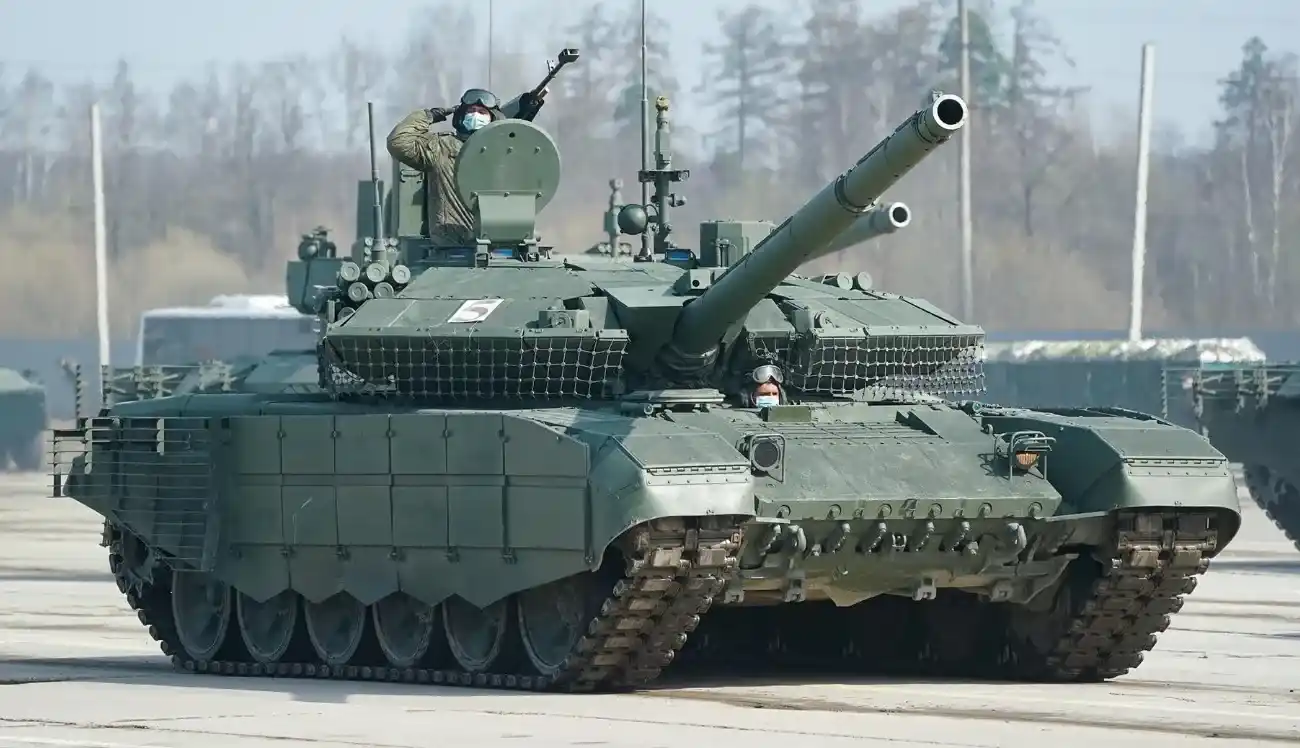
A tank can have a powerful gun, thick armor, and a formidable engine yet still struggle to survive on today’s battlefield. That’s the reality facing Russia’s T-90 tank, one of the country’s most important armored fighting vehicles.
Developed from the T-72 family, the T-90 combines a 125 mm main gun, an automatic loading system, and layered armor protection in a relatively compact design. Its latest major variant, the T-90M Proryv, introduces significant improvements to protection, optics, and fire-control equipment.
On paper, these features make the T-90 a serious opponent. But battlefield conditions rarely follow a manufacturer’s specifications sheet.
Modern tanks must contend with anti-tank missiles, artillery, mines, and drones that can threaten vehicles from unexpected directions. Even advanced armor has limits, especially when crews operate without adequate reconnaissance or supporting forces.
So, how powerful is the Russian T-90 tank in practical terms?
To answer that question, we need to examine more than its gun and engine. We’ll explore its development, technical specifications, firepower, armor, mobility, and combat experience to understand where the T-90 excels, and where its limitations become difficult to ignore.
What Is the Russian T-90 Tank?
The T-90 tank wasn’t designed to reinvent armored warfare. Instead, Russia took a proven tank design, improved its capabilities, and created a vehicle intended to deliver considerable firepower without the size and cost of some Western alternatives.

The story begins with the Soviet-era T-72. Introduced in the 1970s, this tank became widely used because of its relatively compact design, automatic loader, and suitability for mass production. As the Soviet Union dissolved, Russian engineers continued developing the platform to meet changing military requirements.
The result was the T-90, which entered Russian military service in 1992. Initially designated the T-72BU, it received a new name to distinguish the upgraded vehicle from its predecessor.
How Did the T-90 Evolve?
The T-90 family has developed considerably since its introduction. Different variants feature changes to their sights, armor, engines, and fire-control systems.
Here’s how the major versions differ:
| Variant | Key characteristics |
| T-90 | Original production model with a 125 mm main gun and composite armor |
| T-90A | Improved version featuring a welded turret and upgraded equipment |
| T-90S | Export variant adapted for international customers |
| T-90M Proryv | Modernized version with improved protection, sights, and fire-control equipment |
The T-90M deserves particular attention. Its upgraded turret, improved battlefield awareness, and Relikt explosive reactive armor represent a substantial step beyond the original model.
However, these upgrades don’t make every T-90 equally capable. An older T-90 and a modernized T-90M can differ significantly in their equipment and protection.
Why Does Russia Still Use the T-90?
One important reason is practicality. Building an entirely new tank fleet requires enormous industrial resources, specialized components, and years of development.
Upgrading an established platform offers another route. Russia can draw on existing manufacturing experience while introducing newer technologies where they matter most.

The T-90’s compact design and three-person crew also reflect a distinctly Russian approach to tank development. An automatic loader reduces the crew requirement, although it introduces its own ammunition-storage considerations.
That trade-off helps explain the T-90’s appeal. It’s a combination of established engineering and incremental modernization, designed to keep a large armored force operational as battlefield demands change.
Russian T-90 Tank Specifications: How Powerful Is Its Engine?
The Russian T-90 tank packs substantial firepower into a relatively compact vehicle. Its combination of engine power, tracked mobility, and a three-person crew reflects a design built around efficiency rather than sheer size.
But specifications only tell part of the story. To understand what the T-90 can accomplish, you need to look at how its individual systems work together.
T-90 Tank Specifications at a Glance
| Specification | T-90A | T-90M Proryv |
| Crew | 3 | 3 |
| Main armament | 125 mm smoothbore gun | 125 mm smoothbore gun |
| Engine power | Approximately 1,000 hp | Approximately 1,130 hp |
| Combat weight | Approximately 46.5 tonnes | Approximately 48 tonnes |
| Maximum road speed | Approximately 60–65 km/h | Approximately 60 km/h |
| Operational range | Approximately 550 km | Approximately 500 km |
| Loading system | Automatic loader | Automatic loader |
How Powerful Is the T-90’s Engine?
The T-90A uses a diesel engine producing approximately 1,000 horsepower, while the T-90M’s V-92S2F engine delivers around 1,130 horsepower.
That additional output helps the heavier modernized tank maintain useful mobility despite its upgraded protection and equipment.

Consider the power-to-weight ratio. A T-90M weighing roughly 48 tonnes with a 1,130-horsepower engine achieves approximately 23.5 horsepower per tonne. This provides a useful measure of its potential acceleration and mobility, although terrain and mechanical condition also matter.
A tank doesn’t need sports-car speed. It needs enough power to cross uneven ground, climb obstacles, and reposition under pressure.
Why Does the T-90’s Compact Design Matter?
The T-90’s relatively low profile can make it harder to spot and expose less of the vehicle when positioned behind terrain.
Its automatic loader also allows the tank to operate with three crew members rather than the four found in tanks such as the M1 Abrams and Leopard 2.
However, compactness brings compromises. Internal space is limited, and the arrangement of ammunition and crew compartments has important implications for survivability.
The takeaway? The T-90’s engine and dimensions support a practical balance of mobility, firepower, and logistical demands. Yet its real performance depends on much more than horsepower alone. Maintenance, fuel availability, terrain, and crew training all influence how effectively it operates in combat.
How Powerful Is the T-90 Tank’s Firepower?
The T-90 tank carries a weapon capable of delivering devastating firepower against armored vehicles, fortified positions, and other battlefield targets. Its centerpiece is a 125 mm smoothbore cannon, giving the Russian tank considerable offensive potential despite its relatively compact frame.

But caliber alone doesn’t determine lethality. Ammunition design, targeting systems, crew training, and engagement conditions all influence whether a shot hits its intended target.
The T-90’s 125 mm Main Gun
The T-90 uses a 125 mm 2A46-series smoothbore gun, with specific configurations varying across the tank family. This weapon can fire several types of ammunition designed for different battlefield tasks.
| Ammunition type | Primary purpose |
| Armor-piercing fin-stabilized discarding sabot (APFSDS) | Engaging heavily armored vehicles |
| High-explosive anti-tank (HEAT) | Attacking armored targets using a shaped-charge warhead |
| High-explosive fragmentation (HE-FRAG) | Engaging personnel, field positions, and certain structures |
| Gun-launched guided missiles | Attacking compatible targets at extended engagement distances |
The distinction matters. An armor-piercing projectile is designed for a different purpose than a fragmentation round, which can be more useful against exposed troops or defensive positions.
The tank’s gun can also launch compatible guided missiles through the barrel. However, this capability depends on the specific weapon system, ammunition, and equipment installed.

How Does the Automatic Loader Improve Firepower?
Unlike Western tanks such as the M1 Abrams and Leopard 2, which generally use a human loader, the T-90 relies on a mechanical loading system.
This allows the crew to operate with three people: a commander, a gunner, and a driver.
The automatic loader reduces the physical workload associated with manually handling heavy ammunition. It also provides a relatively consistent loading process, although actual firing rates depend on operating conditions and ammunition selection.
There is a trade-off, however. The loader’s design influences how ammunition is stored inside the vehicle, with important consequences for crew safety if the tank’s armor is penetrated.
Why Fire-Control Technology Matters
A powerful cannon is only useful when the crew can identify, track, and engage a target accurately.
Modernized T-90 variants feature improved sights and fire-control equipment compared with earlier models. These upgrades can help crews acquire targets more effectively, particularly when visibility is poor.
Still, technology cannot eliminate every disadvantage. Smoke, terrain, damaged optics, and competing battlefield threats can all complicate engagements.
The T-90’s firepower is formidable, but its effectiveness ultimately depends on the entire system working together, not simply the size of its gun.
How Strong Is the T-90 Tank’s Armor and Protection?
A tank’s greatest weapon might be its cannon, but its armor often determines whether the crew gets another chance to fire. The Russian T-90 tank combines composite armor, explosive reactive armor, and other defensive measures to improve its chances of surviving modern combat.

Yet no tank is invulnerable. Understanding the T-90’s protection means examining both the technology it uses and the threats it struggles to defeat.
Composite Armor and Explosive Reactive Armor
The T-90 uses composite armor designed to provide protection beyond what conventional steel alone can offer. Its exact composition and protective performance vary by variant and armor location.
Many T-90 configurations also use explosive reactive armor (ERA), which is designed to disrupt certain incoming anti-tank warheads.

Earlier models commonly feature Kontakt-5 ERA, while the modernized T-90M incorporates Relikt reactive armor. These systems are intended to improve protection against particular shaped-charge weapons and, depending on the design, some kinetic-energy threats.
| Protection system | Primary role |
| Composite armor | Provides the tank’s underlying armored protection |
| Kontakt-5 ERA | Improves resistance to selected anti-tank threats |
| Relikt ERA | Offers upgraded protection against certain shaped-charge and kinetic-energy threats |
| Smoke launchers | Help obscure the vehicle and complicate enemy targeting |
| Optical countermeasures | Certain configurations can interfere with compatible targeting systems |
These systems don’t provide equal protection everywhere. The turret front and hull front are generally better protected than the roof, sides, and rear.
What About the Shtora Defensive System?
Some earlier T-90 configurations were equipped with Shtora-1, an electro-optical countermeasure system intended to interfere with certain guided anti-tank weapons.
Its effectiveness depends on the threat involved. It shouldn’t be confused with a hard-kill active protection system, which attempts to physically intercept an incoming projectile.
The distinction is important because modern guided weapons use different guidance methods, and not every countermeasure works against every threat.
Why Can the T-90 Still Be Destroyed?
Modern battlefields expose tanks to attacks from multiple directions. Anti-tank missiles, mines, artillery, and drones can exploit vulnerabilities that frontal armor wasn’t designed to eliminate.
The T-90’s ammunition arrangement also creates a serious survivability concern. If a penetrating hit ignites stored ammunition, the resulting fire or explosion can cause catastrophic damage.
Additional armor cannot solve every problem, either. Extra protection increases weight, while poorly positioned equipment or damaged defensive systems may reduce effectiveness.
The T-90’s armor makes it a serious armored fighting vehicle, but protection is a matter of degree, not a guarantee. Crew training, tactical positioning, reconnaissance, and supporting forces remain essential to survival.
How Fast Is the T-90 Tank, and How Mobile Is It?
A tank doesn’t need to outrun every opponent. It needs to reach the right position, cross difficult terrain, and move before the enemy can respond. That’s where the Russian T-90 tank’s mobility becomes important.
Powered by a diesel engine and equipped with tracked suspension, the T-90 is designed to operate across varied terrain. Its performance, however, depends on more than the maximum speed printed in a specification sheet.
T-90 Tank Speed and Operational Range
The T-90A can reach approximately 60–65 km/h on roads under suitable conditions.
The modernized T-90M has a similar road-speed figure, although its greater weight and operating conditions affect practical performance.
Its operational range is commonly reported at around 500–550 km, depending on the variant, fuel capacity, terrain, and driving conditions.
| Mobility characteristic | Approximate capability |
| Maximum road speed | 60–65 km/h, depending on variant |
| Operational range | Around 500–550 km for commonly cited configurations |
| Engine type | Diesel |
| Mobility system | Tracked suspension |
| Power-to-weight ratio | Approximately 23–24 hp per tonne for the T-90M |
These figures provide a useful starting point, but real-world movement is rarely so straightforward.
How Does the T-90 Perform Off-Road?
Tracks distribute a tank’s weight across a larger contact area than conventional wheels, helping it travel over surfaces that would challenge many wheeled vehicles.
This is particularly valuable on muddy ground, uneven fields, and damaged roads. Still, tracks don’t make a tank immune to getting stuck. Deep mud, soft soil, obstacles, and poor route selection can halt even a powerful vehicle.

The engine’s output also matters when climbing slopes or maneuvering through rough terrain. With approximately 1,130 horsepower, the T-90M has substantial power available for a vehicle weighing roughly 48 tonnes.
But there’s a catch. Greater weight can increase pressure on soft ground, while additional armor and equipment may complicate recovery when the tank becomes immobilized.
Mobility Involves More Than Speed
Fuel consumption, maintenance, spare parts, and recovery vehicles all influence how far a tank can operate effectively. A vehicle that moves quickly but cannot receive fuel or repairs offers limited operational value.
The T-90’s diesel engine supports a practical balance between power and range. Nevertheless, sustained movement requires a functioning logistical network and trained crews.
Ultimately, the T-90 is mobile enough to support demanding armored operations. Its battlefield usefulness depends on whether it can maneuver reliably, remain supplied, and reach its objectives without becoming isolated or exposed.
How Effective Is the T-90 Tank in Combat in Ukraine?
The battlefield in Ukraine has tested the Russian T-90 tank under conditions that differ sharply from traditional tank warfare. Modern drones, precision-guided weapons, artillery, and persistent surveillance have made armored operations increasingly dangerous.
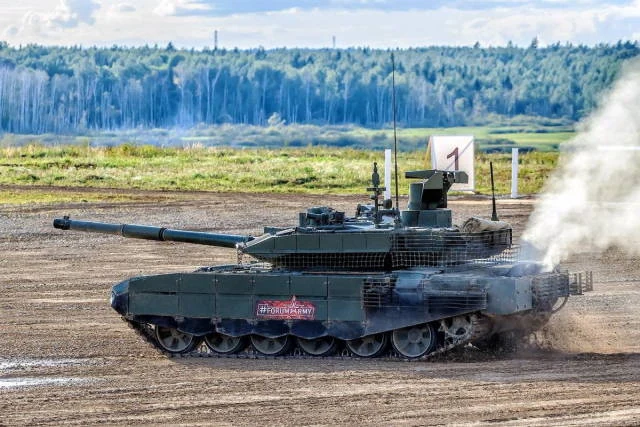
The T-90M Proryv represents Russia’s effort to improve its tank fleet, but its combat experience reveals an important reality: advanced equipment cannot eliminate the risks of modern warfare.
What Has the Ukraine War Revealed About the T-90?
Russian forces have deployed several T-90 variants in Ukraine, including the T-90A and the more modern T-90M. Their performance has varied with battlefield conditions, tactical employment, and the support available to their crews.
The T-90M features upgraded sights, improved fire-control equipment, and enhanced armor protection compared with earlier models. These improvements can help crews detect threats, engage targets, and survive certain attacks.
However, the war has exposed vulnerabilities affecting armored vehicles across both sides of the conflict. Anti-tank guided missiles can exploit weaknesses in armor, while mines and artillery can damage or immobilize tanks before they reach their objectives.
Small drones have added another complication. They can locate vehicles, monitor their movements, and help direct attacks. Some drones also carry explosive payloads capable of damaging vulnerable areas.

Why Can Modern Tanks Still Suffer Heavy Losses?
Consider a tank advancing through an exposed field. Its frontal armor might withstand certain incoming projectiles, but the vehicle could still encounter mines, artillery fire, or attacks from above.
The problem isn’t necessarily that the tank’s armor is useless. Rather, modern battlefield threats can approach from multiple directions, making comprehensive protection extremely difficult.
The T-90’s ammunition arrangement also presents a survivability concern. If penetrating damage ignites stored ammunition, the resulting fire or explosion can destroy the vehicle and endanger its crew.
What Do Documented Losses Tell Us?
Independent visual-loss databases, including Oryx, have documented Russian armored vehicle losses using photographic and video evidence. These records can help establish a minimum number of confirmed losses, but they do not capture every destroyed or damaged vehicle.
It’s important to distinguish between destroyed, damaged, abandoned, and captured tanks. Each category describes a different outcome, and counting them together without explanation can distort comparisons.
Likewise, a tank loss alone doesn’t establish whether its design failed. Crew decisions, tactical support, maintenance, and enemy capabilities all influence the outcome.
Is the T-90M Still Effective?
Yes, it remains a capable main battle tank with substantial firepower and improved protection. However, its performance depends on how effectively its crew and supporting units operate together.
The war in Ukraine demonstrates that tank survivability increasingly depends on reconnaissance, infantry cooperation, air-defense support, electronic warfare, and protection against drones.
The T-90M’s upgrades matter, but they cannot guarantee survival. Modern armored warfare rewards coordination and adaptability just as much as armor thickness or gun caliber.
