

Imagine Marines approaching a hostile shoreline, stepping off amphibious ships, and immediately facing fortified positions or lightly armored vehicles. Transport alone won’t solve that problem. They need firepower that can move with them.
That’s where the ACV-30 USMC enters the picture.
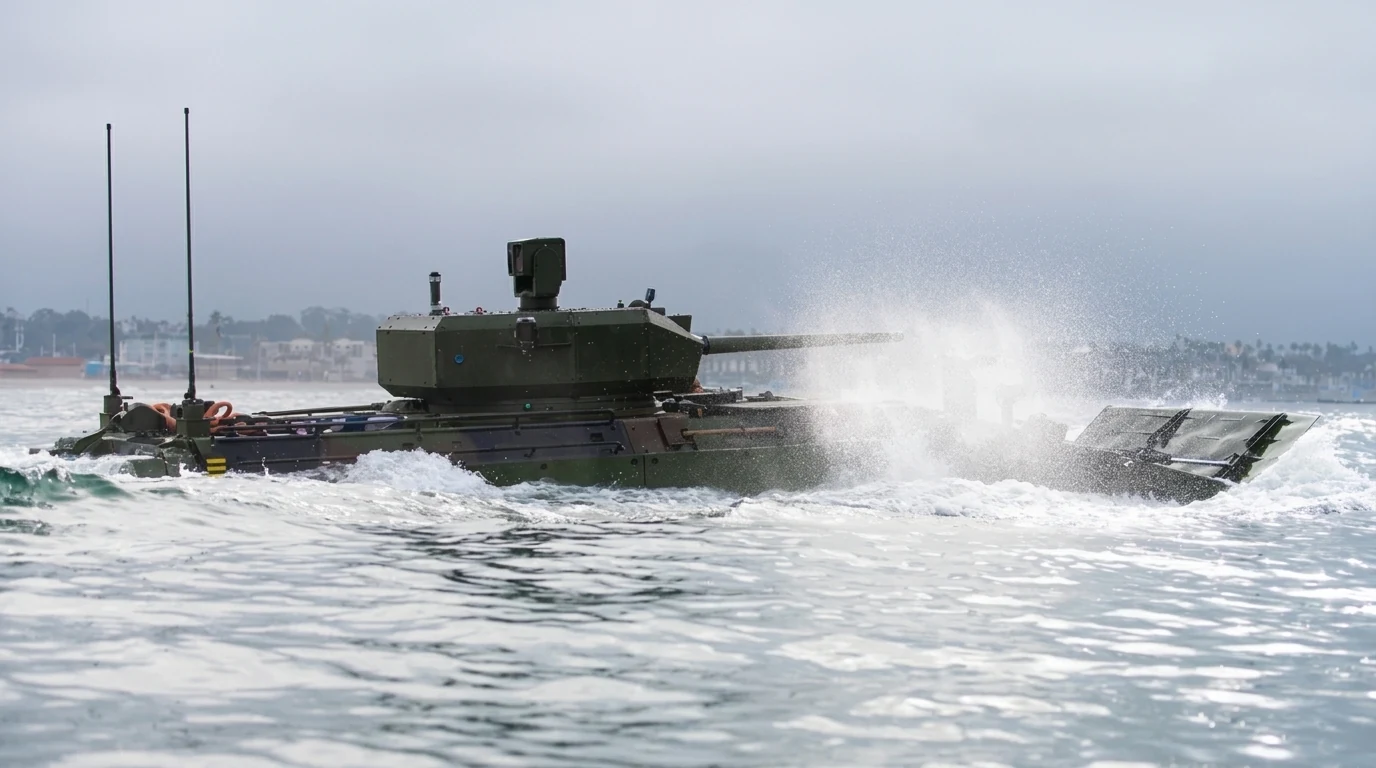
The Amphibious Combat Vehicle-30 is a new fire-support variant developed for the United States Marine Corps. It combines an eight-wheeled amphibious platform with a remotely operated 30mm cannon. Its mission goes beyond carrying Marines from ship to shore. It is designed to provide direct fire support as infantry units advance across difficult terrain.
The vehicle belongs to the Marine Corps’ wider Amphibious Combat Vehicle programme, which is replacing the ageing Assault Amphibious Vehicle fleet. But the ACV-30 USMC brings something distinctive to this modernization effort: a medium-caliber weapon system integrated into an amphibious combat vehicle.
Think of it as a mobile support platform accompanying infantry rather than simply delivering them to the beach. Its cannon can engage selected ground targets, while its protected hull provides mobility for the crew and embarked Marines.
That combination reflects an important shift in Marine Corps planning. Modern amphibious operations increasingly demand forces that can move between ships, coastlines, and inland positions without losing their ability to provide supporting fire.
The ACV-30 USMC is intended to help meet that requirement. Its design also raises interesting questions about weapon performance, armor protection, amphibious mobility, and battlefield integration.
How powerful is its 30mm cannon? How many Marines can it carry? And what makes this vehicle different from the earlier amphibious platforms?
To understand its importance, we need to look beyond the turret. The real story is how the ACV-30 connects mobility, protection, and fire support in one vehicle.
What Is the ACV-30 USMC and Why Is the USMC Developing It?
The ACV-30 USMC is a fire-support variant of the Marine Corps’ Amphibious Combat Vehicle family. Developed by BAE Systems, it combines an eight-wheeled amphibious chassis with a remotely operated 30mm cannon. Its primary purpose is to provide mobile fire support for Marine infantry during amphibious and ground operations.
But why does the Marine Corps need another amphibious vehicle?
The answer lies in its changing operational requirements. For decades, the Assault Amphibious Vehicle (AAV) transported Marines from amphibious ships to shore. However, the Marine Corps has been transitioning toward a newer platform with improved mobility, protection, and adaptability.
Read also: AAV7 Amphibious Assault Vehicle: Specs and Capabilities
The Amphibious Combat Vehicle programme addresses that requirement. Rather than relying on one configuration for every mission, the programme uses several specialized variants.
These include:
- ACV-P (Personnel): Transports Marines from ship to shore and across land.
- ACV-C (Command and Control): Provides command facilities and communications capabilities.
- ACV-R (Recovery): Supports vehicle recovery and maintenance operations.
- ACV-30 (30mm Gun): Adds medium-caliber firepower for direct support of infantry units.
The distinction is important. The ACV-30 USMC is not primarily designed to carry a full infantry squad. Its turret and weapons configuration give it a different role within an amphibious formation.
The vehicle also reflects a wider shift in Marine Corps planning. Modern littoral operations require forces that can move between ships, beaches, and inland positions while maintaining protection and supporting firepower.
Consider an amphibious assault involving several ACV-P vehicles carrying infantry. The ACV-30 USMC can accompany those formations, providing additional fire against selected ground targets as Marines advance.
This arrangement allows different vehicle variants to perform complementary tasks. Personnel carriers transport troops, command vehicles coordinate operations, and the ACV-30 USMC contributes direct fire support.
In other words, the Marine Corps is building a family of vehicles rather than expecting one platform to do everything.
ACV-30 USMC Technical Specifications and Vehicle Design
The ACV-30 USMC combines an amphibious armored chassis with a remotely operated medium-caliber turret. Its design prioritizes three requirements: mobility, crew protection, and supporting firepower.
Rather than developing an entirely separate vehicle, the Marine Corps uses the existing ACV platform as its foundation. The ACV-30 USMC shares major components with the personnel variant, including its powertrain, drivetrain, water propulsion system, navigation, and communications equipment.
The main difference sits above the hull.
Kongsberg supplies the MCT-30 remote turret, which houses the 30mm automatic cannon. Its remotely operated configuration allows the crew to control the weapon from inside the protected vehicle compartment.
Here are the publicly documented specifications:
| Specification | ACV-30 |
| Vehicle configuration | Eight-wheeled amphibious vehicle |
| Manufacturer | BAE Systems |
| Turret | Kongsberg MCT-30 |
| Main armament | 30mm MK44S automatic cannon |
| Secondary armament | Coaxial M240 machine gun |
| Vehicle crew | 3 personnel |
| Embarked Marines | Up to 8 |
| Cannon ammunition | Up to 300 rounds |
| Machine-gun ammunition | Up to 800 rounds |
| Weapon configuration | Stabilized, dual-feed system |
| Sighting systems | Independent thermal and visible-light sights |
Eight-Wheel Chassis and Internal Configuration
The eight-wheel arrangement gives the ACV-30 USMC the mobility needed for amphibious operations and movement across varied terrain. Its shared mechanical architecture also simplifies commonality with other ACV variants.
Inside, the vehicle accommodates three crew members: the driver, gunner, and vehicle commander. It can also carry up to eight embarked Marines.
That is a meaningful design compromise. The ACV-30 USMC sacrifices some troop capacity compared with the ACV-P, which accommodates up to 13 embarked Marines. In return, it gains a larger weapon system and ammunition storage.
Remote Turret and Crew Protection
The MCT-30 separates the weapon system from the crew’s physical position. Gunner and commander have independent thermal and visible-light sighting systems, allowing them to observe and engage targets from inside the vehicle.

This arrangement reduces the need for exposed crew positions during weapon operation. It also gives the ACV-30 USMC a different internal layout from conventional vehicles with crewed turrets.
The result is a specialized amphibious platform designed to carry Marines while delivering supporting fire.
How Powerful Is the ACV-30’s 30mm Cannon?
The biggest difference between the ACV-30 and other amphibious combat vehicles is its main weapon. Instead of relying primarily on a heavy machine gun, the ACV-30 USMC carries a 30mm MK44S automatic cannon mounted inside a remotely operated turret.
That changes its battlefield role considerably.
A 30mm cannon delivers substantially more destructive effect than conventional infantry machine guns. It gives Marine units an additional option against lightly armored vehicles, fortified positions, and exposed battlefield equipment.
The weapon is designed for direct fire support. It is not intended to replace a main battle tank or engage heavily armored vehicles as its primary mission.

MK44S 30mm Automatic Cannon
The MK44S belongs to the Bushmaster family of automatic cannons developed by Northrop Grumman. It uses 30×173mm ammunition and supports different ammunition types for different engagement requirements.
One important feature is its dual-feed ammunition system. This allows the gunner to select between two ammunition types without manually reconfiguring the weapon during an engagement.
Why does that matter?
Imagine Marines advancing through an area containing both lightly armored vehicles and infantry positions. The gunner can select an appropriate ammunition type for the target rather than relying on one ammunition configuration throughout the mission. The ACV-30’s cannon can accommodate up to 300 rounds, according to published programme specifications.
Stabilized Turret and Secondary Armament
The cannon is integrated into Kongsberg’s MCT-30 remotely operated turret. Its stabilization system helps maintain weapon alignment while the vehicle moves across uneven terrain.
This is particularly relevant during amphibious operations, where vehicles may transition from beaches to rough inland routes.
The ACV-30 USMC also carries a coaxial M240 machine gun. This provides a secondary weapon for situations where a 30mm cannon would be unnecessary.
Together, the two weapons offer different levels of firepower. The cannon provides medium-caliber support, while the machine gun handles lighter engagements.
The real advantage is flexibility. Marine infantry can receive supporting fire from a protected vehicle that moves alongside their formation, rather than depending entirely on separate supporting platforms.
How Does the ACV-30 USMC Protect Its Crew and Marines?
Amphibious operations expose vehicles to threats from several directions. A vehicle approaching a shoreline may encounter mines, improvised explosive devices, small-arms fire, artillery fragments, and anti-armor weapons.
The ACV-30 USMC therefore needs more than a powerful cannon. It also needs a protected environment for its crew and embarked Marines.
The vehicle uses an armored hull designed to improve protection against battlefield threats. Its protection architecture builds on the wider ACV family, which was developed with survivability requirements in mind.
However, the exact classified protection levels of the ACV-30 USMC are not publicly established. It would be misleading to assign specific resistance ratings against particular anti-tank weapons without reliable documentation.
Armored Hull and Crew Survivability
One important feature is the separation between the crew and the remotely operated turret. The gunner and commander operate the weapon using internal controls and sighting systems rather than occupying an exposed turret position.
This arrangement reduces their exposure during normal weapon operation. It also allows the vehicle to maintain an armored enclosure around its primary crew positions.
The vehicle accommodates three crew members and up to eight embarked Marines. Its internal layout must balance seating, ammunition storage, equipment, and protected space.
That is a difficult engineering exercise. Every additional component competes for room and contributes to the vehicle’s overall weight.

Balancing Armor, Mobility, and Amphibious Performance
Protection cannot be considered separately from mobility. The ACV-30 USMC must carry its armor and weapon system while retaining the ability to operate in water.
Additional weight can affect vehicle handling, fuel consumption, and amphibious performance. Designers therefore have to balance survivability requirements against the physical limitations of an amphibious platform.
There is also a broader operational lesson. Armor reduces certain risks, but it does not make a vehicle invulnerable. Modern anti-armor missiles, precision-guided weapons, and loitering munitions can threaten even heavily protected platforms.
For Marine commanders, the ACV-30 USMC’s protection is one layer within a wider force-protection approach. Reconnaissance, tactical positioning, infantry coordination, and supporting units remain essential.
Ultimately, its value comes from combining protected mobility with supporting firepower, not from assuming armor can solve every battlefield threat.

What Role Will the ACV-30 USMC Play in Marine Corps Operations?
The ACV-30 USMC is designed to solve a specific problem in amphibious warfare: how can Marines maintain supporting firepower while moving away from the shoreline?
Traditional amphibious vehicles primarily focus on transporting personnel. The ACV-30 USMC adds another capability. Its 30mm cannon allows it to support infantry formations during operations ashore, particularly when they encounter lightly armored vehicles, defensive positions, or exposed battlefield equipment.
This makes the vehicle an important component of the Marine Corps’ broader amphibious combat vehicle family.
Direct Fire Support for Marine Infantry
Consider a hypothetical landing operation involving several ACV-P personnel carriers. These vehicles transport Marines from an amphibious ship toward a designated landing area.
Once ashore, the infantry may need to move through difficult terrain or establish positions further inland. The ACV-30 USMC can accompany these formations, providing additional direct fire support when required.
Its 30mm cannon gives commanders an option between infantry weapons and heavier supporting systems. Meanwhile, its coaxial machine gun provides another weapon for engagements requiring less firepower.
The important point is coordination. The ACV-30 USMC is intended to support infantry operations, not operate independently as a replacement for tanks or dedicated artillery units.
Integration With Other ACV Variants
The Marine Corps plans to organize different ACV variants into complementary formations. Each vehicle performs a specialized function.
- ACV-P: Transports infantry and their equipment.
- ACV-30: Provides mobile 30mm direct fire support.
- ACV-C: Supports command, control, and communications.
- ACV-R: Provides recovery and maintenance support.
According to programme planning, an ACV-equipped company is expected to include six ACV-30 USMC vehicles. This gives commanders dedicated medium-caliber fire-support assets within the formation.
Relevance to Littoral Operations
The ACV-30 USMC also fits the Marine Corps’ growing emphasis on littoral operations and Expeditionary Advanced Base Operations (EABO).
These concepts involve operating across coastal regions, islands, and strategically important maritime areas. Amphibious vehicles can help move forces between dispersed positions while maintaining ground mobility.
The ACV-30 USMC’s contribution is straightforward: it brings protected mobility and direct firepower into the same formation.
ACV-30 Production, Testing, and the Future of the USMC Amphibious Fleet
Developing an advanced amphibious vehicle is one challenge. Delivering enough vehicles, training crews, and integrating them into operational formations is another. The ACV-30 USMC programme has now moved beyond its initial development phase, with production and fleet integration becoming increasingly important.
BAE Systems is the primary vehicle manufacturer, working with Kongsberg on the remotely operated MCT-30 turret. Their partnership combines the amphibious vehicle platform with a specialized medium-caliber weapon system.

Testing and Production Milestones
The ACV-30 USMC underwent extensive development and evaluation before entering full-rate production. Testing focused on vehicle performance, weapon integration, operational suitability, and the reliability of its systems.
In April 2025, the US Marine Corps awarded BAE Systems a full-rate production contract covering 30 ACV-30 vehicles, valued at approximately $188.5 million.
Another production contract worth approximately $195 million followed in February 2026. These agreements demonstrate the programme’s progression toward larger-scale manufacturing.
The Marine Corps also reached an important delivery milestone in 2026, receiving its first production ACV-30 USMC. This marked a transition from development and testing toward the introduction of production vehicles into the service’s amphibious fleet.
How Many ACV-30 Vehicles Will the Marines Acquire?
The programme’s planned procurement target is another important indicator of its intended role. According to the October 2026 Congressional Research Service report, the Marine Corps plans to acquire 152 ACV-30 vehicles.
That number reflects the requirement for dedicated fire-support vehicles across ACV-equipped formations. However, planned procurement should not be confused with vehicles already delivered or operationally deployed. Those milestones follow different schedules.
The Next Challenge: Operational Integration
Production is only part of the equation. The Marine Corps must also train crews, establish maintenance procedures, manage ammunition supplies, and integrate the ACV-30 USMC into amphibious exercises.
The vehicle’s long-term value will depend on these practical considerations. A sophisticated turret means little if units cannot maintain it or coordinate its use effectively.
For the Marine Corps, the ACV-30 USMC represents an important addition to its amphibious fleet. Its real contribution will become clearer as more vehicles enter service and demonstrate their capabilities during operational training.
