

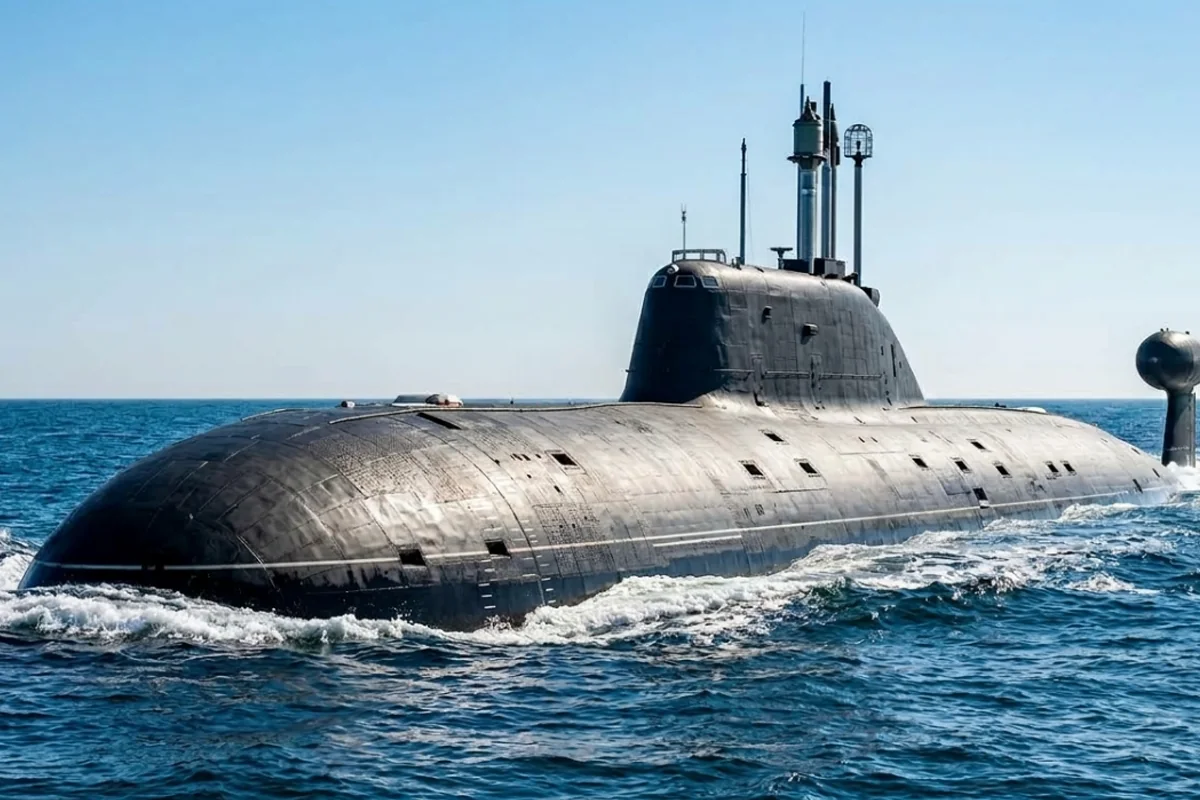
A submarine doesn’t need to be the fastest thing beneath the ocean to be dangerous. Sometimes, the real advantage is simply making sure nobody knows where you are.
That idea sits at the heart of the Akula-Class Submarine, one of the most important attack-submarine designs produced by the Soviet Union during the Cold War.
When the first Project 971 boats entered service in the 1980s, they represented a major leap in Soviet efforts to reduce the noise that had long made its submarines easier for Western navies to track.
The Akula-Class Submarine wasn’t just another nuclear submarine. It was part of Moscow’s attempt to make the underwater battlefield far harder to read.
What Is the Akula-Class Submarine?
The Akula-Class Submarine is the NATO reporting name for the Soviet Project 971 Shchuka-B family of nuclear-powered attack submarines.
In Russian service, these boats were developed as SSNs, meaning their primary role was hunting other submarines and surface vessels rather than carrying strategic ballistic missiles. The first boat, K-284, entered service in 1984.
Think of the Akula-Class Submarine as an underwater hunter with an unusually long hunting season. Nuclear propulsion gives it the ability to remain submerged for extended periods without needing to surface for air or conventional fuel.
Public references commonly put its submerged speed at around 33 knots, while endurance can reach roughly 100 days, depending on how the figure is defined and the specific variant.
Its missions can include anti-submarine warfare, anti-surface warfare, reconnaissance and long-range patrols. That makes the Akula-Class Submarine less about launching one spectacular attack and more about creating uncertainty. An opponent has to assume that a capable nuclear attack submarine could be somewhere in the operating area, listening.
And that brings us to the feature that made the Akula-Class Submarine especially interesting: quieting. Soviet designers understood that underwater warfare is a strange game where the first side to hear the other often has the advantage. The Akula-Class Submarine was built to make that first detection much harder.
Read also: Top 5 Biggest Submarines in the World Ever Built
Why Did Russia Build the Akula-Class Submarine?
The Soviet Union had a problem beneath the waves: its submarines were powerful, but being powerful wasn’t enough if an American submarine could hear them first.
During the Cold War, the U.S. Navy steadily improved its ability to detect and track Soviet submarines. American attack submarines, especially the Los Angeles class, were becoming quieter and more capable, putting pressure on Soviet designers to close the acoustic gap.
The answer was not simply to build a bigger submarine or add more torpedoes. Moscow needed a boat that could survive the underwater game of hide-and-seek.
That requirement shaped the Akula-Class Submarine from the keel up. Project 971 was developed as a new generation of Soviet nuclear-powered attack submarine, with particular attention given to reducing machinery noise, vibration and other sounds that could betray its position.
This was a significant shift in priorities. Underwater, a submarine’s reactor, pumps, gears and propulsion system can become an acoustic fingerprint. Imagine trying to sneak through a dark room while carrying a running washing machine. Speed doesn’t help much if everyone can hear you coming.
The Akula-Class Submarine was designed to make that fingerprint much harder to detect. U.S. assessments of the submarine were notable because its acoustic performance was reportedly better than many Western analysts had expected from Soviet designs at the time. That mattered strategically, even before an Akula fired a weapon.
Read also: Typhoon-Class Submarine: Inside the World’s Largest Nuclear Sub
And there was another reason for the design’s importance. A nuclear attack submarine doesn’t need to remain close to friendly territory. It can travel deep into an operating area, remain submerged for long periods and search for enemy submarines or surface vessels.
So the Akula-Class Submarine wasn’t built around one dramatic capability. It was built to change the odds of being detected first. That sounds subtle, but in submarine warfare, subtle can be deadly.
What Are the Akula-Class Submarine Specifications?
The Akula-Class Submarine is a large nuclear-powered attack submarine, built for a job where size, speed and endurance all matter, but not necessarily in the way you might expect. Its dimensions give it room for powerful sensors, weapons and machinery, while nuclear propulsion allows it to remain underwater for extended periods.
The exact numbers vary somewhat between Akula-Class Submarine variants, so public sources don’t always agree. That matters because the class evolved through several versions, with later boats receiving changes to their hulls, equipment and acoustic systems.
| Specification | Akula-Class Submarine |
| Russian designation | Project 971 Shchuka-B |
| NATO name | Akula |
| Type | Nuclear-powered attack submarine (SSN) |
| Length | Approximately 110–113 m |
| Submerged displacement | Approximately 12,000–13,000 tons |
| Submerged speed | Approximately 33 knots |
| Maximum reported depth | Around 600 m |
| Endurance | Up to about 100 days |
| Crew | Roughly 60–70 personnel |
| Propulsion | Nuclear reactor |
| Hull design | Double hull |
Public references commonly place the submarine at around 110–113 meters long, with submerged displacement in the 12,000–13,000-ton range. Its reported submerged speed of approximately 33 knots is particularly impressive for a vessel of this size.
Depth is another important part of the Akula-Class Submarine’s design. Open sources commonly cite a maximum depth of roughly 600 meters, although exact operational and test-depth figures are not consistently disclosed. At those depths, water pressure becomes a serious engineering problem, making the submarine’s pressure hull a critical part of its survivability.

Then there’s endurance. An Akula-Class Submarine can remain at sea for around 100 days, depending on the specific boat, mission and logistical conditions. Nuclear propulsion removes the need for frequent fuel-related interruptions, although food, maintenance and crew endurance still impose practical limits.
Read also: Russian Kilo-Class Submarine: What Makes It So Deadly
The numbers tell only half the story. Put together, deep-diving capability, high submerged speed and long endurance give the Akula-Class Submarine the ability to travel far from its home waters and remain there for extended patrols. That’s what turns these specifications from impressive statistics into an actual tactical advantage.
How Does the Akula-Class Submarine Stay So Quiet?
For a submarine, silence isn’t a luxury. It’s survival.
Above the water, a warship can rely on radar, visual sensors and aircraft to build a picture of its surroundings. Deep underwater, the situation is different. Sound travels far better than light, so submarines spend much of their time listening. The first boat to detect the other can gain a major tactical advantage, sometimes without ever being seen.
That is why the Akula-Class Submarine was such an important development for Soviet naval technology. Project 971 placed unusual emphasis on reducing the sounds produced by the submarine itself.
Pumps, turbines, gears, cooling systems and other machinery can all create vibrations that travel through the hull and into the surrounding water. Even the propulsion system can leave an acoustic signature.

Soviet designers responded with improved machinery isolation and vibration-control measures, along with changes to propulsion and the submarine’s overall construction.
The exact acoustic performance of individual Akula-Class Submarine variants remains classified, and public claims about precise noise levels should therefore be treated carefully. What is clear is that later Akula boats were substantially quieter than many earlier Soviet designs.
The difference became especially important because the Akula entered service during an era when American attack submarines were already exceptionally capable. Western naval analysts had expected Soviet submarines to improve, but the acoustic performance of the Akula reportedly generated considerable attention.
There is an interesting irony here. The Akula-Class Submarine’s enormous size isn’t what made it difficult to find. In some ways, its real trick was making that huge machine behave acoustically like something much smaller.
That is the heart of submarine stealth: not disappearing from the ocean, but becoming difficult to distinguish from it.
What Weapons and Sensors Does the Akula-Class Submarine Carry?
A nuclear attack submarine is only as useful as its ability to find something worth attacking and then threaten it. That makes the Akula-Class Submarine’s weapons and sensors two sides of the same equation.
The Akula-Class Submarine is equipped with multiple torpedo tubes, including 533 mm and 650 mm tubes. These give the submarine the ability to employ heavyweight torpedoes and other underwater weapons, while also providing options for mine warfare.
The larger 650 mm tubes are particularly notable because they can accommodate larger weapons than the standard 533 mm format used by many submarines.
Later modernization programs have expanded the potential strike role of some Project 971 boats.

Upgraded Akula-Class Submarines have been associated with Kalibr cruise missiles, giving selected vessels a way to attack targets beyond the traditional submarine-versus-submarine mission. That represents an important change: an older Cold War hunter can be given a much broader strike role through modernization rather than being replaced outright.
But weapons are only half the story.
The submarine’s sonar suite is what allows it to hunt in the first place. Akula-Class Submarine boats are associated with the MGK-540 sonar family, including hull-mounted and towed-array systems designed to detect and track contacts at significant distances. Passive sonar is especially important because it allows the submarine to listen without actively broadcasting its own location.
This creates a fascinating balance. The Akula-Class Submarine isn’t trying to win by simply carrying the biggest arsenal. Its advantage comes from combining quiet movement, long-range listening and heavyweight weapons.
What Are the Different Akula-Class Submarine Variants?
Calling every Akula-Class Submarine simply an “Akula” can hide an important detail: the class went through several versions, and later boats were not identical to the submarines that first entered Soviet service.
The original Akula I formed the foundation of Project 971. These boats already represented a major improvement in Soviet attack-submarine design, particularly in acoustic performance. But submarine technology was moving quickly, and the Soviet Navy continued refining the design rather than treating the first version as the finished product.
The next major step was the Improved Akula I. As its name suggests, these boats incorporated refinements to equipment and quieting technology. Some also received changes to their external features, making individual submarines look slightly different despite belonging to the same broad family.

Then came the Akula II, which pushed the design further. The variant was larger and incorporated additional modifications intended to improve its capabilities, including acoustic characteristics. One well-known example, K-157 Vepr, illustrates how these later boats could differ significantly from the earliest Project 971 submarines.
The Akula III designation is generally associated with the final development of the family. Like other late variants, it reflected the Soviet effort to keep improving a platform whose basic concept had already proven successful.
There is a practical reason this matters when reading technical information online. One source may list an Akula at around 110 meters, while another gives a different figure, and both can appear credible. They may simply be describing different variants.
The evolution also explains the class’s longevity. Instead of designing a completely new submarine every time technology improved, Soviet and later Russian engineers could refine the Project 971 architecture.
That made the Akula-Class Submarine less like a single submarine design and more like a long-running engineering experiment beneath the waves, one generation quietly improving on the last.
What Weapons and Sensors Does the Akula-Class Submarine Carry?
An attack submarine can spend weeks hiding beneath the ocean, but stealth alone doesn’t make it a threat. It needs to find something, understand what it is, and have the weapons to act on that information. The Akula-Class Submarine was designed around that complete hunting chain.
Its main underwater weapons are carried through a combination of 533 mm and 650 mm torpedo tubes. The larger tubes gave the Akula-Class Submarine access to heavyweight weapons, while the 533 mm tubes could support standard torpedoes and other payloads.
The submarine could also employ mines, giving it another way to influence an area without remaining on the surface.
Some Akula-Class Submarine boats have also received modernization intended to extend their useful lives. Upgraded Project 971 submarines have been associated with Kalibr cruise missiles, potentially giving them a much broader strike role than the original Cold War design.
Instead of being limited to hunting ships and submarines, a modernized Akula can become a more flexible platform for long-range conventional strike missions.

But here’s the more interesting part: weapons are almost useless if the submarine can’t locate its opponent.
The Akula-Class Submarine family is associated with the MGK-540 sonar system, supported by hull-mounted sensors and towed-array equipment.
Passive sonar is particularly valuable because the submarine can listen for machinery, propellers and other underwater sounds without actively announcing its own position. Active sonar, meanwhile, can provide another method of detecting and classifying contacts when circumstances allow.
This creates the classic submarine advantage: hear first, decide second, attack last.
The Akula-Class Submarine’s weapons and sensors therefore shouldn’t be viewed as separate specifications. They form one system. Its quieting technology helps it remain difficult to detect, its sonar helps build an underwater picture, and its torpedoes or cruise missiles provide the means to act on that information.
That’s what turns a large nuclear-powered vessel into a genuine underwater hunter.
Where Has the Akula-Class Submarine Operated and Is It Still Relevant?
The Akula-Class Submarine was built for a Cold War that ended decades ago, but its career didn’t end with it. Several Project 971 boats continued serving with the Russian Navy, particularly with the Northern and Pacific Fleets, giving Russia a relatively mature nuclear attack-submarine platform that could still perform long-range patrol and undersea warfare missions.
The class also developed an unusual international connection through India. Russia leased K-152 Nerpa, an Akula-class submarine, to the Indian Navy, where it became INS Chakra.
The boat entered Indian service in 2012 and gave India experience operating a nuclear-powered attack submarine. That experience was especially significant because India was simultaneously developing its own nuclear submarine capability.

For Russia, however, the bigger question has been what to do with an aging but still capable design. Building an entirely new nuclear submarine is enormously expensive and time-consuming. Modernizing an existing hull can offer another path.
That is where weapons upgrades become important. Some Project 971 submarines have been associated with modernization programs intended to extend their service lives, including the integration of Kalibr cruise missiles. Such upgrades can give an older submarine a significantly different mission profile from the one it had when first commissioned.
Still, the Akula-Class Submarine isn’t the cutting edge of Russian submarine design anymore. Newer Yasen-class attack submarines incorporate more modern sensors, weapons and other technologies.
The Akula’s advantage today is therefore less about being the newest boat and more about combining nuclear endurance, underwater speed, large weapons capacity and decades of accumulated operational experience.
That’s a useful lesson in naval engineering: a submarine doesn’t suddenly become irrelevant because its design is old. If the hull remains viable and the Navy can keep upgrading the systems inside it, an aging underwater hunter can continue to be a difficult problem for an opponent, just not the same problem it was in 1985.
