

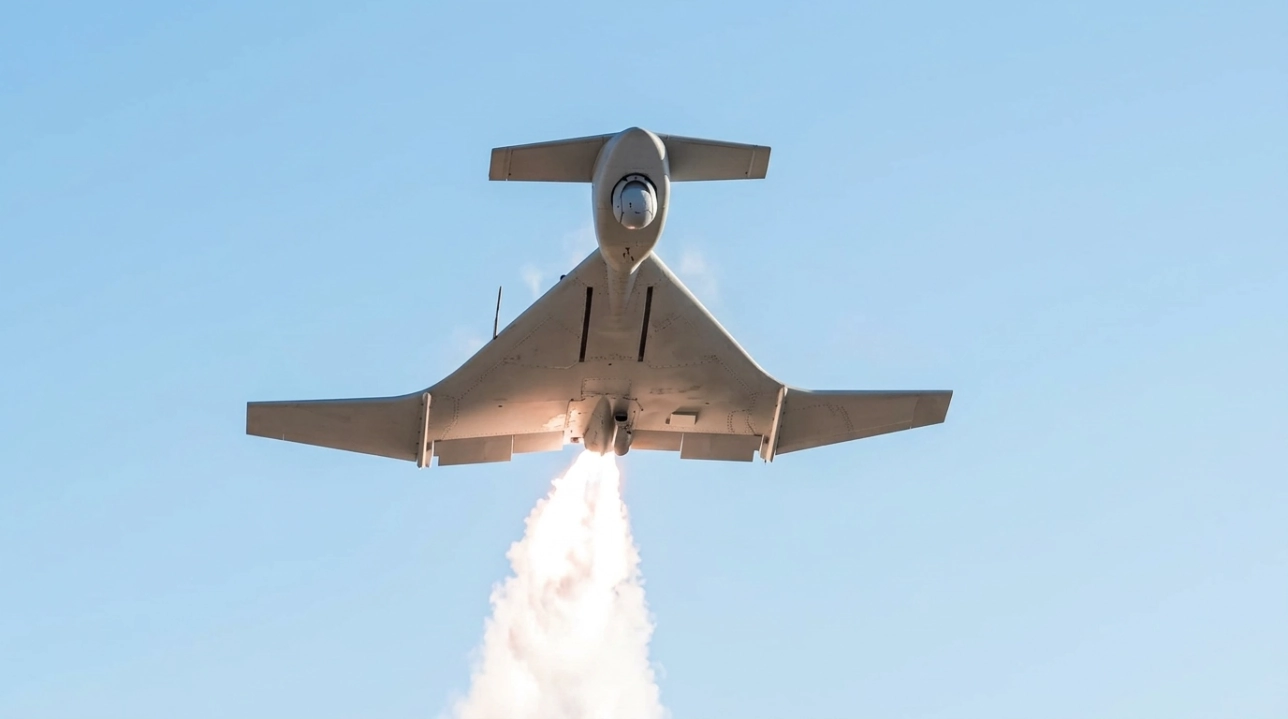
A missile usually needs a target before it leaves the launcher. The IAI Harop Drone turns that sequence on its head: it can fly into an area, search for a target, and remain there until an operator decides that the moment is right.
That makes IAI Harop Drone something of an oddball in modern warfare. It looks like an unmanned aircraft, behaves partly like a surveillance drone, and ultimately performs the job of a precision weapon.
Israel Aerospace Industries (IAI) describes it as a long-range loitering munition designed to locate and engage targets while keeping a human operator involved in the final decision.
The concept is simple enough to picture. Launch the IAI Harop Drone from its canister, send it toward a designated operating area, then let its sensors search for potential targets. Its electro-optical payload provides imagery that allows the operator to assess what is happening rather than relying entirely on coordinates prepared before launch.
That distinction matters when the battlefield refuses to stay still.
A mobile air-defense system might switch positions. A command vehicle could appear unexpectedly. A high-value target may only become vulnerable for a few minutes. Instead of firing first and hoping the intelligence remains accurate, Harop gives the operator time to observe and decide.
IAI publicly lists Harop with up to nine hours of endurance, a remarkable figure for a weapon designed to end its mission by striking a target.
So, don’t think of the IAI Harop drone as simply a larger kamikaze UAV. Its more interesting role is somewhere between a scout and a missile: a weapon that carries its own eyes, waits for an opportunity, and keeps a human decision in the loop until the attack is authorized.
How Did the IAI Harop Drone Evolve From the IAI Harpy?
The IAI Harop Drone didn’t appear out of nowhere. Its roots reach back to another Israeli weapon, the IAI Harpy, which helped establish the idea that an unmanned aircraft could spend time searching for a target before destroying it.
Harpy was designed primarily as an anti-radiation weapon, giving it a specialized job: hunt radar emitters. That made sense in an era when suppressing enemy air defenses often meant finding and attacking the radar itself. But modern battlefields created a problem. What happens when the target switches off its radar, moves position, or simply isn’t an emitter?
Read also: 5 Best Kamikaze Drones and What Makes Them Effective
IAI Harop Drone took the concept in a broader direction.
Instead of depending on a radar signal alone, the Harop loitering munition uses an electro-optical/infrared sensor to search and identify targets. More importantly, it introduced a human operator into the engagement process, allowing a person to observe the situation and make the final decision.
That changes the personality of the weapon.
Think of Harpy as a specialist waiting for a particular radio signal. IAI Harop Drone is more like a hunter with a camera; it can be sent toward a designated area, search for an appropriate target, and remain available until circumstances make an attack worthwhile.
This flexibility also explains why calling Harop simply a “suicide drone” misses the point. The aircraft is designed to loiter, observe, and give its operator time to assess what is happening before committing the weapon.
IAI’s current description places Harop in the space between unmanned aircraft and missile technology, emphasizing its combination of long endurance, electro-optical sensing and human-in-the-loop control.
The evolution from Harpy to Harop therefore wasn’t just an upgrade in hardware. It was a change in philosophy: from hunting a particular kind of signal to hunting opportunities on a battlefield.
What Are the IAI Harop Drone Specifications?
The IAI Harop Drone is much larger and more persistent than the small attack drones that have become common on modern battlefields. Its design reflects a different idea: keep a relatively substantial weapon airborne for hours, give it eyes, and let the operator decide when an opportunity is worth taking.
IAI’s current public material lists the Harop with up to nine hours of endurance, while its published specifications identify an electro-optical/infrared sensor and human-in-the-loop control. Public references also commonly associate the system with a 23 kg-class warhead.
| Specification | IAI Harop Drone |
| Manufacturer | Israel Aerospace Industries (IAI) |
| Type | Long-range loitering munition |
| Endurance | Up to 9 hours |
| Guidance | Electro-optical / infrared |
| Control | Human-in-the-loop |
| Launch | Canister |
| Warhead | Up to 23 kg in public references |
| Primary role | Persistent surveillance and precision strike |
The range figure deserves a little caution. Different public sources have published different numbers over the years, reflecting configurations, mission profiles and reporting differences.
Rather than treating one figure as universal, it is safer to emphasize the capability that makes IAI Harop Drone unusual: long-range deployment combined with prolonged loitering.
That distinction is important because range and endurance are not the same thing. A weapon might theoretically travel a great distance, but if it must spend most of its flight getting there, its useful time over the target area shrinks. IAI Harop Drone’s long endurance gives operators considerably more flexibility.

The aircraft is also launched from a sealed canister, allowing the munition to be stored and deployed as part of a dedicated ground-based system. Its lack of a conventional pilot cockpit leaves the available payload and internal volume focused on sensors, communications, propulsion and the warhead.
In practical terms, the IAI Harop drone is built around one valuable commodity: time. And on a battlefield where targets move, hide and suddenly appear, time can be more useful than another few miles per hour.
How Does the Harop Drone Find and Select Its Targets?
A missile usually has one major limitation: the target generally needs to be identified before the weapon is committed. The IAI Harop Drone takes a different approach. It can arrive in a designated area, remain there, search for potential targets and give an operator time to decide what happens next.
That capability comes from the IAI Harop drone’s electro-optical sensing system and its human-in-the-loop architecture. Rather than functioning as a completely autonomous weapon that independently decides which object to destroy, IAI Harop drone allows an operator to monitor the mission and select a target. The system can also abort an attack, giving the operator a final decision point before impact.
This distinction is important because battlefield identification is rarely as simple as finding something on a map. Vehicles move, radar systems switch positions, command posts relocate, and friendly forces can operate close to potential targets. A weapon that can continue observing the situation gives its operator more information than a conventional pre-planned strike.

IAI Harop drone’s sensor package also gives it a broader target set than the original IAI Harpy, which was primarily designed around anti-radiation missions.
IAI Harop drone can use electro-optical imagery to locate and identify targets rather than depending solely on an enemy radar emission. IAI describes the system as capable of engaging both static and mobile high-value targets, including air-defense systems, command posts, tanks and supply depots.
The result is a weapon sitting somewhere between a drone and a missile. It has the persistence and observation characteristics of an unmanned aircraft, but the mission-ending strike function of a precision weapon.
And that is where IAI Harop drone’s design becomes particularly interesting: the most important targeting decision can happen after launch, not before it.
Why Is Harop Drone’s Long Endurance Its Biggest Advantage?
Speed gets most of the attention when people compare weapons. For the IAI Harop, however, the more important number may be the clock.
IAI publicly lists Harop with up to nine hours of endurance. That gives the loitering munition something a conventional missile usually doesn’t have: the ability to remain available after reaching its operating area instead of immediately committing to an attack.
Picture a mobile air-defense vehicle moving between positions. If a missile is launched before the target is confirmed, the opportunity can disappear by the time the weapon arrives.
IAI Harop drone approaches the problem differently. It can spend time searching, observing and waiting while its electro-optical sensor feeds information back to its operator.
That is where IAI Harop drone becomes more than a flying warhead.
Its persistence creates a useful gap between reconnaissance and strike. A surveillance drone might find the target but cannot necessarily attack it. A conventional missile can deliver destructive force but generally depends on accurate targeting information before launch. Harop combines elements of both.

There’s another important detail: the operator remains involved in the engagement. The system is designed around human-in-the-loop control, meaning the person controlling the mission can assess the target and determine whether to proceed.
This matters particularly when the battlefield is messy, which, inconveniently, is most of the time.
Targets move. Civilians enter areas. Vehicles change direction. Intelligence becomes outdated. A weapon that can wait has more opportunities to adapt to those changes than one committed to a fixed target coordinate.
That doesn’t make IAI Harop drone invulnerable, nor does nine hours of endurance mean nine hours spent directly over a target. But it does explain the weapon’s appeal.
The real advantage of the IAI Harop drone isn’t simply how far it can fly. It is the ability to buy the operator time and in modern warfare, time can turn uncertain information into a usable targeting opportunity.
What Targets Can the Harop Drone Attack and Where Has It Seen Combat?
The IAI Harop drone was built for targets that are valuable enough to justify a long-range precision weapon, but mobile or unpredictable enough to make a pre-planned strike less attractive. That distinction is central to understanding why the system has attracted attention in several conflicts.
Israel Aerospace Industries identifies air-defense systems, command posts, tanks, supply depots and other high-value targets among Harop’s intended targets. The system’s electro-optical sensor gives operators the ability to observe potential targets before deciding whether to commit the munition.
Air-defense systems are particularly important. A radar or missile battery can move, shut down its emissions, or change position after detecting an attack. A weapon that can remain airborne and observe the area creates a different problem for the defender: simply moving may not be enough if the system can continue searching.

IAI Harop drone’s combat reputation grew significantly during the Nagorno-Karabakh conflicts, where Azerbaijan used Israeli-made loitering munitions as part of a broader unmanned warfare strategy.
The fighting helped demonstrate how these weapons could complement artillery, conventional aircraft and reconnaissance drones rather than operate as standalone systems.
The system has also been associated with Israeli strikes against Syrian air-defense targets, reinforcing its relevance to suppression and destruction of enemy air-defense missions.
More recently, Israeli-origin loitering munitions featured prominently in reporting surrounding the 2025 India–Pakistan conflict. Claims about specific weapons and individual strikes varied between sources and opposing sides, so those reports should be treated with care rather than presented as universally confirmed Harop engagements.
What stands out across these cases is the weapon’s flexibility. IAI Harop drone isn’t tied to one battlefield niche. Its value comes from giving commanders a persistent airborne option against targets that may move, hide or suddenly become important, which is exactly the sort of uncertainty that makes modern targeting so difficult.
Is the IAI Harop drone Still Relevant in Modern Drone Warfare?
The battlefield has become crowded with cheap FPV drones, autonomous systems and increasingly sophisticated air defenses. Against that backdrop, the IAI Harop drone can look almost old-fashioned: a relatively large loitering munition designed to spend hours airborne rather than a few minutes racing toward a target.
Yet that endurance is precisely why IAI Harop drone still has a place.
IAI continues to position the Harop as a long-range loitering system with up to nine hours of endurance, electro-optical sensing and human-in-the-loop control. That combination gives it a mission profile quite different from small frontline drones, which are generally optimized for short-range tactical attacks.
The biggest challenge is electronic warfare. GNSS jamming, communications disruption and increasingly capable counter-drone systems can make any unmanned aircraft vulnerable.

IAI Harop drone is designed with resistance to GNSS-jamming conditions in mind, but that should not be confused with being immune to electronic warfare. A sophisticated defender can attack the navigation, communications or sensing chain in several different ways.
That is where the future of IAI Harop drone gets interesting. The system is already being adapted beyond its traditional land-based role, including naval applications.
Meanwhile, the broader loitering-munition market is moving toward greater autonomy, improved sensors and more sophisticated methods of operating in contested electromagnetic environments.
IAI Harop drone therefore doesn’t need to compete with every cheap drone. It serves a different purpose.
A small FPV drone might be the battlefield equivalent of a pocket knife, cheap, numerous and expendable. IAI Harop drone is closer to a patient marksman who can stay in position for hours, watching for the right opportunity.
That distinction could keep the IAI Harop drone relevant even as drone warfare changes rapidly. Its future may depend less on making the airframe dramatically faster and more on improving the things that make persistence useful: sensing, communications, electronic-warfare resilience and increasingly intelligent target management.
Why the IAI Harop Drone Still Matters
The IAI Harop drone is not simply a larger version of the armed drones now filling modern battlefields. Its real significance comes from the way it combines persistence, sensing, precision and human decision-making in a single weapon system.
Instead of forcing an operator to know exactly where a target will be before launch, Harop can spend hours searching an assigned area and wait for the situation to develop.
That makes its up to nine-hour endurance more than an impressive specification. It changes how the weapon can be used.
A target can move, an air-defense system can activate, or a high-value opportunity can emerge after the mission has already started. The operator can then make the engagement decision rather than relying entirely on a pre-programmed strike sequence. IAI specifically describes Harop as a human-in-the-loop system with electro-optical sensing and the ability to abort an attack.

Of course, IAI Harop drone isn’t immune to the problems facing every modern unmanned system. Electronic warfare, counter-drone defenses, increasingly sophisticated sensors and the proliferation of cheaper loitering munitions are all changing the battlefield around it.
The challenge is no longer simply finding a target. It is surviving long enough to identify the right target and make the weapon useful in a contested environment.
That is why the Harop loitering munition remains an interesting benchmark. Its design anticipated a battlefield where information moves quickly, targets don’t stay still and commanders need more options between conventional missiles and expendable tactical drones.
In that sense, IAI Harop drone’s most important capability may not be its warhead or speed. It is the ability to wait. And in modern warfare, having the time to observe before committing a weapon can be just as valuable as having the weapon itself.
