

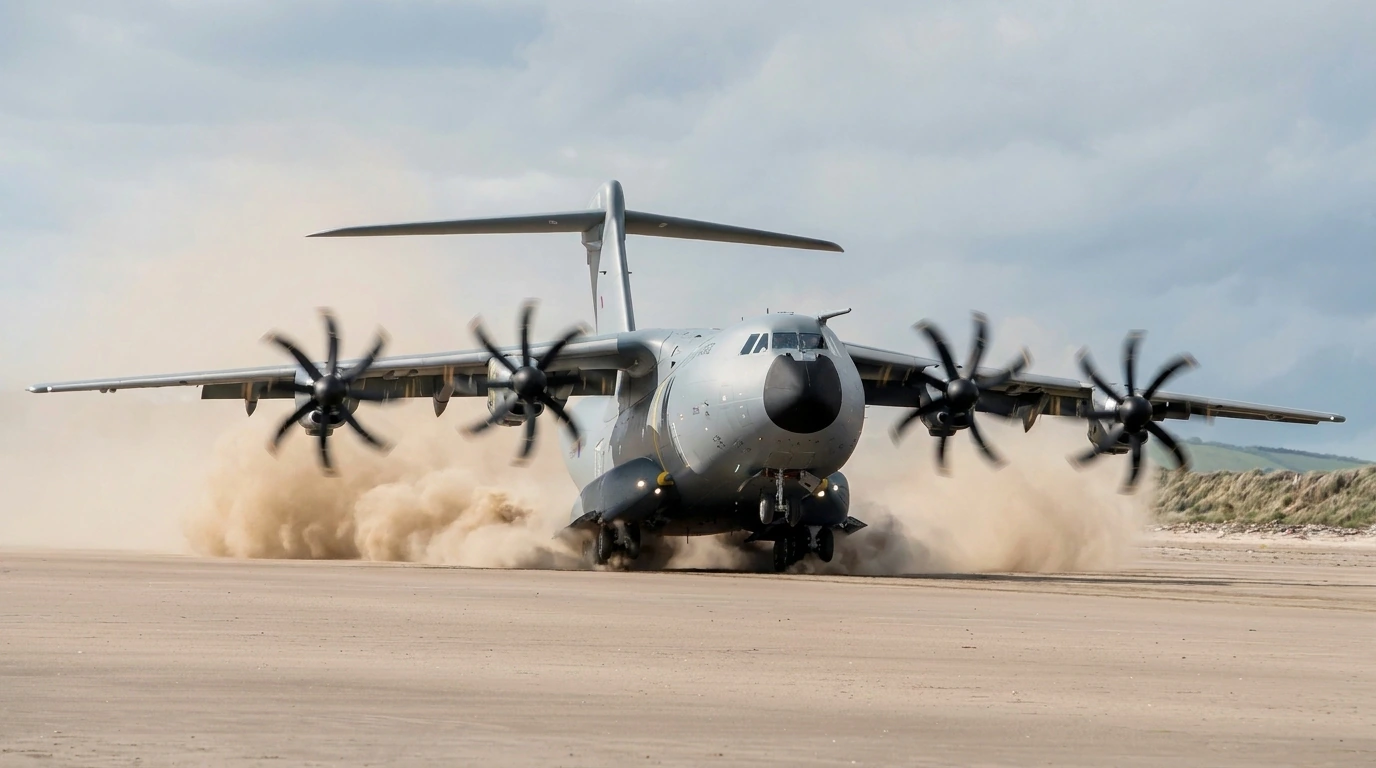
There’s something quietly fascinating about an aircraft that refuses to fit into a neat category, and the Airbus A400M Atlas is exactly that kind of machine. It’s not just a cargo plane. Not just a tactical workhorse. Not quite a strategic giant either. It lives somewhere in between, and that “in-between” space is where things get interesting.
Picture this: a single aircraft that can haul armored vehicles across continents, then descend onto a rough dirt strip barely worthy of being called a runway. Hours later, it might be refueling fighter jets mid-air or delivering emergency aid after a natural disaster. That’s not marketing fluff, it’s the real-world job description of the A400M Atlas.
Built by Airbus, this aircraft was designed to solve a very specific problem that militaries had been juggling for decades: choosing between range and ruggedness.
Older aircraft like the C-130 handled rough terrain well but lacked long-distance muscle. Larger jets could cross oceans, but needed pristine runways. The A400M? It tries to do both. And surprisingly, it works.
But here’s where it gets even more intriguing. The A400M isn’t just about specs or engineering, it represents a shift in how modern air forces think about mobility. Flexibility is no longer a bonus; it’s the whole point.
So if you’ve ever wondered what makes the A400M Atlas such a big deal, or why countries are investing heavily in it, you’re in the right place. Let’s unpack it piece by piece.
What is the Airbus A400M Atlas?
At its core, the A400M Atlas is a military transport aircraft, but calling it just that feels a bit like calling a smartphone “a device for making calls.” Technically true… but wildly incomplete.
Developed by Airbus Defence and Space, the A400M was built to bridge a long-standing gap in military aviation. On one end, you’ve got smaller tactical transports like the Lockheed C-130 Hercules, tough, reliable, but limited in payload.
On the other, giants like the Boeing C-17 Globemaster III, capable of hauling massive loads but needing proper runways to operate efficiently.

The A400M? It sits right in between, and that’s intentional.
It first took to the skies in 2009 and officially entered service around 2013. Since then, it’s been adopted by several countries looking for a single aircraft that can do multiple jobs without constant trade-offs. And that’s really the pitch here: one platform, many roles.
So what does that look like in practice?
- It can carry heavy military vehicles across continents
- Land on short, rough, or semi-prepared runways
- Deploy troops and cargo mid-air
- Even refuel other aircraft while flying
That mix of strategic range + tactical flexibility is what makes the A400M unusual. It’s not the best at any single thing, but it’s very good at many things. And in real-world operations, that versatility often matters more than specialization.
In simple terms, the A400M Atlas isn’t just a transport aircraft. It’s more like a multi-tool for modern air forces, designed for missions that don’t go according to plan… which, let’s be honest, is most of them.
Airbus A400M Atlas Specifications
Numbers don’t always tell the full story, but with the Airbus A400M Atlas, they get pretty close.
This aircraft was engineered with a very deliberate balance in mind: carry more than a tactical airlifter, go farther than expected, and still land where others hesitate.
Let’s start with the essentials.
Key Performance Data
| Specification | Value |
| Maximum Payload | ~37 tonnes |
| Range (20-ton load) | ~3,400 nautical miles |
| Cruise Speed | Mach 0.68–0.72 |
| Engines | 4 × Europrop TP400 turboprops |
| Wingspan | 42.4 meters |
| Cargo Hold Volume | ~340 m³ |
Now, on paper, those numbers place the A400M neatly between aircraft like the Lockheed C-130 Hercules and the Boeing C-17 Globemaster III. But here’s where things get a bit more nuanced.
The payload, around 37 tonnes, isn’t just about weight. It’s about shape.
The cargo hold is wide and tall enough to carry bulky military hardware that older aircraft simply can’t accommodate without disassembly. Think helicopters with minimal prep, or armored vehicles ready to roll the moment they touch ground.

And then there’s range. A400M can fly intercontinental missions without constant refueling stops, yet it doesn’t sacrifice its ability to drop into tight, rugged airstrips. That duality shows up clearly in real missions, long haul one day, short-field landing the next.
A small but telling detail: those four turboprop engines aren’t just about efficiency. They generate immense thrust at lower speeds, which is exactly what you need when landing on a dusty strip carved out of nowhere.
So yes, the specs matter. But what really matters is how those numbers work together, and that’s where the A400M Atlas quietly outperforms expectations.
Key Features and Capabilities
If the specs tell you what the Airbus A400M Atlas can do, its features reveal how it actually behaves in the real world, and that’s where things get a little impressive.
Tactical Muscle (Where It Gets Gritty)
The A400M isn’t afraid of rough conditions. In fact, it was built for them.
It can take off and land on short, uneven runways, gravel, dirt, even semi-prepared strips that look questionable at best. This is thanks to a mix of high-lift wing design, powerful turboprops, and landing gear that feels… overbuilt in the best way.

And then there’s low-level flight.
The aircraft can skim terrain at relatively low altitudes to avoid radar detection, something you won’t see from larger strategic jets like the Boeing C-17 Globemaster III on a routine basis.
Strategic Reach (The Long Game)
Flip the script, and the A400M becomes a long-distance hauler. It cruises at near-jet speeds for a turboprop, covering thousands of nautical miles without breaking a sweat. That means fewer stops, faster deployments, and less logistical juggling.
Multi-Role Flexibility (The Real Trick)
Here’s where it starts to feel like a Swiss Army knife:
- Air-to-air refueling (as tanker and receiver)
- Airdrops of troops and cargo
- Medical evacuation missions
- Rapid reconfiguration between roles
One aircraft, multiple missions, sometimes within the same week.
There’s a certain elegance to that flexibility. Instead of relying on a fleet of specialized aircraft, operators can lean on one platform that adapts quickly. And in unpredictable situations, humanitarian crises, conflict zones, that adaptability isn’t just useful. It’s everything.
Design and Technology of A400M Atlas
Climb inside the Airbus A400M Atlas, and you start to notice something: it doesn’t feel like a traditional cargo plane. It feels… engineered for the future, even if that sounds a bit cliché. But stay with me.
A Different Kind of Flight Deck
The cockpit is fully digital, a glass cockpit powered by advanced avionics and fly-by-wire controls. If you’ve seen modern commercial jets, the layout feels familiar, but with a military edge. Fewer manual inputs, more system-assisted flying.

Fly-by-wire, in particular, changes the game. Instead of direct mechanical linkages, pilot inputs are translated into electronic signals.
The result? Smoother handling, better stability, and built-in protections against pushing the aircraft beyond safe limits. It’s like having a quiet co-pilot constantly making micro-adjustments in the background.
Materials That Do More With Less
Roughly a third of the aircraft is made from composite materials, lighter than traditional metal, but incredibly strong. That weight saving doesn’t just improve fuel efficiency; it also extends range and payload flexibility. Subtle gains, but they add up over thousands of flight hours.
The Propeller Setup (Yes, It’s Unusual)
Now, here’s a detail aviation geeks love: the A400M’s counter-rotating propellers.
Each wing has two engines, and the propellers spin in opposite directions toward the fuselage. It looks odd at first glance, but there’s logic behind it:
- Improved airflow over the wings
- Better lift at low speeds
- More control during takeoff and landing
It’s one of those design choices that seems small, until you realize it directly supports the aircraft’s short-runway performance.

So, while the A400M Atlas might look rugged on the outside, underneath it’s packed with quiet innovations. Not flashy. Just… cleverly done.
Airbus A400M Atlas vs Other Aircraft
Comparisons are where the Airbus A400M Atlas really starts to make sense. On its own, it’s impressive. But line it up next to its peers, and you see the niche it quietly dominates.
Most discussions circle around two benchmarks: the Lockheed C-130 Hercules and the Boeing C-17 Globemaster III. Think of them as the “before” and “after” in military airlift evolution, with the A400M sitting right in the middle, but not awkwardly so.
Quick Comparison
| Feature | A400M Atlas | C-130 Hercules | C-17 Globemaster III |
| Payload | ~37 tonnes | ~20 tonnes | ~77 tonnes |
| Range (typical load) | Medium–long | Medium | Long |
| Runway Requirement | Short/rough | Very short/rough | Longer/prepared |
| Speed | Near-jet turboprop | Slower turboprop | Jet-speed |
| Role | Hybrid (tactical + strategic) | Tactical | Strategic heavy |
So Where Does the A400M Fit?
Here’s the interesting part, it doesn’t replace either aircraft perfectly. Instead, it reduces the need for both.
- Compared to the C-130, it carries significantly more and flies farther.
- Compared to the C-17, it sacrifices sheer capacity but gains flexibility in rough environments.
It’s a trade-off, sure. But a very intentional one.
Imagine needing to move a heavy armored vehicle into a remote region with limited infrastructure. A C-17 might struggle with runway constraints. A C-130 might struggle with the load. The A400M? That’s exactly its comfort zone.
So rather than asking “which is better,” the smarter question is: which mission are you planning? Because the A400M Atlas was built for the gray areas, the missions that don’t fit neatly into anyone else’s playbook.
Advantages and Limitations
No aircraft gets everything right, and the Airbus A400M Atlas is no exception. What makes it interesting, though, is how its strengths and weaknesses often stem from the same design choices. That hybrid identity? It’s both the magic and the complication.
Where the A400M Excels
First, the obvious one: versatility.
This aircraft can switch roles faster than most platforms in its class.
One day it’s hauling armored vehicles across continents, the next it’s configured for medical evacuation or mid-air refueling. That kind of flexibility reduces the need for multiple specialized aircraft, a big deal for air forces trying to do more with tighter budgets.

Then there’s accessibility.
The A400M can land where heavier jets simply can’t. Remote airstrips, semi-prepared runways, unpredictable terrain, it handles them with surprising confidence.
And let’s not ignore payload balance. It carries significantly more than tactical aircraft like the Lockheed C-130 Hercules, without needing the pristine infrastructure required by larger jets.
Where It Falls Short
Now, the less glamorous side.
- Cost: It’s expensive, not just to acquire, but to maintain.
- Development History: The program faced delays and technical issues early on, which still color perceptions today.
- Not a Heavy Lifter: Compared to something like the Boeing C-17 Globemaster III, it simply can’t match raw capacity.
And here’s the subtle one: being a “jack of all trades” means it’s rarely the absolute best at any single role.
Still, for many operators, that’s a compromise worth making. Because in real operations, perfection matters less than adaptability, and that’s exactly where the A400M Atlas earns its reputation.
Operators and Global Use
The Airbus A400M Atlas isn’t just a European experiment anymore, it’s a working tool in multiple air forces, quietly proving its value across very different kinds of missions.

Who’s Flying the A400M?
The core operators are the nations that helped fund and shape the program in the first place. Countries like Germany, France, the UK, and Spain rely on it heavily for both military logistics and humanitarian operations. But what’s interesting is how its user base has slowly expanded beyond Europe.
Nations such as Turkey and Malaysia have integrated the A400M into their fleets, and others, including Indonesia, have shown growing interest. That tells you something: this aircraft isn’t tied to one doctrine or geography. It adapts.
Real-World Missions (Where It Earns Its Keep)
This isn’t a hangar queen. The A400M gets used, a lot.
- Disaster Relief: After earthquakes or floods, it delivers heavy equipment, medical supplies, and rescue teams directly into damaged regions where infrastructure is compromised.
- Military Deployments: Rapid troop movement, armored vehicle transport, and resupply missions in remote bases.
- Humanitarian Aid: Food drops, evacuation flights, and emergency logistics during crises.
There was a case, easy to overlook in headlines, where an A400M landed on a rough strip in a disaster-hit region while larger aircraft had to divert. That’s the kind of moment where its design philosophy clicks into place.
Why Countries Are Choosing It
It comes down to flexibility. Instead of maintaining separate fleets for tactical and strategic roles, operators can consolidate capabilities.
Not perfect, of course. But increasingly, the A400M Atlas is becoming the aircraft that shows up when conditions are far from ideal, and still gets the job done.
