

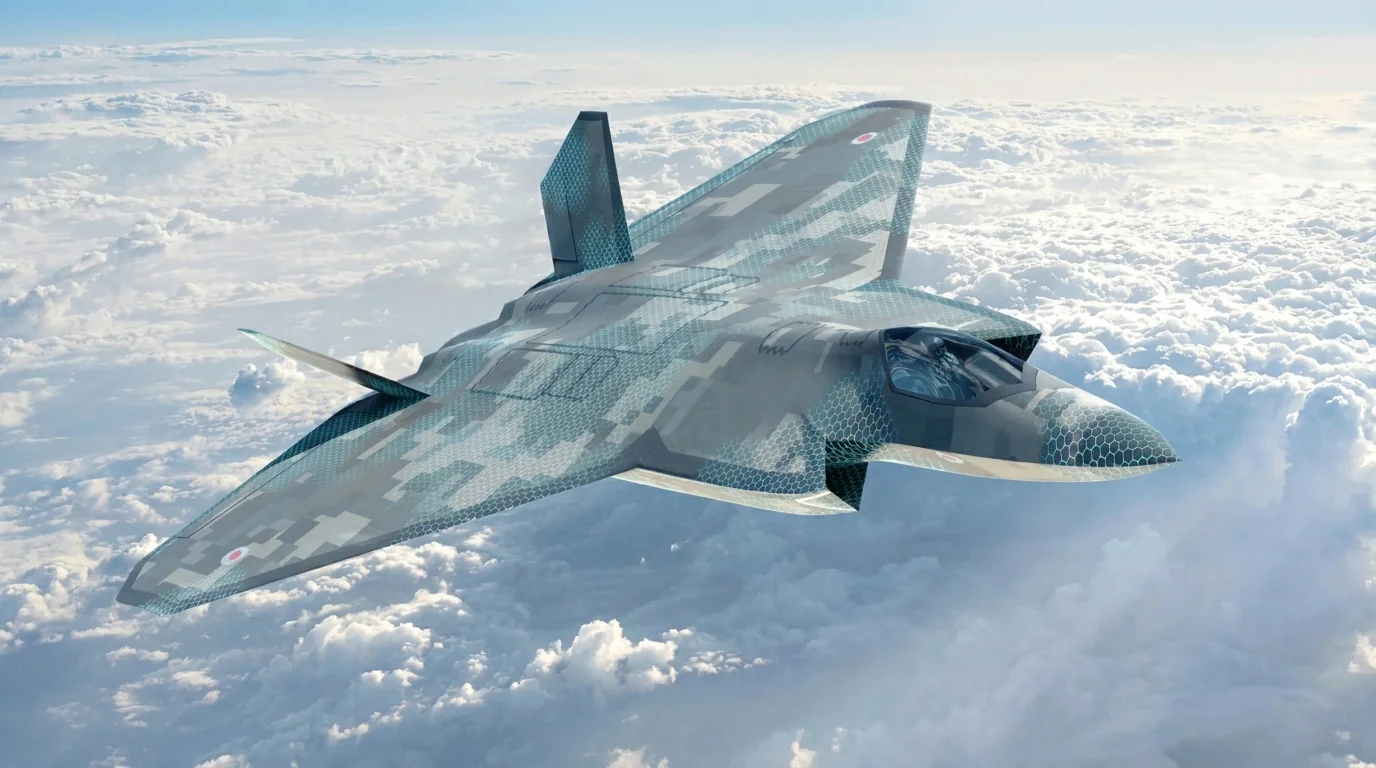
Imagine a fighter jet that can detect threats beyond the reach of conventional radar, coordinate with autonomous drones, and share battlefield information across multiple military platforms. That’s the ambition behind the GCAP fighter.
Developed jointly by the United Kingdom, Italy, and Japan, the Global Combat Air Programme (GCAP) aims to introduce a sixth-generation combat aircraft by 2035. It represents a major investment in the future of air warfare, combining advanced stealth, next-generation sensors, intelligent weapons, and digital combat systems.
But how powerful could this aircraft actually become?
Unlike conventional fighter development, GCAP is not simply about building a faster jet or installing more powerful engines. Its real ambition is to create an aircraft capable of controlling information across an entire battlefield. Think of it as an airborne command center with the speed and agility of a fighter.
The program also reflects changing military priorities. Future air combat will increasingly depend on detecting opponents first, sharing information quickly, and coordinating multiple platforms during complex missions.
Three countries are betting on that approach.
However, many important details remain classified or undisclosed. Its maximum speed, combat radius, weapons payload, and final radar specifications have not been officially confirmed.
So, what technologies could give the GCAP fighter its potential advantage? And could it eventually challenge aircraft such as the F-35 and America’s upcoming F-47?
Let’s examine what makes this ambitious sixth-generation fighter program worth watching.
What Is the GCAP Fighter and Why Is It Being Developed?
The GCAP fighter is a next-generation combat aircraft being developed by the United Kingdom, Italy, and Japan. Its name stands for Global Combat Air Programme, a multinational initiative designed to shape the future of military aviation.
The partnership brings together three countries with different defense priorities but a shared requirement: maintaining advanced air combat capabilities well into the 2030s and beyond.
The United Kingdom and Italy previously collaborated on the Eurofighter Typhoon. Japan, meanwhile, operated the Mitsubishi F-2 and sought a successor to maintain its air defense capabilities.
GCAP brings these requirements together under one ambitious program.
Why Are Three Countries Building GCAP?
The partnership officially emerged in December 2022, merging the UK’s Tempest fighter project with Japan’s F-X development program. Italy joined the British Tempest initiative earlier, bringing additional industrial and technological expertise.
Each country contributes important defense companies. BAE Systems leads major British aircraft development activities, while Leonardo brings substantial electronics and sensor expertise. Japan’s Mitsubishi Heavy Industries also plays a central role.
The program aims to deliver more than another conventional fighter.
Its planned technologies include advanced stealth, integrated sensors, intelligent weapons, and digital connectivity. These systems are intended to work together rather than operate independently.
When Will the GCAP Fighter Enter Service?
The three partners target 2035 for the aircraft’s introduction into operational service. That timeline gives the consortium several years to develop, test, and integrate its technologies.

The aircraft is expected to replace aging fighter capabilities, particularly the Eurofighter Typhoon and Mitsubishi F-2.
For the participating countries, GCAP also represents an opportunity to maintain domestic aerospace expertise and strengthen their long-term defense industries.
Ultimately, the program is about preserving air superiority in a changing military environment. And that ambition goes far beyond building a faster fighter jet.
How Powerful Will the GCAP Fighter Be? Expected Specifications and Performance
The GCAP fighter is being designed for a different kind of air warfare. Its potential power won’t come from speed alone. Instead, the aircraft is expected to combine stealth, advanced sensors, long-range weapons, and sophisticated computing into one integrated combat platform.
But just how capable could it become?
The honest answer is that several important specifications remain undisclosed. Nevertheless, the program’s technological objectives offer clues about its potential performance.

Expected GCAP Fighter Speed and Flight Performance
Supersonic flight is an important consideration for GCAP. The aircraft will need sufficient speed to intercept threats, reposition quickly, and operate across large combat zones.
However, its maximum speed has not been officially confirmed. Claims suggesting specific Mach figures should therefore be treated as estimates, not established specifications.
Speed also tells only part of the story. Acceleration, maneuverability, aerodynamic efficiency, and sustained performance matter during actual combat operations.
Range, Payload, and Operational Flexibility
Range could become particularly important for Japan and its partners. Operating across the Indo-Pacific involves enormous distances, making endurance and mission flexibility essential.
A capable airframe must accommodate fuel, sensors, computing equipment, and weapons without compromising its intended stealth characteristics.
Internal weapons storage could help achieve that balance. It allows the aircraft to carry weapons while reducing external surfaces that increase radar visibility.
GCAP Fighter Specifications: What Do We Know?
The following table separates announced program objectives from specifications that remain unavailable publicly.
| Specification | Current information |
| Aircraft generation | Sixth-generation |
| Planned service entry | 2035 |
| Maximum speed | Undisclosed |
| Combat radius | Undisclosed |
| Maximum payload | Undisclosed |
| Propulsion | New engine under development |
| Primary role | Advanced air combat |
One important distinction: GCAP’s projected capabilities are not proven operational performance. Its eventual effectiveness will depend on testing, engineering decisions, and successful integration.
In other words, the aircraft’s real power will be determined by how well its technologies work together.
A particularly interesting aspect is the program’s emphasis on what military planners describe as effects reach: the ability to deliver weapons, sensors, and other effects across long distances while maintaining survivability. A 2025 analysis by the Joint Air Power Competence Centre highlights this balance as central to GCAP’s design.
That could prove more important than achieving an impressive top-speed figure. After all, reaching a target, detecting threats, and remaining effective in hostile airspace are what ultimately matter.
How Advanced Will the GCAP Fighter’s Stealth and Radar Be?
A fighter can be incredibly fast and still lose a battle. If an opponent detects it first, the advantage may already be gone.
That’s why stealth and radar technology will play such important roles in the GCAP fighter. The aircraft is being designed to detect threats, process information, and operate in heavily defended airspace.
But there’s an interesting twist. GCAP isn’t just expected to hide from enemy radar. It must also understand the surrounding electromagnetic environment.

How Will GCAP’s Stealth Technology Work?
The aircraft is intended to feature advanced low-observable technology, reducing the chances of detection by hostile radar systems.
This involves more than simply giving the aircraft an unusual shape. Engineers must consider its overall radar signature, materials, surface treatments, engine installation, and weapons arrangement.
Internal weapons bays are particularly important. Carrying missiles externally can increase radar visibility and aerodynamic drag, potentially compromising stealth.
For GCAP, the challenge is balancing stealth with range, payload, and sensor performance. An aircraft cannot sacrifice everything simply to become harder to detect.
A Next-Generation Radar That Processes More Data
One of GCAP’s most interesting planned technologies is its advanced radar system.
According to the UK government, the radar is intended to provide up to 10,000 times more data than current systems. This is an ambitious program target, not a publicly demonstrated operational result.
The idea goes beyond detecting enemy aircraft. More sophisticated processing could help pilots interpret complex information and identify potential threats faster.
Leonardo, Mitsubishi Electric, and other industry partners are working on the aircraft’s integrated sensing and communications architecture.

Sensor Fusion: Combining Multiple Sources of Information
Radar is only one piece of the puzzle.
GCAP’s planned Integrated Sensing and Non-Kinetic Effects and Integrated Communications System (ISANKE & ICS) will bring different sensing and communication capabilities together.
These include:
- Radar sensors: Detecting and tracking potential airborne threats.
- Infrared sensors: Identifying aircraft through their heat signatures.
- Electronic warfare systems: Detecting and responding to hostile electromagnetic activity.
- Integrated communications: Sharing information with other aircraft and military platforms.
The real advantage comes from combining these inputs. Rather than forcing pilots to interpret separate sensor displays, the system aims to create a more unified picture of the battlespace.
Think of it as having several pairs of eyes working together, each looking through a different lens.
Could GCAP Detect Stealth Aircraft?
Advanced sensors could improve the ability to identify and track difficult targets. However, stealth aircraft are not invisible, and detection depends on radar characteristics, distance, viewing angles, and operating conditions.
GCAP’s integrated sensing architecture could help address these challenges. Whether it can consistently detect particular stealth fighters remains unknown.
That’s an important distinction. Advanced radar and sensor fusion offer considerable potential, but they don’t guarantee battlefield superiority.
For GCAP, the objective is straightforward: see more, understand faster, and give pilots better information before an engagement begins.
What Engine Will Power the GCAP Fighter, and How Fast Could It Fly?
A sixth-generation fighter needs more than an advanced radar and stealthy airframe. It also needs an engine capable of powering increasingly demanding onboard systems without compromising flight performance.
That’s where GCAP’s propulsion program becomes particularly interesting.
The aircraft will use a new engine developed through cooperation between British, Italian, and Japanese aerospace companies. The partnership brings together Rolls-Royce, Avio Aero, and IHI Corporation.

A Three-Nation Partnership Behind the GCAP Engine
Each company contributes experience in aircraft propulsion and engineering. Rolls-Royce leads major British propulsion activities, while Italy’s Avio Aero and Japan’s IHI bring additional manufacturing and technological expertise.
Their objective is to develop a propulsion system suited to the demands of a sixth-generation combat aircraft.
This involves more than generating thrust. Modern fighters require substantial electrical power for radar, electronic warfare, communications, and onboard computing.
GCAP must accommodate those requirements while maintaining the performance expected from a frontline combat aircraft.
Why Next-Generation Propulsion Matters
One important development area is thermal management.
Advanced radar and electronic systems generate considerable heat. As these systems become more powerful, the aircraft needs better ways to manage their temperatures.
Engine architecture therefore becomes closely connected to the performance of other onboard technologies.
Fuel efficiency matters, too. A fighter operating over enormous distances needs to balance speed, endurance, and fuel consumption.
For GCAP, these requirements make propulsion a central part of the aircraft’s overall design rather than an isolated engineering project.

How Fast Could the GCAP Fighter Fly?
Despite considerable interest, its maximum speed remains classified or undisclosed. There is currently no reliable official figure confirming whether GCAP will reach Mach 2 or exceed it.
However, supersonic performance is an important design consideration. The aircraft must balance acceleration, fuel efficiency, endurance, and maneuverability rather than prioritize one impressive number.
A notable development milestone arrived in July 2026. The propulsion consortium reported completing more than 100 subscale component tests, moving closer to ground-testing its engine demonstrator.
The demonstrator will help engineers evaluate technologies before finalizing the production propulsion system.
The bigger picture: GCAP’s engine is being developed as both a source of thrust and an integrated power system. That combination could prove essential when advanced radar, electronic warfare, and future weapons demand more electricity.
And that’s what makes this engine particularly interesting. Its success could influence almost every major capability aboard the aircraft.
What Weapons Will the GCAP Fighter Carry?
A sixth-generation fighter needs more than advanced sensors and stealth. It also needs weapons capable of engaging threats at considerable distances.
The GCAP fighter is expected to support several combat roles, including air superiority, precision strike, and maritime operations. However, its final weapons inventory has not been publicly confirmed.
The important question is not simply which missiles it will carry. It’s how effectively the aircraft will integrate weapons into its wider combat system.

Air-to-Air Weapons for Long-Range Engagements
Air-to-air combat will likely remain one of GCAP’s primary missions.
The aircraft is expected to accommodate advanced beyond-visual-range missiles, allowing pilots to engage hostile aircraft before entering close combat. Longer-range weapons are particularly relevant in the Indo-Pacific, where aircraft may need to operate across enormous distances.
The UK Parliament has identified greater payload capacity and the ability to carry larger, longer-range air-to-air missiles as important GCAP requirements.
Shorter-range missiles may also be needed for engagements at closer distances. But specific missile models have not been officially announced.
Air-to-Ground and Maritime Strike Capabilities
GCAP is also expected to support air-to-surface missions. These could include precision attacks against ground targets and operations against hostile naval forces.
Its exact weapon options will depend on future integration decisions. The aircraft’s flexible payload architecture is intended to accommodate different mission equipment and effectors.
Internal Weapons Bays and Stealth
Carrying weapons internally helps reduce radar visibility and aerodynamic drag. This makes internal weapons bays an important feature for a stealth-focused aircraft.
The RAF’s Tempest concept, which contributed to GCAP’s development, describes a flexible payload bay for air-to-air and air-to-surface weapons.
An Intelligent Weapons System
Leonardo identifies an intelligent weapon system as part of GCAP’s planned architecture.
This points toward closer integration between sensors, mission computers, and weapons.
Ultimately, GCAP’s advantage may come from selecting and coordinating the right effects at the right moment, not simply carrying more missiles.
How Will AI, Autonomous Drones, and Networked Warfare Change GCAP’s Combat Power?
The GCAP fighter is being developed for a battlefield where aircraft may no longer fight alone. Instead, they could coordinate with autonomous drones, ground systems, ships, and other aircraft.
This approach could fundamentally change how air forces conduct combat operations.
Rather than relying entirely on the pilot, GCAP will use artificial intelligence, advanced computing, and connected systems to process information and support decisions.

How Will AI Help the GCAP Fighter?
Artificial intelligence is expected to handle some of the most demanding information-processing tasks.
Modern combat aircraft collect enormous amounts of data from radar, infrared sensors, electronic warfare equipment, and other platforms. Interpreting everything quickly can overwhelm even experienced pilots.
GCAP aims to use AI to organize this information, identify potential threats, and help pilots understand changing combat situations.
The UK Ministry of Defence has stated that AI and autonomous technologies will help GCAP task sensors, prioritize data, and analyze combat situations more quickly.
However, AI is intended to support the pilot, not necessarily replace human decision-making.
Could GCAP Control Autonomous Combat Drones?
One particularly interesting capability is crewed-uncrewed teaming.
GCAP is expected to operate alongside autonomous collaborative platforms, commonly described as combat drones. These aircraft could perform surveillance, carry additional weapons, or support electronic warfare missions.
The Royal Air Force’s Tempest technology program highlights scalable autonomy and operations involving both crewed and uncrewed platforms.
Importantly, the GCAP fighter program does not currently include responsibility for developing all accompanying drones. Their development and ownership remain separate questions.
A Connected Battlefield Through Networked Warfare
GCAP will also rely on secure communications to exchange information across multiple military platforms.
This could allow pilots to receive targeting information from other aircraft, ships, or surveillance systems without relying exclusively on their own sensors.
The result could be a more coordinated force with greater situational awareness.
Ultimately, GCAP’s greatest advantage may not be its individual performance. It could be the ability to coordinate an entire network of combat platforms, turning one fighter into the center of a much larger fighting force.
GCAP vs. F-35 and F-47: Could It Become the World’s Most Powerful Fighter?
GCAP will not enter a battlefield without competition. The United States already operates the F-35, while its next-generation F-47 program is intended to introduce even more advanced air combat capabilities.
Comparing these aircraft reveals an important distinction: they belong to different generations of development and serve different strategic requirements.
The F-35 is an operational fifth-generation fighter. GCAP and the F-47 are being developed around sixth-generation ambitions, although neither has demonstrated its final capabilities.
GCAP vs. F-35: A Different Level of Technology
The F-35 Lightning II already combines stealth, sensor fusion, electronic warfare, and networked operations.
Its greatest strength is its ability to collect information and distribute it across allied forces. The US Air Force describes the F-35A as a fifth-generation aircraft designed around stealth and enhanced situational awareness.
GCAP aims to build on that foundation. Its planned capabilities include more advanced sensing, greater computing capacity, intelligent weapons, and closer cooperation with autonomous platforms.
However, GCAP’s eventual advantage remains unproven. The F-35 has operational experience that a future aircraft cannot claim yet.
GCAP vs. F-47: Which Sixth-Generation Fighter Could Be More Powerful?
Boeing F-47 is the United States’ next-generation fighter program under the broader Next Generation Air Dominance initiative.
Like GCAP, it is intended to operate as part of a wider combat network involving autonomous aircraft and other military systems. The US Department of Defense announced Boeing’s development contract in March 2025.
Both programs emphasize stealth, advanced sensors, and networked warfare. Their precise performance specifications remain unavailable, making a definitive comparison impossible.
| Comparison | GCAP | F-47 |
| Main developers | UK, Italy, Japan | United States |
| Generation | Sixth-generation target | Sixth-generation target |
| Planned service | 2035 target | Not publicly confirmed |
| Autonomous teaming | Planned | Part of wider NGAD concept |
| Maximum speed | Undisclosed | Undisclosed |
| Combat radius | Undisclosed | Undisclosed |
The UK government reaffirmed GCAP’s 2035 target in July 2026, when it announced a £4.6 billion contract to advance the aircraft’s design.
Could GCAP Become the World’s Most Powerful Fighter?
Possibly, but there is no reliable way to rank it against the F-47 before either aircraft demonstrates its final capabilities.
GCAP’s multinational development could deliver considerable technological advantages. Its success will depend on engineering execution, funding, weapons integration, and the ability to deliver the aircraft on schedule.
Ultimately, the most powerful fighter may not be the fastest or stealthiest aircraft. It could be the one that combines sensors, weapons, autonomous platforms, and human decision-making most effectively.
