

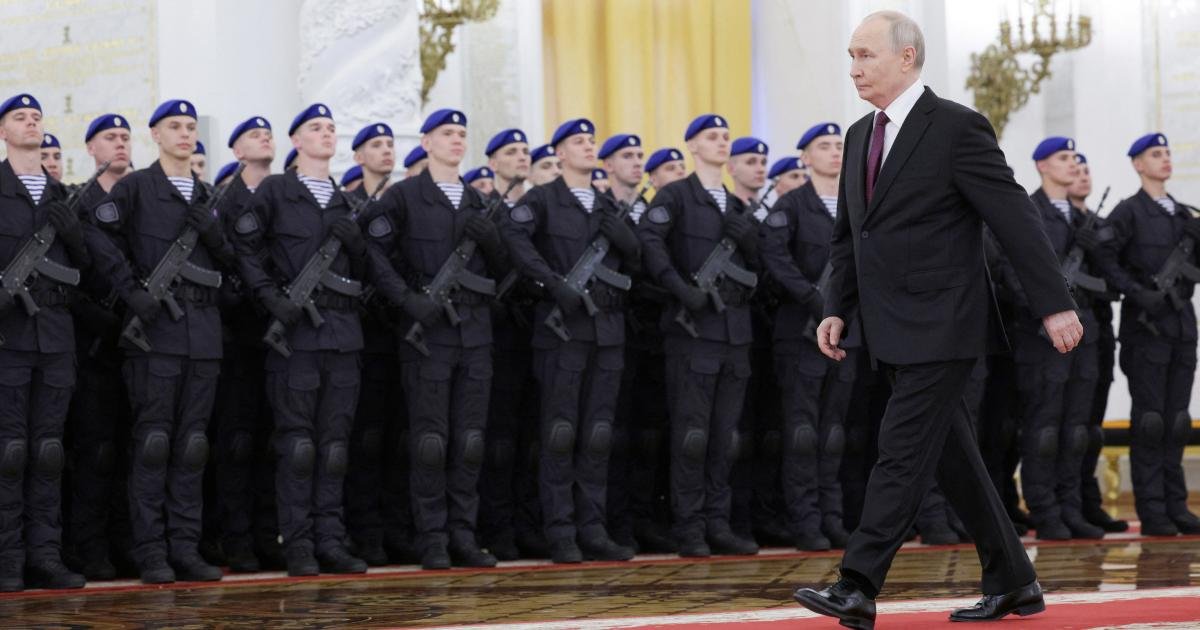
“I believe we should talk to Putin,” Finnish President Alexander Stubb said in an early June interview. It was a revealing admission. Stubb has, for years, been one of Europe’s most pro-Ukraine politicians and generally hawkish toward the Kremlin. But now, Stubb told journalists, ignoring Russian President Vladimir Putin was becoming untenable. “This border will remain,” he said, referring to his country’s 833-mile boundary with Russia. “At some point, we will have to maintain political relations.”
Stubb is hardly the only European politician who has recently advocated talking to the Kremlin. French President Emmanuel Macron spoke in favor of it back in February, as did Italian Prime Minister Giorgia Meloni in June. These European leaders are motivated, in part, by a sense that high-level diplomacy could yield a deal that finally ends the war in Ukraine. But they are also motivated by a desire to stabilize the increasingly dangerous Russian-European relationship, which has yielded an uncontrolled arms race; Russian hybrid operations on EU territory, such as its arson attacks in the United Kingdom and drone incursions on Europe’s east; and an overall growing risk of direct military confrontation. The continent, in other words, is looking for ways to contain a potential crisis and prevent escalation.
Europe’s leaders are right to want to speak with Putin. But they do not yet have a path forward for doing so. They do not, at the most basic level, know who should talk to the Kremlin on the continent’s behalf. More important, they are not quite sure what should be on the agenda.
To answer these questions, the continent must establish a coalition of the willing. Europe’s leading powers—France, Germany, and the United Kingdom—should join with an eastern European state, such as Finland or Poland, to engage with Putin. Their goal should be to stabilize relations with Moscow while continuing to support Kyiv. This will not end the Russian-European standoff, much less lead to friendship. But it could shore up European security and help prevent a wider war.
DANGER ZONE
Europe’s frustration with the idea of talking to the Kremlin is rooted in experience. In the lead-up to Russia’s full-scale invasion of Ukraine, French President Emmanuel Macron and German Chancellor Olaf Scholz met directly with Putin to try to dissuade him from attacking. Putin, in turn, lied to their faces, promising that he would not invade even as he prepared to do so. Following this humiliation, Europe issued sweeping sanctions against Russia and joined the United States in offering extensive support to Ukraine. Most of the continent’s countries severed almost all their official lines of contact with the Kremlin.
Since then, Washington has handled most of the crisis diplomacy with Russia to prevent escalation. Whenever NATO countries stepped up support for Kyiv and pushed against the Kremlin’s ostensible redlines, Europe could be sure that a competent Biden administration official, such as former CIA director Bill Burns, would work the phones with Russian counterparts to establish guardrails and manage confrontation.
Then, U.S. President Donald Trump returned to the White House and filled his administration with neophytes. Steve Witkoff, a real estate developer with no government experience, was charged with speaking directly to Putin. Pete Hegseth, a Fox News host, was picked to lead the Pentagon. At the same time, the White House started threatening to pull back from NATO, criticizing European allies for neglecting defense spending, and even threatening to annex Greenland.
Russia and Europe are at risk of replaying the most dangerous parts of the Cold War.
Meanwhile, Europe’s security predicament vis-à-vis Moscow deteriorated. Putin has publicly said that Russia is confronting not only Ukraine but all of Europe, since the continent supplies Kyiv with weapons, intelligence, military training, technology, and general funding. The Kremlin plans to massively increase its military presence along the EU’s borders and has begun carrying out more hybrid attacks against EU members, such as by floating drones over their territory. Russia is rapidly building up its missile and drone arsenals—just as the last remaining arms control deals between Russia and NATO have been destroyed.
Europe, too, has enhanced its long-range and medium-range missile capabilities. It is scaling up drone production and testing new weapons systems. Many European countries are designing these systems specifically to hit the Russian heartland. Some European leaders are even making plans to extend the continent’s system of nuclear deterrence, either by having France patrol European skies with its strategic bombers or by having other European states develop their own nuclear weapons.
Still, these steps are unlikely to prevent conflict by themselves. In the absence of guardrails and channels of communication, the growing arsenals could prompt miscalculation and escalation as each side becomes more fearful and more reliant on automation and AI, which is prone to glitches and manipulation by outside actors. Meanwhile, thanks to Finland’s and Sweden’s accession to NATO, the geography of a potential Russian-European confrontation has expanded. The warning times for potential missile attack have collapsed. As a result, Russia and Europe are at risk of replaying the most dangerous parts of the Cold War, such as the European missile crisis of the 1970s and 1980s (when Moscow first deployed stealthy, medium-range missiles in eastern Europe, and NATO later countered by deploying American missiles in western Europe), with no real recourse.
THE PERSONAL IS THE POLITICAL
During the Cold War’s most perilous times, the Eastern and Western blocs often resolved their differences through personal diplomacy. But then as now, it was always the White House, which maintained a crisis hotline with the Kremlin, that took the lead on most challenging issues—as U.S. President John F. Kennedy and Soviet Premier Nikita Khrushchev did during the Cuban missile crisis. U.S. President Richard Nixon’s conversations with Soviet Premier Leonid Brezhnev also helped stabilize relations during the 1970s, easing tensions across Europe. But because it can no longer rely on Washington, Europe must now open its own high-level channel to the Kremlin.
It will be easier, and therefore tempting, to work with Russia’s chief of foreign intelligence, the country’s national security adviser, or another Putin representative. To do so, the continent might be able to rely on existing channels. These connections could certainly prove helpful when discussing certain narrow topics, such as Russia’s hybrid activities. But for diplomacy to have a broader stabilizing effect, European leaders will have to deal with Putin himself. Doing so may be deeply unpleasant, but ultimately, Russia’s president is the only person in the country with authority.
This means Europe will need to reach out to the Kremlin via its own top leaders. No special envoy can build credibility with Russia’s president. Since the EU and NATO will not be able to reach a consensus on this issue , the burden of setting up initial dealings must fall on the shoulders of the leaders of Europe’s largest countries. At the very least, this group should include France, Germany, and the United Kingdom—three countries that, together, pose a real security challenge to the Kremlin given their sizable militaries and economies. To add weight and perspective, however, it should also include at least one state from NATO’s eastern flank that has extensive military capabilities and a border with Russia, most likely Finland. (Poland could also be an effective representative, but its prime minister and president are currently locked in conflict.)
The coalition need not be limited to these countries, and all EU members, as well as North American NATO allies and Ukraine, should be routinely informed about the group’s conversations. But some countries need to be in charge, and the number of interlocutors should be limited. This decisive approach helped Europe expedite its military assistance to Ukraine, and it should be deployed again for conflict diplomacy with Russia.
To make contact with Putin, this coalition could use a tool from a bygone era: a personal, confidential letter. A written document helps avoid the emotions and awkwardness of in-person or an online, video engagement, which could easily go off script. It would thus allow Europe to calmly make the case for establishing regular contact that will help both sides determine guardrails, institute crisis management mechanisms, and generally distinguish between real signals and noise. The letter should, for example, propose setting up teams and hotlines to regularly discuss specific flash points—such as military incidents, including when NATO airspace is violated and undersea cables are cut.
To get the Kremlin’s attention, the letter could appeal to Putin’s grandiose sense of destiny by suggesting that it should be his responsibility, as Russia’s leader, to work alongside European heads of state to prevent a major war on the continent. The legacy of leaders in Moscow and European capitals, after all, will be judged in part by their ability to avoid sleepwalking into a catastrophic outcome. Europe should also point out that a war with NATO is not in the Kremlin’s interest: Russia could not credibly win such a conflict without using nuclear weapons. Finally, the letter should invite the Kremlin to discuss ways to reimagine the continent’s security architecture—something Putin has desired for over a decade.
The Europeans, however, must make it clear that they are not interested in a new security architecture on Moscow’s terms. They should tell Putin that Europe’s rearmament is a reaction to Russia’s belligerence and that it will continue as long as Russia poses a threat. But Europe would prefer to manage its adversarial relationship with Russia not only by arming itself to the teeth but also via negotiated frameworks that control and reduce risks, as happened during the stable stage of the Cold War. The Europeans should also tell Putin that any serious discussion about the continent’s future cannot happen without a cease-fire in Ukraine. And they should emphasize that Europe is ready to start discussing the modalities of such an agreement in partnership with Kyiv and Washington. This will put the ball in Putin’s court.
TOUGH TALK
Right now, there is little to suggest that Putin is prepared to talk seriously to the Europeans. Instead, the Kremlin is still focused on dealing with the Trump administration. Yet in reality, the chances of Trump making a deal that favors Putin have grown quite slim—and they are only growing slimmer. For starters, the White House has warmed up to helping Ukraine, with Trump signaling at a June G-7 summit in France that he is willing to reimpose oil sanctions on Russia as a way of pressuring its leader. Trump, of course, could change his mind, as he so often does. But the White House is gradually losing leverage over Kyiv. During the first year of Trump’s second term, Ukraine was slowly losing territory to Russia. Now, however, it is mostly holding the frontline and inflicting ever more pain on its adversary, as its June strikes on Moscow made evident. Europe, meanwhile, has stepped in to provide the largest share of assistance to Kyiv.
If Putin is not already aware of his country’s eroding position, he eventually will be. As Russian losses mount and the country struggles to recruit soldiers, the resulting manpower issues will be too critical to ignore. (His domestic political situation may also become more difficult as Ukraine’s attacks cause energy shortages.) Putin may then agree to speak to the Europeans. He will also likely realize that Russia cannot negotiate a new security architecture in Europe with Washington alone, given the continent’s own expanding military capabilities and demonstrated autonomy.
Ukraine’s growing strength, of course, might seem like a reason for Europe to punt on conversing with Putin. If the continent is gaining the upper hand, hawks might argue, it should instead keep waiting, perhaps until Putin comes to them. They might also point out that Russia’s president could leak the letter European leaders send him in order to suggest that the continent is begging for a deal.
But Europe can mitigate that risk by writing in a way that is not moralistic but still portrays European leaders as responsible, principled adults in the room. And speaking with Putin is not tantamount to making a deal with him; Europe can start conversations while rejecting any proposal that it regards as detrimental to its interests. Plus, the trajectory of the war remains unpredictable. The Europeans may hope that their position will improve further, but they cannot be sure. Should the trajectory of the war change, or should Putin feel cornered and embark on an even more reckless path, Europe will appreciate having professionally managed channels to the Kremlin.
Europe might be able to affect political dynamics within Russia.
The continent’s political calendar should also prompt action. For the most part, Europe’s current leaders work well together, as the continent’s ongoing support for Ukraine indicates. But there is no guarantee that its next generation will be as collaborative, particularly if populist forces win more elections. It is thus better for Europe to establish channels to the Kremlin today, when it is relatively united, than risk a more turbulent future. Engaging in diplomacy with Russia could also help Europe’s mainstream parties answer their populist critics, such as Germany’s AfD, which have argued that their countries are doing too much to aid Kyiv.
Finally, by acting now, Europe might be able to affect political dynamics within Russia. Growing numbers of the country’s elites have finally come to realize that the war is diminishing Russia’s security, prosperity, and global influence. Even some Putin loyalists, such as Herman Gref, the CEO of Russia’s largest bank, have dared to challenge the Kremlin’s decision to keep fighting rather than looking for an off-ramp. These new critics are in no position to challenge Putin yet. But news that Europe is trying to negotiate an offramp with the Kremlin will eventually reach Russia’s elites. And if Europe can indicate to them that a more peaceful Moscow might find partners to its west, it could increase such dissension and put additional pressure on the Kremlin—at least in the form of passive resistance, such as hamstringing war-related orders. For such signaling to work, however, European leaders should align on public messaging aimed at Russia’s educated class .
As it reaches out to Putin, Europe will want to simultaneously shore up relations with the U.S. foreign policy community. It should invest in structured discussion formats with both Democrats and Republicans who have real-world experience negotiating European security issues with the Kremlin. This will help the continent tap a deep well of American experience in crisis diplomacy, on which its own track record is thin. It will also help build a common language on these crucial issues that can be used on both sides of the Atlantic. For all of Europe’s military investments, the reality is that no better system of managing security in Europe can emerge without American buy-in. Washington’s nuclear arsenal, its commanding position in NATO, and its leadership in many military technologies are simply too important. The Kremlin will want the United States to be a party to any agreement it makes with Europe.
With Trump in charge, Washington lacks the focus and expertise to be part of serious talks on the future of European security right now, and thus any deal will most likely have to wait until 2029. But direct engagement between European leaders and Putin can help lay the groundwork for that moment. More important, it can help the two sides manage risk right now—and thus avert a catastrophic conflict.
Loading…
