

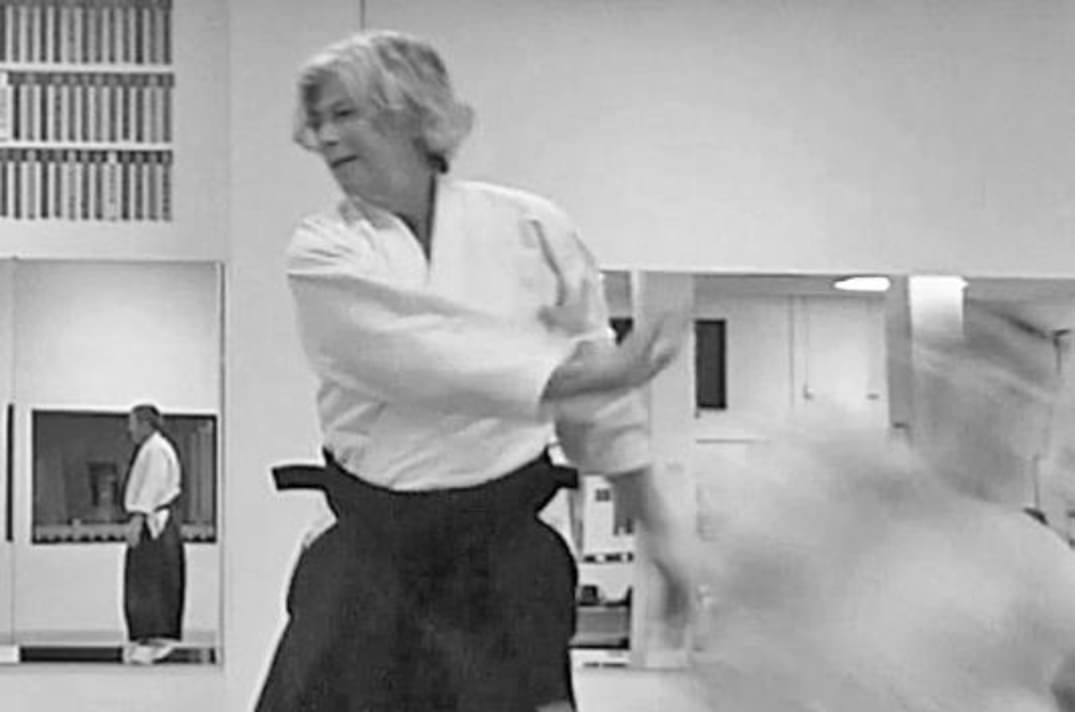
With a background in dance and a love for movement, Lynne Morrison found herself drawn to Aikido when she saw it for the first time in 1972 with Yoshimitsu Yamada leading a class at the New York Aikikai. Immediately, she signed up and trained intensely when, in 1978, she began teaching classes at New York Aikikai and around the US. About two decades later, she moved to India, taking a job at a non-profit, teaching aikido to meditation-oriented people. Morrison returned to the American Aikido world in 2010, and based on her and other female experiences, she joined the Independent Coalition of USAF Women in late 2019. Today, Morrison talked about her time at the New York Aikikai and the Coalition. All images provided by Lynne Morrison.
Martial Arts of Yesterday, Today, and Tomorrow: Welcome Morrison Sensei! Thank you for joining us for a conversation about your Aikido and the Independent Coalition of USAF Women!
Lynne Morrison: Thank you for having me!
MAYTT: You began training aikido in 1972 under Yoshimitsu Yamada. How did you come to find the Art of Harmonizing Energies and what about the art continues to motivate you to train to this day?
LM: When I think back to those times, I see that a number of my interests came together and led me up the stairs to the NY Aikikai. I loved movement, whether sports like tennis or arts like dancing. I wasn’t a trained dancer, but I took classes in NYC with wonderfully creative people like Trisha Brown, Carmen Beuchat, and performed with Sylvia Whitman’s group. There was a lot of experimentation with movement, flow, and connection with other people. During the same period, I studied Tibetan Buddhist Art and Culture at the New School with John Bzostoski, met Geshe Wangyal, and traveled to Nepal for several months to live with the Tibetan community. Somehow, the experience of energy through meditation and dance led me to be curious about aikido. I don’t remember the first time I heard the word aikido, but I was reading books like Hara, the Vital Center of Man by Karlfried Graf Durkheim, and then Aikido in Daily Life by Koichi Tohei. I tried to make sense of the wonderful drawings in Aikido and the Dynamic Sphere. Somewhere, I saw a photo of Morihei Ueshiba representing the time that he became inspired to shift from Aiki-Budo into the development of aikido. I became very determined to explore what this “ki” could be. I wanted to feel it and develop a “center.” And I figured that since O-Sensei had become inspired to develop these “techniques,” that the secret to aikido must lie in learning the techniques. I discovered that aikido was being taught on 18th Street in NYC and I headed over to see it.
MAYTT: Many within the aikido community have a perception that training in the early years of the New York Aikikai (NYA) was hard, rough, spartan, and there were a fair share of injuries on the mat. Does this description of the NYA training reflect what you experienced? How have you seen aikido training change or evolve as you continued your time in the art?
LM: The first time I walked up the stairs of the NY Aikikai, I could hear the Boom! Boom! sounds but had no idea what I would see. The mat was long and narrow, as it still is, and filled with people moving and flying. That’s what it looked like to me, and I didn’t consider that there might be some sensation when the bodies hit the mats. Those days, I don’t remember any “feather” falls. Constant movement, flying, and falling. It looked really beautiful to me, and I signed up. I met the instructor, Yoshimitsu Yamada, a strong man in his thirties. And so, my training began. I’m not going to say that it was easy for me. I was very confused and sometimes scared. Sometimes, I’d feel a little sick walking up the stairs, but I also felt joyful, and I was determined to feel that “ki.” In those days, I would hear from some of the instructors, “Extend Ki!”
My body loved the movement, and I learned the value of being able to take ukemi from my partners and instructors. The atmosphere in the dojo was dynamic. The training was continuous, fast and very sweaty. At the time I started, the mats were well-worn true tatami. They were pretty hard.
Yamada Sensei didn’t do much talking about technique, but there were lots of demonstrations. I learned to be a responsive uke for my partners and for the instructors. There was a lot of learning transmitted through the uke experience. Yes. The falls could be hard. But almost everyone on that mat was young, twenties, thirties, and even younger, like Bruce Bookman. One exception was a small, aged man named Harry. He could make us fly with the wave of his arms. The senior students were inspirational for me: Harvey Konigsberg, Angel Alvarez, Hal Lehrman, Nelson Andujar, Kioshi, Harry Mckormick, Jane Ozeki, Leida Andujar, Sybille Hayn, Frank Johnson, Luqman Hakeem, Henry Smith, Paul Zimet, and Tina Shepard. I especially loved to practice with Sybille Hayn. She became a mentor for me. In the first few years, there weren’t many women, but at that time there wasn’t much distinction in the training. Aikido became important in my life. For a while, I worked nights so I could fit in lots of training with my family life.

In those earlier days, Yamada Sensei would invite other instructors. We saw a lot of Kazuo Chiba Sensei and Mitsunari Kanai Sensei. And guest instructors from Japan. Terry Dobson was around, and Lou Kleinsmith taught a really interesting class on Sundays with Taiji (tai chi) foundations.
I don’t remember many injuries, except for the occasional wrist and elbow sprains, and a couple of clavicle breaks. Each person had their own relationship to the intensity of their training. I certainly got sore, but never badly injured. But, again, we were young and strong. Students who needed a less vigorous practice were accommodated. In general, in the early days I experienced good spirit and serious training.
A few years after I began, a lot of new students entered. More women like Kris Varjan, Gina Zarilli, Lynn Sonneman, Cheryl [Pimsler] and Marianne [Workoff], and others. And then later, women like Alesia Kunz, Claire Keller, Ruth Peyser, Karen De Paola, and more. And a group of men who would become close to Yamada Sensei: Peter Bernath, Steve Pimsler, Robert Workoff, Rick Stickles, Butch Chernofsky, and James Keller.
It’s hard to duplicate the intensity and excitement of the early practice. Everything was new.
Over the years, I’ve learned from a number of teachers. I’ve seen my aikido move from practicing technique and details, to focus on connection and flow, to building internal power with a strong center and deep relaxation. At seventy-five years old, I still experience a lot of joy in my practice and my teaching. Aikido has moved from something that I learned, to a living part of my existence. It has become mine. And I love to share it.
MAYTT: It seems the training had a lasting impact on you! How would you describe training under Yamada? What was he like as a teacher and as a person?

LM: I think that on the mat, Yamada Sensei was the perfect teacher for me at the time. He taught by demonstrating, without much talk. This allowed me to learn and also to keep the precious moments for myself. I will always be grateful for that strong, foundational training. I loved his big circular movements and the power he generated. He was pretty specific about the details, but he also allowed the students to express themselves. He let me know that he respected my practice and that he liked my aikido. Sometimes he would practice with me, often resisting my technique to teach. He encouraged me to get stronger in my technique, and he was never unkind on the mat. Early on, he would often take us out for Japanese food, and he was generous and fun. And I believe he cared about us. When I was a third or second kyu I had a pretty bad car accident that smashed up my knee. I was in the hospital for a few days. One day, I woke up and Yamada Sensei was standing by the bed with a few students. It really lifted my spirits and I worked hard to get back on the mat.
MAYTT: Fast-forward seven years, and you are teaching at the NYA. How did you come to assume the role of teacher? What about that experience influenced you later on your aikido career and training?
LM: In 1978, Yamada Sensei invited me to accompany him and Kanai Sensei to Florida to help with the students in a seminar and to take ukemi for them. I was first kyu. I was not yet preparing for my shodan test. In fact, I disliked testing because I became too anxious. After a first full day of training, as I was heading for my hotel room, Yamada Sensei said, “Ahhh Lynne, tomorrow you take your shodan test.” A few weeks after that he offered me an evening class to teach. I think that Sybille Hayn recommended it. Harvey Konigsberg was very supportive. Happily, people came to the class. In my role as teacher, I found out that not all the men thought that women belonged on the mat, especially as teachers. There were some grumbling, snide remarks, and I was challenged a lot. I began to think more specifically about teaching. Nobody learns aikido all alone; I am constantly learning from all my training partners and students.
MAYTT: You also lived and worked in India for twelve years, introducing aikido into traditional meditation there. What factors led you to move to India? How did the people there receive aikido training along with meditation?
LM: Sometime around the mid-1980s, the atmosphere in the dojo became less respectful and supportive for a lot of women. The social activities of the students and teachers filled the dojo atmosphere, and I found myself looking for other outlets for my aikido. I had been teaching at various places and found myself drawn to study with an energy healing group which wanted to include some aikido training. Then I met an Indian meditation teacher connected to an International Non-Profit organization. I initially went to India in 1992 to engage in long periods of meditation and to study traditional yoga philosophy. After a few years, I accepted a position within the non-profit and was able to introduce aikido. I trained security personnel, held regular classes for members of the community, and offered some training in the children’s school. The regular classes consisted of young men and women and a few older women who showed up in traditional Indian saris. None of them had heard of aikido so I needed to develop ways to express the principles and techniques. They made quick progress. They were all meditators and had already developed a stillness, silence, and relaxation within themselves. Strong centers. It was a magical time for me, to be able to share aikido in that environment.
MAYTT: Sounds like a wonderful experience. In talking with Janice Taitel, the formation of the Independent Coalition of USAF Women stemmed from the experiences felt by female aikidoka throughout their years of training. What influenced you to first join anonymously and then publicly soon after?
LM: In 2010, I began living and working in Florida. I re-entered the organized aikido scene, reconnected with Yamada Sensei, and Peter Bernath Sensei, began to train and also teach. As I became more familiar with this new aikido world, I saw that the USAF had grown, and I noticed that the USAF organization had not addressed inclusivity and visibility and representation of women practitioners in its administrative structure and teachers at seminars. I spoke to women, and many felt left out, marginalized, and they were receiving the message that the aikido practiced by women was not considered valid. A number of women had suffered harassment and abuse on the mat without any proper channel to report. And over the years, quite a few women, including myself had attempted unsuccessfully to get a conversation going with members of the Board or Teaching Committee.
When I was asked to participate in the Independent Coalition of USAF Women, I knew that I wanted to help and that doing so could jeopardize my upcoming promotion. So, I was tentative at first, concerned about our approach, tone, and methods. The letter to Yamada Sensei, and then the petition were crafted carefully and respectfully. When I felt comfortable with my contribution and adding my name publicly, I did. Ultimately, I went to NY with two other Coalition members to meet with the Board and Yamada Sensei.
MAYTT: I have spoken to Taitel and Arielle Herman earlier about their respective experiences in speaking with the Board and Yamada on October 30, 2019. Both reiterated the meeting was not productive for either side. In this second meeting, why do you think both the Board and Yamada were unwilling to reach an agreement with the Coalition?

LM: Shortly before our scheduled meeting, the Board told us that they were meeting with “another ‘group” with similar suggestions. The group they meant was “their folks”. Though Ariel and Janice were both Dojo-cho, and NY Aikikai was my home dojo, we had been labeled as “other”. Yamada Sensei had taken the petition as a personal attack and the opportunity for rational discussion was long gone. The Board’s focus remained on Yamada Sensei. The coalition, with respect and deference for Yamada Sensei saw the USAF as an organization, and the focus of the Petition was on issues for the membership.
MAYTT: How did the aikidoka around you respond to your association with the petition? Did people that you had long relationships and friendships with quickly deteriorate or did they treat you the same before the Coalition and petition existed?
LM: Many aikidoka and instructors did not have the full picture of the process involved with the petition, did not educate themselves, did not ask questions, and so, there was misinformation and misunderstanding. And there was fear. There were unintended feelings of hurt and betrayal. A number of people distanced themselves from me. I still feel love, especially for people who were with me in the early days, but the relationship is not there. There were also many supportive responses from aikidoka worldwide and new relationships have developed.
MAYTT: When the Coalition forwarded the petition to the United States Aikido Federation (USAF) on September 18, 2019, the organization and its founder seemed to discourage early and potential signers and supporters of both the petition and the Coalition. Why do you think the USAF chose that course of action?
LM: Yamada Sensei asked me why I joined the group. “To help,” is what I told him. It seemed like the conversation was long overdue and this is why we recommended, as members of the USAF, the formation of a working group to research situations, look at statistics, etc. Three of the five members of the Coalition were also Dojo-cho.
I can’t speak for the motivations of the USAF, but I was very disappointed in the dramatic reactions and how the women were treated. I’m not naïve. I expected some upset, but the organization is a not-for-profit 501(c)(3) membership organization, not House of the Dragon.
MAYTT: Interesting. What does the Coalition-USAF event mean for female aikidoka currently practicing and future female practitioners? How has this event furthered the awareness of women’s experiences in aikido?

LM: One good outcome of the event is that conversations began in dojos and organizations about the importance of open communication, equity, inclusivity, and visibility for women and others, as well as addressing the hurt, humiliation, harassment, and abuse that some have experienced. Some of these conversations turned into ongoing individual and group actions, such as the Solstice Seminars and MeTooAikido. My wish is for women and other groups such as LGBTQ+ to be welcomed onto the mat and into healthy structures of the aikido world in a way that allows everyone to flourish. I wish this for the men as well. If an aikidoka chooses to join a particular aikido organization or dojo, my wish is that whoever they are, they will see themselves reflected on every level, and have the opportunity to participate in whatever way fuels their love for aikido. I wish for the possibility of open communication without fear, and specific pathways for that communication. I wish that aikidoka can love and respect each other and their teachers. Power concentrated in the hands of one person is not healthy for a relationship or an aikido organization.
MAYTT: Using this event as an example, how can future generations of aikidoka take steps at both the micro and macro level to ensure that the severity of the Coalition-USAF event occurs again?
LM: I don’t think we can control a person’s reactions. I am responsible for my actions and reactions. For organizations, I hope something has been learned in being responsible and responsive to one’s members, and in touch with changing times.
MAYTT: Final question. Looking forward, what do you think aikido will look like in both a post-Covid society and addressing the concerns of women and other marginalized experiences within the art?
LM: Covid certainly slowed down the aikido community world-wide. There was plenty of opportunity for reflection. The last in-person seminar I taught was as a guest instructor for Linda Holiday’s dojo in Santa Cruz California March 7, 2020. I was very grateful to Linda Holiday Sensei and Penny Sablove Sensei, plus the wonderful practitioners for having that supportive experience following the turmoil with the USAF. Now, in 2022, the aikido in-person practice is happening pretty fully. I still see seminars being offered with three, four, or five instructors without including the women instructors. That’s not something I can support. However, from what I hear, there are organizations and pockets of aikidoka dedicated to sharing the beauty and power of aikido as a transformative Art of Peace with integrity and inclusivity. I support this future for aikido.
MAYTT: Thank you again for being here and for the wonderful conversation!
LM: Thank you. I enjoyed it!
To learn more about aikido and it’s history in America, click here.

