

Abstract
While conventional wisdom suggests small states facing gray zone maritime pressure require external protection or significant force expansion, systematic examination of Seychelles, Mauritius, and the Philippines reveals that resilience depends more on governance, legitimacy, and persistence than firepower. These cases demonstrate six counterintuitive findings: law-enforcement primacy outperforms military responses, littoral waters matter more than distant EEZs, evidence collection functions as operational capability, transparency serves as deterrence, persistence trumps resolution, and partner support must avoid dependency. For U.S. security cooperation, these findings suggest prioritizing institutional capacity building over platform transfers and measuring partner independence rather than equipment delivered, producing more resilient partners at lower cost.
While strategists debate carrier strike groups and hypersonic missiles, the actual gray zone competition is being won or lost in fishing harbors, port inspection offices, and coast guard patrol boats. As great-power competition intensifies across the Indo-Pacific, gray zone tactics, including harassment at sea, maritime militia operations, survey misuse, and illegal fishing, have proliferated as preferred tools of coercion below the threshold of armed conflict. Small island and coastal states find themselves disproportionately vulnerable to these pressures, yet they remain largely absent from strategic literature.
The conventional wisdom holds that small states facing gray-zone pressure need external protection, alignment with larger powers, or significant force expansion to maintain sovereignty. This assumption, while intuitive, may be fundamentally wrong.
Recent systematic examination of Seychelles, Mauritius, and the Philippines, three small island nations facing persistent gray zone pressure, demonstrates that resilience depends more on governance, legitimacy, and persistence than on firepower or force expansion. These cases were selected using ASCOPE filters to ensure comparability with small archipelagic contexts while providing variation in scale and threat intensity.
What emerges are six counterintuitive findings that challenge military conventional wisdom about gray zone competition, with immediate implications for U.S. security cooperation and small-state defense planning.
Finding 1: Governance Over Firepower
Military culture equates security with combat capability. The evidence from successful small-state gray zone responses tells a different story. Across all three cases, law enforcement primacy consistently outperformed military responses in managing persistent pressure below armed conflict. Seychelles relies on Coast Guard-led enforcement under the Maritime Zones Act. Mauritius employs port-centric governance that links maritime monitoring to shore-based authorities, including customs, fisheries, and immigration.
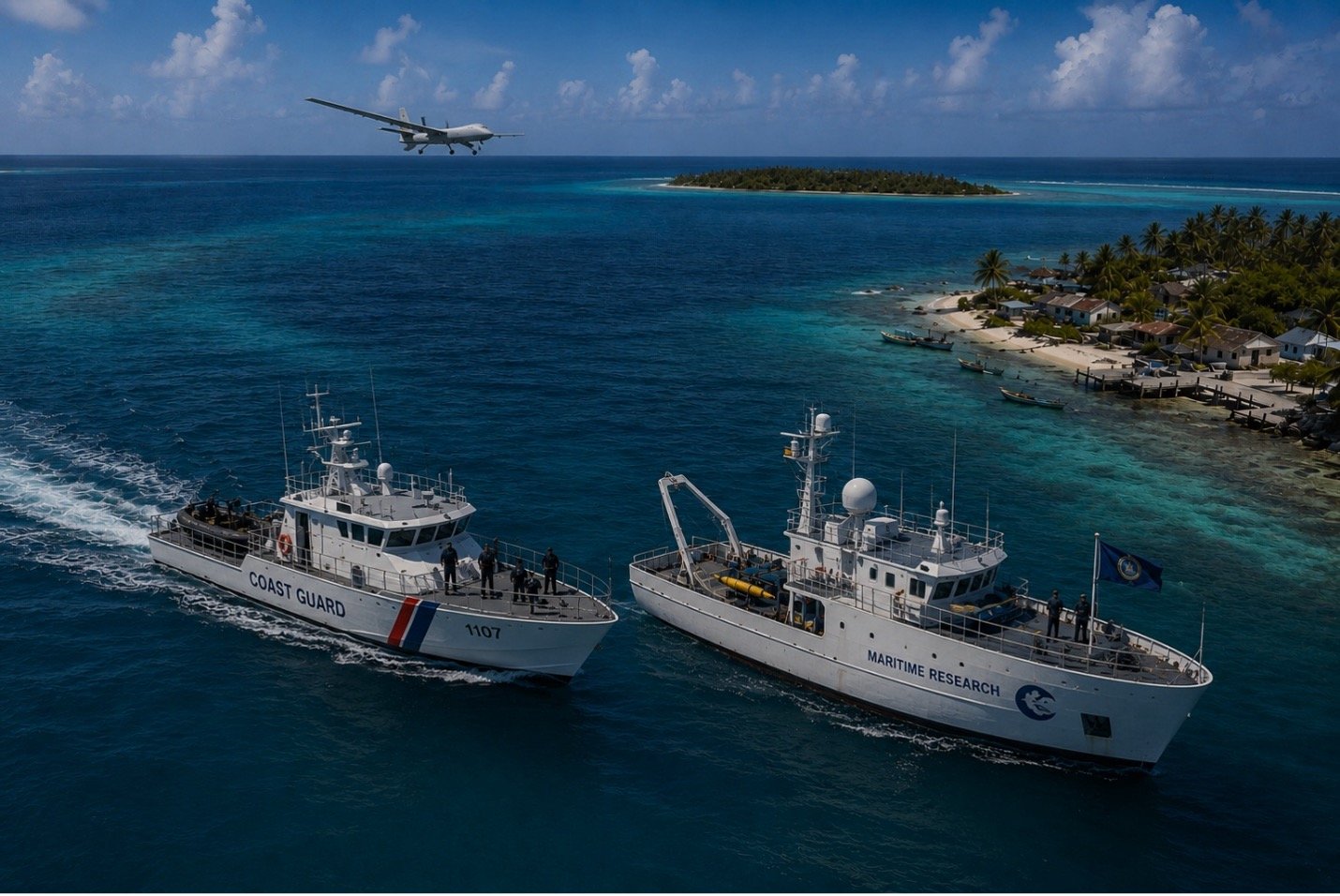
The Philippines case is particularly instructive. Despite facing sustained harassment from maritime militia and coast guard vessels in contested waters, the Philippine government deliberately employs its coast guard rather than its navy to avoid military escalation. This is not a capability limitation. It is a strategic choice. Law enforcement-led responses preserve legitimacy, maintain legal authority, and enable persistence without triggering escalation dynamics that would favor a larger adversary.
The key insight: Legitimacy, legal authority, and persistence matter more than kinetic capability in gray zone competition. This challenges U.S. security cooperation’s emphasis on Foreign Military Sales and platform transfers. It suggests that institutional capacity building – such as training prosecutors, developing legal frameworks, and establishing interagency coordination mechanisms – may yield better return on investment than combat systems.
Finding 2: The Real Battlefield is Littoral, Not Blue Water
Gray zone literature exhibits a persistent maritime-centric bias, focusing on distant exclusive economic zones. This framing misses where small states actually face pressure. Evidence from all three cases demonstrates that littoral waters and adjacent land domains are the primary competitive spaces for archipelagic nations. Gray zone activity concentrates in ports, fishing harbors, resort approaches, and coastal communities, not in distant offshore areas.
Consider what this looks like operationally. In the Philippines, harassment of fishing vessels occurs within sight of coastal communities. Maritime militia vessels position themselves near harbor approaches, creating intimidation effects that directly impact civilian livelihoods. Survey vessels conduct operations near critical port infrastructure, exploiting the ambiguity between legitimate scientific research and intelligence collection.
The Philippine response centers on fisherfolk protection. The Bureau of Fisheries and Aquatic Resources (BFAR), a civilian agency, operates support programs providing fuel, supplies, and market access to fishing communities. Coast Guard vessels conduct escort missions, positioning themselves between fishing boats and harassing vessels. This maintains civilian economic activity while demonstrating government commitment without military escalation.
Mauritius employs “one-stop-shop” port inspections at Port Louis, where fisheries officers, customs officials, and coast guard personnel are physically co-located. A suspect vessel triggers coordinated inspection: Fisheries officers check catch documentation, customs officials examine cargo manifests, coast guard personnel conduct safety inspections, and immigration officials verify crew documentation.
Why do adversaries prefer littoral operations? Civilian vessels provide cover and complicate attribution. Economic disruption is immediate and visible. Legal ambiguity is greatest in near-shore waters where multiple jurisdictions overlap. Population centers witness government action or inaction directly, affecting domestic legitimacy.
The doctrinal implication: Maritime security for small archipelagic states is fundamentally a civil-military integration problem. Customs, immigration, fisheries authorities, and port officials are as critical as coast guard forces. For U.S. security cooperation, this suggests that partner capacity building must extend beyond defense ministries to include civilian maritime agencies.
Finding 3: Evidence Collection as Combat Function
Military organizations treat documentation as a bureaucratic requirement. This administrative mindset fundamentally misunderstands gray zone competition, which is as much about information and narrative as about physical presence.
All three cases treat evidence collection as an operational priority. The Philippines has institutionalized transparency through systematic incident documentation. The Foreign Service Institute maintains detailed records of gray zone encounters, including Automatic Identification System (AIS) tracks, photographs, timelines, and witness statements.
The effect is significant. Attribution reduces adversary deniability and shapes international opinion. When the Philippine government releases photographic evidence of water cannon attacks on resupply missions, it creates political costs for the aggressor while demonstrating restraint and legitimacy.
Seychelles employs rigorous chain-of-custody procedures that support the prosecution of maritime violations. Mauritius uses Vessel Monitoring System (VMS) data as an evidence base for fisheries enforcement, creating a documented record that supports both operational decisions and legal proceedings.
Small states lack the satellite coverage and advanced sensors available to major powers. They compensate through disciplined documentation: standardized incident reporting, photographic and video evidence, AIS data collection, and witness statements. This approach to information advantage does not require Intelligence, Surveillance, and Reconnaissance (ISR) dominance. It requires procedural discipline and institutional commitment to evidence as an operational function.
Finding 4: Transparency as Deterrence
Military institutions reflexively default to operational security. In gray zone competition, however, secrecy can be self-defeating.
The Philippines has developed a deliberate transparency strategy that inverts conventional OPSEC logic. The government publicly discloses gray zone incidents with supporting evidence. Presidential Communications Office releases include photographs, videos, AIS tracks, and detailed narratives. The National Task Force for the West Philippine Sea coordinates timing and messaging across agencies.
The strategic effect is deterrence through exposure. Public disclosure increases political costs for adversaries by generating international attention and constraining coercive behavior. When water cannon attacks on civilian resupply missions are documented and released globally, the aggressor faces diplomatic consequences and reputational damage. Domestic legitimacy is strengthened. Filipino citizens see their government actively defending national interests.
The contrast with quiet diplomacy is instructive. When incidents remain classified or are handled through private diplomatic channels, adversaries control the narrative and can deny or minimize their actions. Without public evidence, international attention dissipates, and domestic populations may perceive government inaction.
This is not indiscriminate disclosure. The Philippines employs controlled release coordinated across agencies. Disclosures are evidence-based, not propaganda-based. They include verifiable AIS data, photographs, and witness statements. Timing aligns with diplomatic protests and legal actions. The key distinction is that transparency serves legitimacy and attribution, not provocation.
For U.S. security cooperation partners, this finding has immediate implications. Security cooperation should include strategic communication capacity building, treating public affairs as a core capability. Partners need training in evidence-based transparency: how to document incidents to evidentiary standards, verify information before release, coordinate disclosure across agencies, and time releases for maximum diplomatic effect.
Finding 5: Persistence Over Resolution
Military culture is oriented toward decisive outcomes. This decisive battle mindset does not fit gray zone competition, which does not end. It persists.
None of the successful cases achieved a decisive victory. Seychelles continues to face IUU fishing, though at reduced levels. Mauritius port controls manage but do not eliminate pressure. The Philippines experiences ongoing harassment yet maintains civilian access and economic activity. Success is measured not by elimination of threats but by sustained access to contested areas, controlled escalation that avoids armed conflict, maintained civilian economic activity, preserved legitimacy, and endurance over time within resource constraints.
This requires a different operational design for competition below armed conflict. Appropriate metrics include presence days, incident response times, legal outcomes, and civilian activity levels – not enemy forces destroyed or territory seized. The question is not “How much force can we generate?” but “How long can we maintain presence?”
Resource implications follow directly. Persistence requires efficiency, not mass. Repeatable procedures matter more than episodic operations. Partner augmentation extends endurance without requiring force expansion.
Finding 6: Partner Support Without Dependency
External partners often provide operational capabilities directly to small states. While well-intentioned, this approach creates risk: Partner presence can substitute for national capacity, creating dependency that undermines sovereignty.
All three cases demonstrate selective enablement models where partners provide capacity building, not operational substitution. Seychelles participates in the Regional Maritime Information Fusion Center (RMIFC), which provides cueing and situational awareness but does not conduct enforcement operations, and has been integral in Operation MARLIN, a joint operation with EUNAVFOR designed to strengthen regional maritime security. Mauritius receives training and information sharing from India but maintains national control of enforcement. The Philippines accepts U.S. support for institutional development while ensuring that Philippine forces conduct all operations in Philippine waters.
The key principle is this: National forces conduct enforcement while partners provide awareness, training, and institutional support. This preserves legitimacy. Enforcement authority remains visibly national. For U.S. security cooperation, this finding suggests a shift from Foreign Military Sales toward institutional capacity building. Assessment, Monitoring, and Evaluation (AM&E) should measure whether partners can act independently, not just whether they possess certain capabilities.
A Different Perspective of Gray Zone Competition
Conventional theory treats gray zone competition as proto-warfare; competition that may escalate to armed conflict and should be managed through escalation dominance. The small-state cases reveal a different theory. Gray zone competition is fundamentally a governance challenge. Success comes through legitimacy, persistence, and legal authority rather than through escalation of dominance.
Three pillars emerge consistently across cases. First, the legal-institutional pillar: clear statutory authority, evidence-based enforcement, and judicial follow-through. Second, the civil-military integration pillar: whole-of-government coordination, civilian protection, and interagency unity. Third, the information-narrative pillar: transparency, attribution, controlled disclosure, and legitimacy maintenance.
Why does this approach work for small states? It plays to governance strengths rather than military weaknesses. It is sustainable within resource constraints. It preserves legitimacy and international support. It avoids escalation that would favor larger adversaries.
Implications for U.S. Security Cooperation
Current U.S. security cooperation emphasizes Foreign Military Sales and equipment transfers. The gap is significant: Partners receive capabilities they cannot sustain or that do not address their actual threats. Patrol boats sit pier-side for lack of maintenance capacity while gray zone pressure continues unabated.
Four shifts would better align security cooperation with partner needs. First, prioritize institutional capacity over platforms. This means legal framework development assistance, prosecutor and judge training, interagency coordination mechanisms, evidence handling procedures, and strategic communication capacity.
Second, emphasize law enforcement over combat training. Focus on boarding and inspection procedures, rules of engagement for law enforcement contexts, de-escalation techniques, documentation standards, and coordination with civilian authorities.
Third, build whole-of-government capacity by including civilian agencies in security cooperation programs. Provide fisheries management training, port authority development, customs and immigration coordination, and public affairs capabilities across agencies.
Fourth, implement rigorous Assessment, Monitoring, and Evaluation throughout program lifecycles. Measure effectiveness against gray zone threats: Can the partner detect and respond to IUU fishing? Can they document incidents to evidentiary standards? Can they coordinate across agencies? Can they sustain operations independently?
Success metrics for this approach differ fundamentally from traditional security cooperation. Instead of “patrol boats delivered,” measure legal outcomes achieved, civilian activity maintained, incident response times, interagency coordination effectiveness, and partner independence.
The resource implications remain encouraging. Institutional capacity building is often cheaper than platform acquisition and produces more durable results. The challenge is that this approach requires different skill sets in the security cooperation enterprise to include lawyers, governance experts, and strategic communicators, not just military operators and acquisition professionals.
Conclusion
Gray zone competition for small archipelagic states is fundamentally about governance, legitimacy, and persistence – not firepower. Six counterintuitive findings challenge conventional military wisdom: governance trumps firepower, the real battlefield is littoral, not blue water, evidence collection is a combat function, transparency deters through exposure, persistence matters more than resolution, and partner support must avoid dependency.
These findings matter because dozens of small island and coastal nations face similar challenges across the Indo-Pacific, Caribbean, Mediterranean, and West Africa. For U.S. strategy, more resilient small-state partners mean more stable regions and less demand for direct intervention. Investment in partner governance capacity may be the most cost-effective approach to competition.
For small-state defense planners, the message is empowering: Gray zone competition does not require capabilities you cannot afford. Focus on what you can sustain: governance, legitimacy, persistence.
In gray zone competition, the side that can sustain a legitimate presence over time wins, not the side with the most firepower. For small states, that is not a limitation – it is an opportunity.
