

In July 1982, Albert Wohlstetter and Dennis Gormley were studying how emerging precision weapons could exploit the time an adversary needed to mobilize and move from peacetime readiness to war. Their work responded to a wider strategic problem: Western access to forward bases was becoming less certain, threats of nuclear escalation were losing credibility against conventional aggression, and democracies needed ways to limit potential collateral damage. Rose Gottemoeller recently described a contemporary version of that dilemma, arguing that increasingly accurate conventional capabilities are making nuclear deterrence more uncertain while increasing the value of resilience and survivability. The problem is especially acute in the western Pacific, where long-range strike, politically contingent access, and the prospect of a rapid Chinese campaign compress the time available for allied decisions.
Deterrence today is a contest over time. The United States and its Pacific allies and partners need time to decide, move, repair, and coordinate. Beijing needs speed, ambiguity, and an opportunity to present the region with a fait accompli. Those opposing clocks point to five practical plays available to the United States and its allies and partners to deter Chinese aggression in the region now.
Play One: Make Access Real Before a Crisis
Access, basing, and overflight are too often imported into plans as assumptions. RAND’s recent work on fighting from allied territory is a useful corrective. In one scenario, even a friendly state withheld access because of domestic politics. Another RAND study delivers the larger point more bluntly: Some allied and partner decisions on access could determine the outcome of a conflict with China.
East Asia has lived with this problem for decades. Consultation arrangements signed with Japan in 1960 required Washington to consult with Tokyo before using US forces based in Japan for combat operations elsewhere in the region, such as in Korea. A 1969 memorandum from national security advisor Henry Kissinger to President Richard Nixon on Okinawa described the same dynamics in even plainer language—weighing the political costs of maintaining US administration of the island against the security costs of returning administration to Japan and the consequent reduced flexibility in the use of Okinawan bases. The 2023 expansion of Enhanced Defense Cooperation Agreement sites in the Philippines is important for the same reason. It makes access, dispersal, storage, and repair more real before the clock starts.
The policy implication is straightforward. The United States should continue to treat access as daily work. More logistics drills. More movement exercises. More repair and refuel rehearsals. More small deployments that normalize allied presence without looking like a dress rehearsal for a first strike. And if allies and partners see the machinery working in peacetime, they are less likely to hedge when pressure rises.
For the US Army, this is where theater-specific formations should earn their keep. Multidomain task forces were designed in part for the western Pacific antiaccess problem and are already rehearsing distributed command and control, sensing, and effects across the theater. The less glamorous aspect of the same effort belongs to the Army’s sustainment enterprise: Theater opening, movement control, prepositioning, repair, and distribution are what turn assumed access into real access before a crisis.
Wohlstetter saw the older version of the problem clearly. In a 1982 memo to Rear Admiral Leland Stanford Kollmorgen, then chief of naval research, preserved in the Hoover Institution Library and Archives, he described a “deteriorating Western military position” marked by “decreasing Western access to bases and air space in critical spots and increasing Soviet access.” The geography in question may have changed, but the fundamental problem has not.
Play Two: Accelerate US and Allied Readiness, and Make It Legible
The next play is readiness. Allied preparation must move faster while remaining sufficiently legible that defensive measures are less likely to be mistaken for imminent offensive action. In the western Pacific, reserve call-ups, munitions dispersal, fuel movements, and communications activation can all look ambiguous when viewed from the other side. Legibility does not require exposing operational detail. It requires making the defensive purpose of visible preparations difficult to misread.
Some of the answers here are procedural. Governments should decide now which actions can be preannounced, which can be privately notified, and which should be explained in the same way across regional capitals. Some drills should be described plainly as logistics drills. Some reserve and mobility measures should be accompanied by explanations of the conditions that would trigger them and the defensive purpose they serve. A little disciplined clarity buys time. Thomas Mahnken’s work on selective disclosure offers a companion principle: reveal enough about new concepts and capabilities to reassure allies and complicate People’s Liberation Army (PLA) planning, while protecting the details that preserve advantage.
The US and its regional allies and partners are already moving in this direction. Australia’s 2024 National Defence Strategy makes a strategy of denial the cornerstone of defense planning. Taiwan’s 2025 Quadrennial Defense Review warns that the PLA can shift from blockade to invasion quickly and says Taiwan’s armed forces will rely on immediate readiness training, rapid mobilization, defense in depth, and sustainable resilience. As an example, during a June 2026 readiness exercise in Taipei, I watched troops rehearse urban deployments in Daan Forest Park through a morning of heavy rain and strong winds. Japan’s National Defense Strategy uses different terminology, but the meaning rhymes: By fiscal year 2027, it aims to reinforce transport, resolve ammunition shortages, harden key facilities, and improve the resilience of command networks.
Valiant Shield 2026 offered another glimpse of this pattern, integrating allied forces across Japan, Guam, the Northern Mariana Islands, and multiple domains of warfare in activities including detection and tracking, resupply, cross-decking, expeditionary reload, and live fire.
Gormley, another Reagan-era defense intellectual who worked closely with Wohlstetter, succinctly identified the underlying problem in July 1982. In a dictation memo preserved in the same Hoover archive mentioned earlier, he wrote that existing US capabilities did little to exploit “the time dynamics of various target sets, or the time required to bring a military force from its peacetime readiness condition to a full wartime readiness posture.” He had Soviet mobilization in mind. A similar time problem applies to allied mobilization today. The allied force that can move first, explain enough, and avoid a panic spiral starts from a stronger position.
Play Three: Protect the Allied Decision Cycle
In the event of a conflict, China would try to attack the allied decision cycle early. That effort has already begun in peacetime. Taiwan’s 2025 defense review describes gray-zone harassment, cyberattacks, and cognitive warfare meant to test and exhaust readiness, erode morale, reduce warning time, and speed the opening tempo of any fight.
The third play is to protect the allied force’s ability to decide. That process begins with resilient command and control, but it does not end there. It also means establishing backup communications paths, commercial redundancy, degraded-mode operations, and consultation habits that keep allies in touch when the information picture fragments. The 2018 Joint Concept for Operating in the Information Environment frames the task as protecting the “decisions” and “behaviors” of the joint force, its allies, and its partners.
This work is less glamorous than missile ranges or order-of-battle charts, but it is more important than most observers acknowledge. An allied force built around exquisite awareness and perfect connectivity can become brittle very quickly. An allied force that has practiced amid uncertainty, however, can keep functioning after the first hit.
Wohlstetter’s phrase from 1982 still hits home. In the same July 1982 Hoover file, he wrote about “time urgency and the weapons release problem.” His list of central factors was spare and familiar: fixed targets, dwell times, time to make the decision, time to effect the decision. Remove the Cold War framing, and the logic holds. Every step in the chain depends on sensing, making sense, deciding, and communicating before the window of opportunity closes.
Play Four: Make the First Week Slow and Expensive for China
China benefits from speed. A fast blockade. A quick seizure. A political shock before allied logistics and command arrangements catch up. The allied force should plan to wreck that timeline. Analysis published in 2019 by the Center for Strategic and Budgetary Assessments (CSBA) put it plainly: US and allied forces will not have weeks or months to mass near the theater. They will have to inflict losses from the outset. The Defense Department’s 2025 China report is a reminder of why. PLA conventional strike capabilities already place Taiwan, Japan’s southwestern islands, and many US and allied operating locations across the first island chain at risk. CSBA’s study adds another uncomfortable observation: Concentrated hubs such as Kadena Air Base and Yokosuka Naval Base are highly vulnerable to massed missile attacks.
This is where the grubby work of logistics and readiness pays dividends. That means having stockpiles in the right places. Runway and port repair capabilities. Forward sustainment. Spare parts on hand. Fuel. Redundant intelligence collection, processing, and dissemination paths. Mines. Uncrewed underwater systems. It all counts. The goal is delay and disruption. Taiwan’s own defense review makes the same assertion using more operational language: defense in depth, rapid mobilization, and resilience designed to slow, break, and deny a swift-victory strategy. A 2018 Taiwan-focused study makes the deterrence logic even plainer: raise the costs of invasion and reduce the prospect of a quick victory for the PLA.
This is friction by design. Enough of it, applied in the right places, can change Beijing’s political calculations before a campaign begins.
Play Five: Fortify Off-Ramps Before Crisis Channels Can Fail
The objection to this play is fair: Beijing has repeatedly used military dialogue for political signaling when bilateral relations sour. After the August 2022 visit to Taiwan by the speaker of the US House of Representatives, China canceled planned talks between senior military leaders, defense policy discussions, and Military Maritime Consultative Agreement (MMCA) meetings. The MMCA working group remained on ice until April 2024. Beijing’s willingness to suspend these channels does not make prioritizing off-ramps naïve; it makes building them before a crisis more urgent. Because formal channels can go dark in response to events, backup procedures must be in place before a crisis begins.
Hotlines can be useful when they work. The harder work is procedural: establishing agreed responses to unsafe air and maritime encounters, standardized incident reporting, and meeting regularly to review dangerous behavior. Allied decision rules must also keep escalation-sensitive actions under political control. CUES, the 2014 Code for Unplanned Encounters at Sea, offers one modest model: a nonbinding protocol adopted by twenty-one Pacific navies for unplanned naval encounters. Its reach is limited, however, for it excludes coast guard and maritime militia vessels and their activities. The US–China MMCA offers another model. Its working-level meetings review unsafe naval and air encounters and reinforce professional conduct; the latest round met in Hawaii in late May 2026.
RAND’s work on Taiwan escalation identifies target selection as the most powerful factor to manage escalation under US control. Off-ramps therefore also require allied rules governing which targets are struck or held at risk, who authorizes escalation-sensitive moves, and how consultation continues amid disruption. This risk-control architecture has two layers. Bilateral procedures reduce misperception and unsafe encounters, while allied rules govern targeting and authorities even when Beijing lets bilateral channels go dark.
East Asia has seen the cost of late improvisation. The first Taiwan Strait crisis of 1954–55 helped produce the US–Republic of China Mutual Defense Treaty, signed in December 1954 and effective as of March 1955, and the January 1955 Formosa Resolution. The resolution authorized President Dwight Eisenhower to use US forces to defend Taiwan, Penghu, and, as he judged necessary, related positions. The treaty covered Taiwan and Penghu but did not automatically protect Quemoy/Kinmen and Matsu. When China shelled those offshore islands again in 1958, Washington faced ambiguous commitments, inadequate conventional preparations, and a real risk of nuclear escalation. China would not test its first nuclear device until 1964, but Washington considered nuclear options, and the Sino-Soviet alliance meant that any US atomic attack risked Soviet involvement. Soviet Premier Nikita Khrushchev warned Eisenhower—in messages published at the time—that an attack on China could bring Soviet nuclear retaliation. US intelligence nevertheless assessed that Moscow sought to keep the conflict limited to avoid direct military participation unless the war expanded. Meanwhile, US commanders worried about sortie rates, questioned whether conventional defenses would hold, and found forward bases short of needed supplies. The lesson is plain: Military leaders should not have to improvise escalation control under fire.
This play rests on procedures that assume confusion, partial information, and fear in the opening stages of a conflict. The allied force must build mechanisms now that remain useful when normal channels go dark, and decision rules that still function when nobody is manning the other end of the hotline. Some of this amounts to plain, old-fashioned staff work. That basic blocking and tackling can keep decision-makers working with partial information from making irreversible decisions under terrible pressure.
None of these plays will settle the problem on its own. The strategic challenge in the western Pacific is cumulative, and the response must be as well.
Wohlstetter’s 1982 treatment of the dilemma formed one part of a broader effort already underway. Years of research and development, investment, experimentation, acquisition, and organizational work turned stealth, precision strike, improved battlespace sensing, and related Second Offset technologies and innovations into operational advantage. However, the new technology became decisive only after institutions learned how to use it effectively.
The United States and its allies may eventually assemble comparable advantages in today’s strategic competition with China. They should still act now. The work outlined here cannot wait: make access real, accelerate allied readiness, protect decisions, build friction into China’s first week, and fortify off-ramps before crisis channels fail. Together, these steps buy allies time, deny Beijing time, and preserve room for diplomacy. The task now is to design initiative before the crisis begins.
Dr. Gary J. Sampson is a 2026 research fellow with the Modern War Institute at West Point and a retired US Marine Corps lieutenant colonel who served as an intelligence and international affairs officer specializing in China and East Asia. He earned a PhD in international relations from The Fletcher School at Tufts University. He leads When the Day Is Ours, a research project examining how the United States and its allies can recover strategic initiative. He also cohosts Marine Pulse, a War on the Rocks podcast.
The views expressed are those of the author(s) and do not reflect the official position of the United States Military Academy, Department of the Army, or Department of Defense.
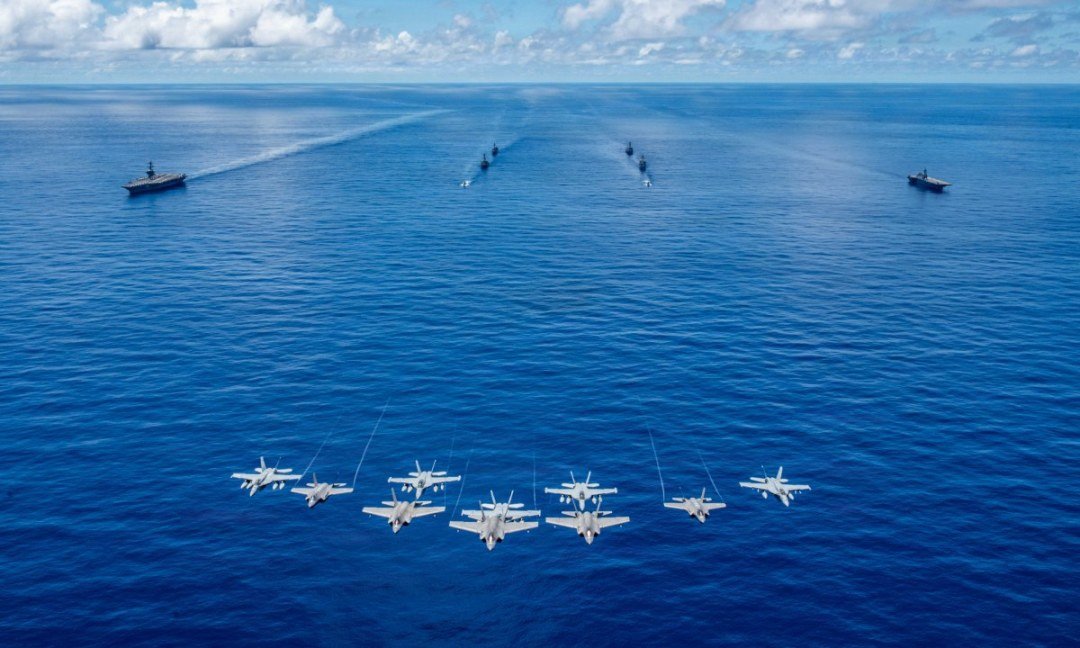
Image: US Navy and US Air Force aircraft fly over the George Washington Carrier Strike Group as it sails in formation with Japan Maritime Self-Defense Force ships (credit: Mass Communication Specialist 2nd Class Tyler Crowley, US Navy)
