

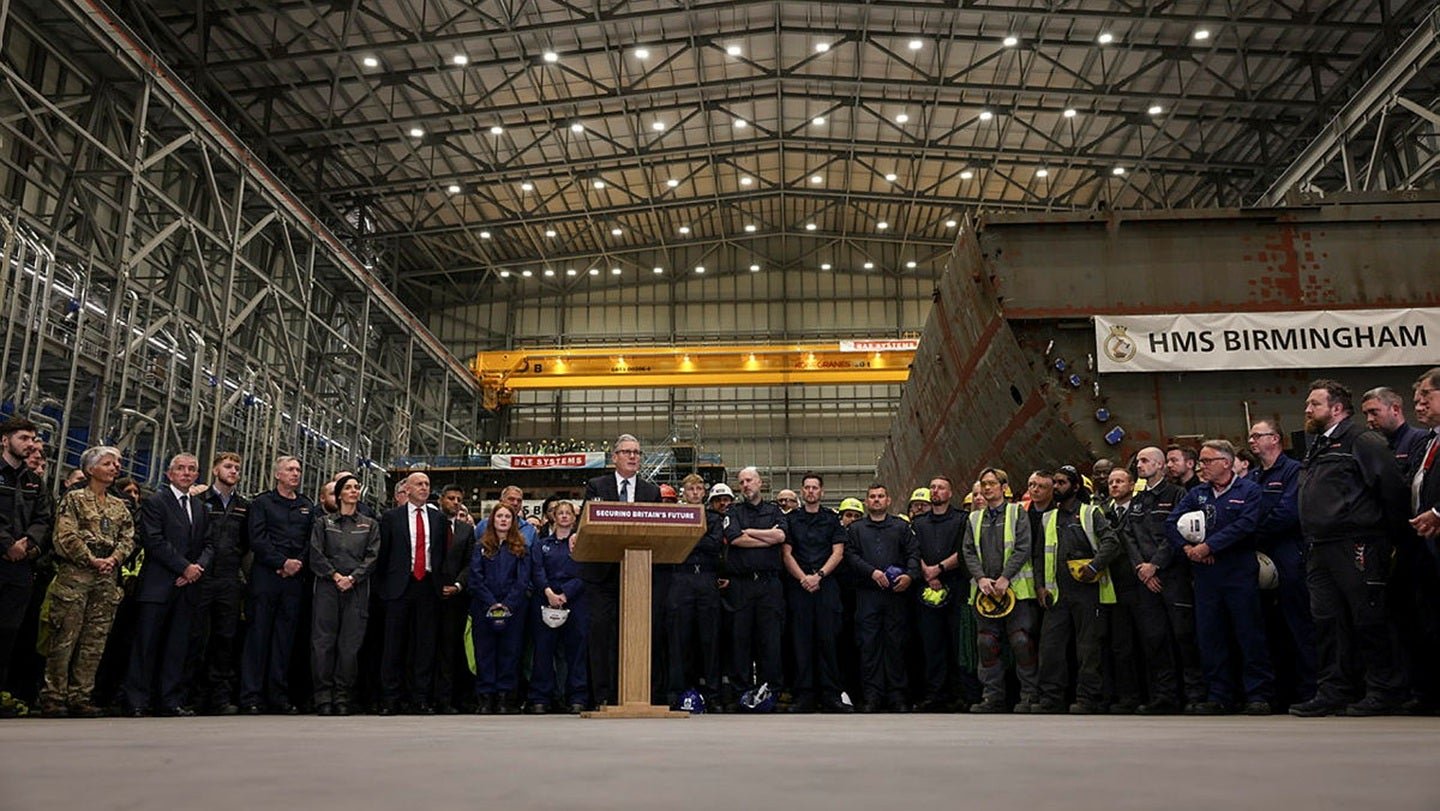
- Starmer said Labour is boosting naval defence, with £300m more for shipbuilding and “13 ships on order,” contrasting this with Conservative cuts.
- The 13 ships are Type 26 and Type 31 frigates, but they were ordered under the previous Conservative government; most builds started under the Conservatives versus Labour so far
- Fact check adds context: Type 23 frigates fell from 13 (2010) to 9 (2024), while destroyer numbers were broadly during that time period flat as Type 45s replaced Type 42s
UK Prime Minister Keir Starmer’s asserted the current Labour Government stands apart from its Conservative predecessor in terms of naval defence spending due to having “13 ships on order”, despite the vessels having been ordered during the previous administration.
Addressing parliament on his return from a diplomatic visit to the Middle East on 13 April, Starmer provided an update to the global security situation, and confirming reports the UK and France would co-chair a conference to determine a European-led approach to the Iran crisis.
However, responding to questions from Kemi Badenoch, Leader of the Opposition, Starmer sought to delineate the difference of approach of his administration compared to the 14-year period of Conservative and Coalition governments, which ended in July 2024.
“On the Conservatives’ watch, frigates and destroyers were reduced by 25%. Minehunting ships were reduced by 50% on their watch. Yet she lectures us about being ready, having hollowed out our armed forces and hollowed out our capabilities,” Starmer said.
“We are investing £300 million more in shipbuilding, and we have 13 ships on order. That is the difference between the two parties.”
The 13 ships refer to the ongoing build programme for the Type 26 and Type 31 frigates, which will replace the Type 23 fleet, of which just a handful of vessels remain in service.
Fact Check (frigates): The first three Type 26 frigates were ordered in July 2017 in a £3.7bn ($5bn) contract with BAE Systems. The second batch of five frigates, a reduced order from a planned total of 13 vessels, was made in November 2022 in a £4.2bn deal.
Type 26 Construction Start Dates (First Steel Cut):
- HMS Glasgow: July 2017 (Conservative Government)
- HMS Cardiff: August 2019 (Conservative Government)
- HMS Belfast: June 2021 (Conservative Government)
- HMS Birmingham: April 2023 (Conservative Government)
- HMS Sheffield: November 2024 (Labour Government)
The final three frigates, HMS Newcastle, Edinburgh, and London, are likely to begin construction during the current Labour Government, giving a final 4/4 split (from the current 4/1 ratio) between the current and previous administrations. However, it is highly likely that some of these production slots will switch to filling Norway’s Type 26 order.
Fact Check (frigates): The contract for five Type 31 frigates was formally awarded to Babcock in November 2019, in a £1.25bn deal that would subsequently undergo dispute resolution.
Type 31 Construction Start Dates (First Steel Cut):
- HMS Venturer: September 2021 (Conservative Government)
- HMS Active: January 2023 (Conservative Government)
- HMS Formidable: October 2024 (Labour Government)
- HMS Bulldog: February 2026. (Labour Government)
- HMS Campbeltown: Scheduled for production, likely late-2026/early-2027
The split of warships that began production in Conservative and Labour governments is 2/2, although this will swing in the latter’s ‘favour’ when construction begins on HMS Campbeltown.
Thus, extrapolating the number of frigates that began construction during the previous Conservative administrations, with those of the Labour Government, reveals that six frigates began construction under the Tories, and three for the current government.
This will swing to 6/7 when the Type 26 Batch 3 begin their build phase, although it is currently unknown which of the Type 26 frigates will switch hands to Norway.
Fact Check (frigates): When the Conservative-Liberal Democrat coalition government came to power in 2010, there were 13 Type 23 frigates in service. By the time the Conservatives left power in July 2024, this number had reduced to just nine vessels, a 30% reduction.
Of the nine Type 23 warships in service in July 2024, two have since been decommissioned, most recently, HMS Lancaster in December 2025, representing a ~22% reduction. However, another, HMS Richmond, is expected to be retired this year, bringing the percentage of the Type 23 force retired under Keir Starmer’s premiership to 33% of the fleet.
Fact Check (destroyers): Regarding destroyers, when the Conservative-Liberal Democrat coalition government came to power in 2010, the Royal Navy was between withdrawing the old Type 42 class and inducting the newer Type 45 platforms into service.
Examining service exit and entry dates for the Type 42 and Type 45, and it becomes apparent that Labour and Conservative oversaw the decommissioning of five and seven Type 42 destroyers respectively. The list does not include vessels lost during the 1982 Falklands War.
- HMS Edinburgh: June 2013 (Conservative Government)
- HMS York: September 2012 (Conservative Government)
- HMS Liverpool: March 2012 (Conservative Government)
- HMS Gloucester: June 2011 (Conservative Government)
- HMS Manchester: February 2011 (Conservative Government)
- HMS Nottingham: February 2010 (Labour Government)
- HMS Exeter: May 2009 (Labour Government)
- HMS Southampton: February 2009 (Labour Government)
- HMS Cardiff: July 2005 (Labour Government)
- HMS Glasgow: February 2005 (Labour Government)
- HMS Newcastle: February 2005 (Labour Government)
- HMS Birmingham: December 1999 (Labour Government)
Of the incoming Type 45 destroyers, one was commissioned during a Labour Government (HMS Daring in 2009), while five entered service during the Conservative-Liberal Democrat coalition (HMS Dauntless in 2010, HMS Diamond in 2011, HMS Dragon in 2012, HMS Defender in 2013 and HMS Duncan in 2013).
Taking these fleet numbers in reference to the 25% reduction in frigates and destroyers during Coalition/Conservative rule, destroyer numbers stated static (five in, five out), while under Labour’s previous administrations of Prime Ministers Blair and Brown, destroyer numbers reduced (seven out, one in).
Fact Check (minehunters): The Royal Navy’s lack of minehunters, also known as mine countermeasure vessels (MCMV), has gained significant currency as the US begins its own mine sweeping operations in the Strait of Hormuz, just months after the UK sent the last of its Middle East-based MCMVs back to the UK for eventual decommissioning.
The claim made by the Labour Prime Minister that the Conservatives oversaw a 50% reduction in the MCMV fleet is broadly accurate from around 15 vessels in 2010 down to seven at the time of the handover in July 2024.
However, the current Labour Government has continued the Conservatives in pursuing the development of an uncrewed minehunting capability under the MHC programme, which is not expected to deliver a usable capability until 2028 and is dependent on funding from the long-delayed Defence Investment Plan.
Verdict: On balance of the abovementioned data, both Labour and Conservative/Conservative-Liberal coalition are responsible for the position the Royal Navy now finds itself.

