

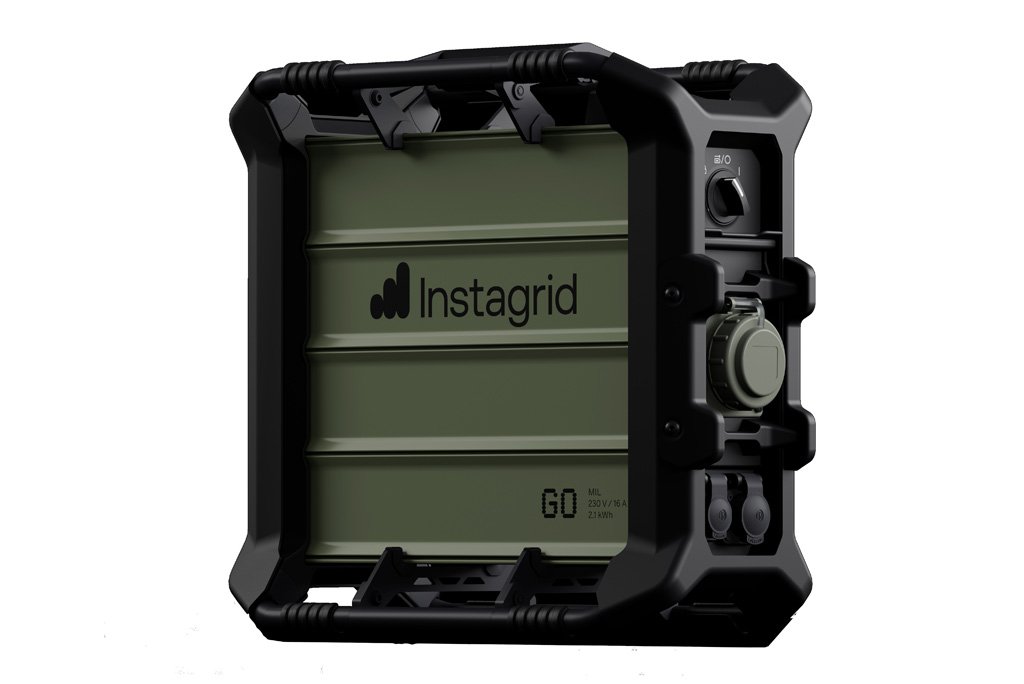
At Eurosatory 2026, the crowded exhibition halls once again showcased the latest in firepower, sensors and autonomous systems. Yet, one of the most consequential trends on display was less visible: the growing centrality of energy as a tactical and strategic determinant in modern warfare. Instagrid’s GO MIL, a portable power system presented by the German company last week in Paris, sits squarely within this shift
The war in Ukraine and other recent high-intensity conflicts have underscored a profound transformation of the battlespace. Often described as “transparent”, today’s operational environment is saturated with surveillance capabilities. Commercial satellites, loitering drones, signals intelligence and thermal imaging have compressed detection-to-strike timelines to minutes. In such conditions, survival increasingly depends not only on mobility, but on the ability to operate without being seen, heard or even thermally detected.
This evolution is obliging armed forces to rethink one of the most basic enablers of military activity: energy. Modern units rely heavily on electricity to sustain communications, electronic warfare, ISR assets and medical support systems. However, the legacy solution — diesel generators — is becoming a liability. Their acoustic and thermal signatures, combined with their logistical footprint, make them both detectable and vulnerable. Fuel supply chains, in particular, have emerged as critical weak points, frequently targeted and costly to protect.
It is against this backdrop that Instagrid’s GO MIL should be understood. More than a technical upgrade, it represents a response to a structural operational problem. With a mass of 21 kg and deployable by a single operator, the system belongs to a new category of Tactical Power Nodes designed for distributed and mobile forces.
Its defining feature is not simply portability, but discretion. With a fanless design and low thermal output, GO MIL significantly reduces the signatures that adversaries increasingly exploit. This enables units to maintain electronic activity – from satellite communications to drone operations – while minimising exposure in contested environments.
The implications extend beyond tactical convenience. As European armed forces accelerate their adaptation to high-intensity scenarios, energy autonomy is emerging as a component of strategic resilience. Systems such as GO MIL, which can integrate into hybrid energy architectures and reduce dependence on fuel logistics, align with broader efforts to enhance operational endurance while mitigating vulnerabilities.

The system’s early adoption provides further insight into this trend. Already assigned a NATO Stock Number and reportedly in use within the Bundeswehr, GO MIL reflects a growing institutional recognition that energy solutions must evolve alongside sensors and weapons. Its production within Europe also resonates with ongoing efforts to strengthen industrial sovereignty in defence supply chains, an issue brought into sharp focus since 2022.
GO MIL’s presence at Eurosatory therefore signals more than the launch of a new product. It illustrates a deeper recalibration in military thinking, where the management of energy-its generation, distribution and concealment – is becoming inseparable from combat effectiveness.
In future conflicts, the decisive advantage may not lie solely in who can strike harder, but in who can remain operational, undetected and self-sufficient for longer. In that equation, energy is no longer a background function. It is fast becoming a frontline capability.
The Go MIL comes in a small form factor, 444 x 210 x 420 mm, and is IP 65 protected against dust and water. It hosts 24 battery packs each one capable to store 86.4 Wh of energy, for a total of 2,074 Wh. At 100% capacity it provides 3,600 W output power at 230 V AC at 16 A. However it can be used in overload from 150% (5,400 W) for up to 500 seconds to 300% (10,800 W) for 7 seconds, peak power being 18,000 W. It can operate between -32°C and +60°C and up to 4,000 metres altitude. Charging tension is 100 – 240 V AC at 50-60 Hz, with a rated input power of 600 – 1,440 W. At room temperature using 240 V tension the GO MIL reaches 80% capacity in 1.5 hours and 100% in 2 hours. Being a fanless system, its noise signature is below 30 dB(A) which is defined as whisper-quiet.
Photos courtesy Instagrid
