

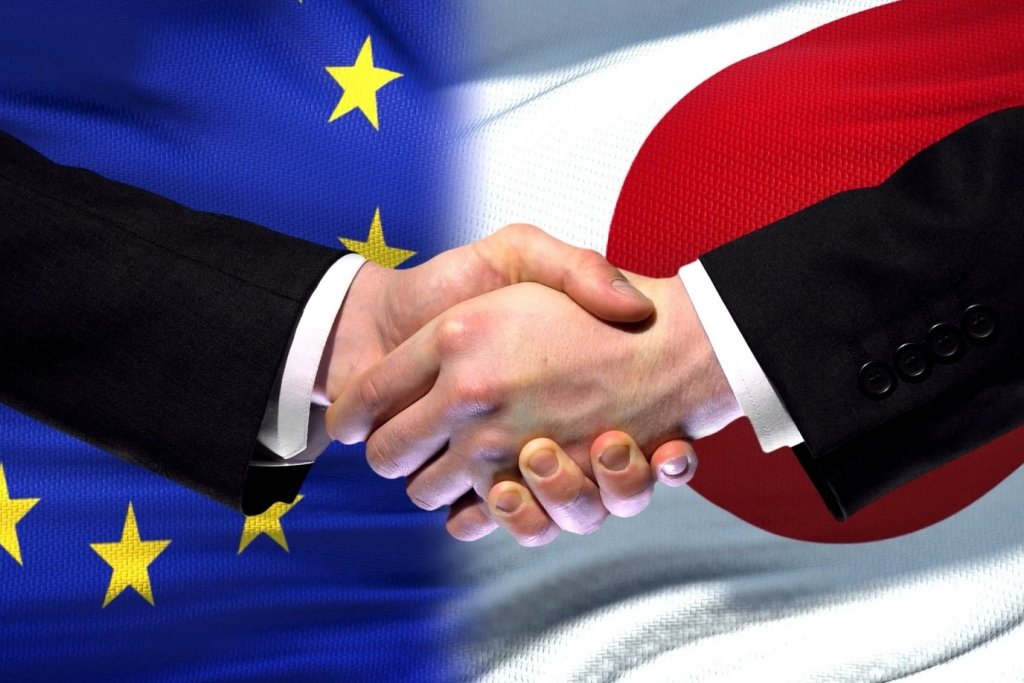
Prime Minister Sanae Takaichi’s landslide victory in Japan’s February 2026 snap election marks a decisive turning point in Tokyo’s defence and security policy and, by extension, in EU-Japan cooperation. With a two-thirds majority in the House of Representatives, her government now has the authority to accelerate defence spending, liberalize export controls, and consolidate Japan’s strategic posture. For Europe, this signals the emergence of a more assertive and operational security partner in the Indo-Pacific. This moment marks a shift from symbolic alignment to potential operational integration between the EU and Japan, but only if Europe can match Japan’s pace.
Prime Minister Takaichi has committed to accelerating Japan’s defence spending target to 2 percent of GDP by fiscal 2025, two years ahead of the original timeline, while revising core security documents by end of 2026. The objective is clear: move from incremental reform to structural transformation. This includes strengthening long-range strike capabilities, expanding missile defence, and reinforcing command, cyber, and maritime capacities. China is explicitly identified as Japan’s greatest strategic challenge, while Russia’s invasion of Ukraine has reinforced Tokyo’s conclusion that deterrence cannot remain theoretical.
The expected liberalization in 2026 would move from a highly restrictive, case-by-case model to a more permissive regime that allows exports of a broader range of lethal equipment to allied and like-minded partners under stricter governance and end-use monitoring. This reform is primarily strategic rather than commercial. It aims to deepen co-development and co-production with trusted partners, strengthen the resilience of Japan’s defence industrial base, and embed Japan more firmly within democratic security networks
Japan’s evolving export posture builds on a long record of missile defence cooperation with the United States. Mitsubishi Heavy Industries already co-develops and produces key components for the SM-3 Block IIA interceptor alongside US firms. Tokyo and Washington have agreed to scale up annual SM-3 production to around 100 missiles to replenish depleted stocks and reinforce allied ballistic missile defence. This expanding co-production ecosystem shows that Japan’s defence industrial growth is embedded in alliance supply chains and that future EU-Japan projects would complement rather than replace existing transpacific structures. As such, any EU-Japan cooperation will not start from zero but will have to integrate into an already mature and US-anchored industrial ecosystem.
For the EU, this transforms Japan from a primarily normative partner into a defence industrial actor capable of contributing to European capability development. The EU-Japan Security and Defence Partnership signed in November 2024 established the framework for cooperation across maritime security, cyber defence, hybrid threats, space, crisis management, and defence industry exchange. The political conditions now exist to make this framework operational.
Japan has shown interest in engaging with European defence industrial initiatives, including co-development in unmanned systems, missile defence, and maritime surveillance. Europe’s strategic focus should be on areas where capabilities are complementary rather than competing with Japan in overlapping markets like fighter aircraft. This would enable Japanese firms to participate in European projects while giving European industry access to advanced Japanese technologies, particularly in missile systems and high-end electronics. The planned Agreement on the Security of Information will be essential to unlock this deeper level of collaboration by enabling classified intelligence sharing. Accelerating this agreement should be Europe’s immediate priority. Without it, cooperation remains theoretical. However, the constraint is not political will, but institutional design. The EU lacks mechanisms that allow non-EU partners such as Japan to integrate into its defence industrial programmes at scale. The EU does not need to redesign its entire defence architecture but rather fast-track mechanisms that allow trusted non-EU partners to participate in specific projects without requiring full institutional integration.

The broader strategic convergence between Europe and Japan reinforces this shift. Russia’s invasion of Ukraine reshaped threat perceptions on both sides. Tokyo concluded that forcible territorial revision poses an immediate risk, particularly given China’s military pressure around Taiwan and activity near the Senkaku Islands. Japan’s accelerated defence spending, expanded strike capabilities, and deterrence posture align with Europe’s reassessment of industrial resilience and hard power. For the first time in decades, European and Japanese security strategies are converging in ways that enable operational cooperation.
Prime Minister Takaichi’s March summit with President Trump reinforced this alignment. She committed Japan to Trump’s Golden Dome initiative, a next-generation, multilayered missile defence system designed to counter hypersonic and advanced threats. As part of this, Tokyo committed to expand co-development and production of interceptors and space-based infrastructure, shifting Japan from passive beneficiary to front-line contributor in allied missile defence. At the same time, she reiterated that Japan’s contributions must remain within the constraints of its postwar legal framework, highlighting how constitutional limits continue to shape the operationalization of Tokyo’s more assertive posture.
Industrial cooperation is also advancing through the Global Combat Air Programme, which brings together the United Kingdom, Japan, and Italy to develop a sixth-generation fighter aircraft for deployment by 2035. Japan and Italy formalized a special strategic partnership in early 2026, linking defence collaboration with economic security, critical minerals, and supply chain resilience. These initiatives reflect a shared recognition that strategic autonomy requires diversified and reliable partnerships.
For Europe, the implications are clear but uncomfortable. Japan’s consolidated political leadership provides stability and continuity, and its defence industrial expansion could complement European efforts to strengthen capabilities within alliance frameworks. Yet the EU’s ability to respond remains constrained by structural fragmentation. Defence industrial integration is divided across 27 member states, with duplicated programmes, no common procurement budget, and no streamlined mechanisms to integrate non-EU partners at scale. Budget coordination is hampered by competing national priorities, as France’s push for strategic autonomy often clashes with Germany’s preference for transatlantic solutions. The result is not inefficiency but institutional incapacity. The EU cannot currently engage Japan as a defence industrial partner at the speed and scale this moment requires.
Prime Minister Takaichi’s election victory represents more than a domestic political event, as it confirms Japan’s transition into a proactive security and industrial actor at a time of mounting geopolitical instability. This shift, however, will unfold within significant domestic constraints. Constitutional sensitivities around Article 9, divided public opinion on militarization, and budgetary pressures from an aging economy will shape the pace and scope of Japan’s defence expansion. For Europe, this means the window for deeper integration is open but not indefinite. The question is whether European institutions can adapt quickly enough to meet Japan’s offer of partnership.

The emerging EU-Japan partnership also carries risks. Industrial competition could intensify as Japanese firms such as Mitsubishi Heavy Industries and Kawasaki compete directly with Airbus, Leonardo, and Thales in third-country markets. Technology transfer concerns may limit cooperation, with Japan cautious over intellectual property and European partners wary of asymmetric dependencies. Deeper defence ties also risk being interpreted in Beijing as containment, potentially accelerating military escalation or hybrid pressure in the Indo-Pacific. The challenge is managing both economic friction and strategic escalation.
For the EU, this is a defining moment. Closer EU-Japan defence cooperation could become a structural pillar linking Europe and the Indo-Pacific, reinforcing deterrence, resilience, and the rules-based order. The central challenge is asymmetry, with Japan moving from strategy to procurement faster than Europe can overcome fragmentation. Europe must act on three fronts. First, establish fast-track mechanisms that allow trusted non-EU partners like Japan to participate in European defence industrial projects without requiring full institutional integration. Second, prioritize co-development in areas where European and Japanese capabilities are complementary, such as missile defence, unmanned systems, and maritime surveillance, rather than competing in overlapping markets. Third, accelerate the Agreement on the Security of Information to unlock classified collaboration before Japan’s political window narrows.
Without these steps, EU-Japan defence cooperation will remain politically ambitious and operationally hollow. The opportunity is real, but it is time limited. Europe’s choice is not whether to engage Japan, but whether it can move fast enough to make that engagement matter.
* Attilio Caligiani is Partner at FGS Global; Colin Thompson is Geopolitical Advisor at FGS Global
Graphics courtesy FGS Global
