

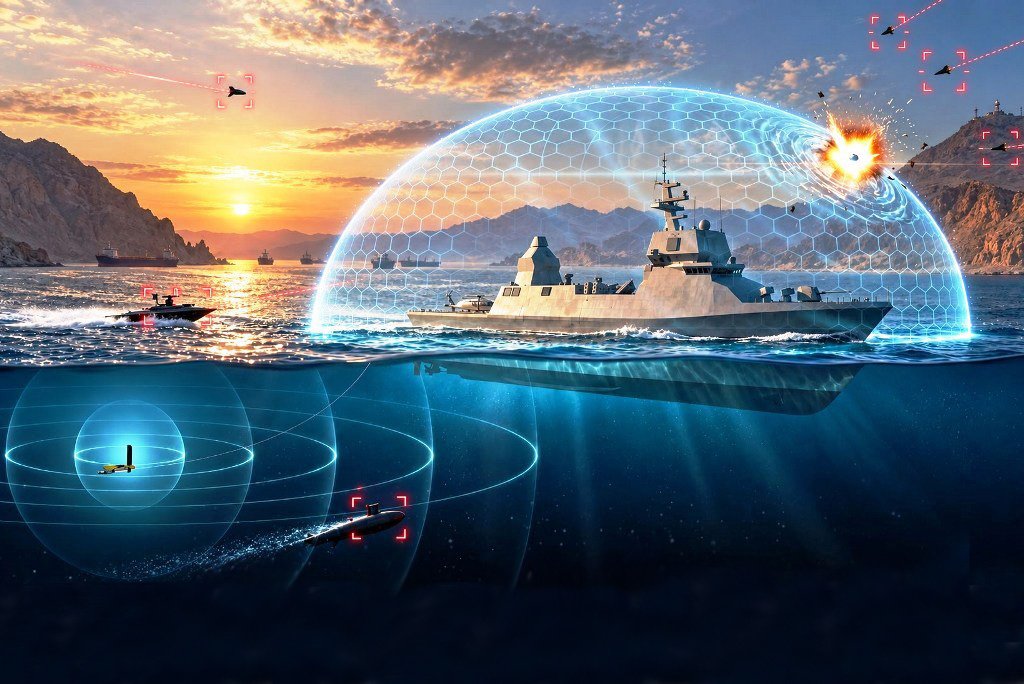
The constantly increasing importance of the underwater domain led Elbit Systems of Israel to increase its footprint in the unmanned naval systems field, and in mid-October it announced the acquisition of International Submarine Engineering (ISE) company of Canada, a renowned player in the underwater unmanned vehicles (UUVs) community. Euronaval was the first opportunity for the Haifa-based Israeli group to publicly discuss this acquisition and its’ view of unmanned systems in the naval world
“We have an extensive autonomous portfolio in Elbit starting from aerospace. Fifteen years ago, Elbit Systems was a pioneer in moving into the surface vessel domain with our Seagull family. And we were working also with underwater autonomous drones, integrating them into our solution package. Elbit also has an extensive portfolio for the naval domain, which includes different sensors and effectors. Three weeks ago, we completed the acquisition of ISE and today we are able to offer our customer a complete suite coming from Elbit as a package or as a standalone solution,” Saar Koursh, Senior Vice President GM of Elbit Naval Systems, told EDR On-Line at the Paris exhibition.
The UUV world is quite varied, unmanned underwater systems ranging from small handheld devices to mid-size, large-size, and the extra-large platforms. “So, first we were looking for large size UUVs, this was our main focus. The second thing we were looking for was a mature technology, a mature product. And ISC was a good fit for us because that company has been in the UUV business for the last 50 years,” Saar Koursh said adding that over the last 50 years, ISE sold more than 250 vehicles to 20 different navies worldwide.
“Most of the critical infrastructure are laying on the ocean bottom, such as oil and gas pipelines, and 99% of the world telecommunication lines are lying on the ocean floor. Unfortunately, in the last few years, there were more and more issues, however the problem is not just the issues that we know. The problem is what we do not know,” Saar Koursh underlined, adding that what is scary is the idea that somebody can put some time-delayed system that may be remotely activated on D-Day, disrupting the entire world life.

“The only way to avoid this is to continuously monitor this critical infrastructure. And since they are laying on the bottom of the ocean, some at very high depth, ISE solutions can operate at 6,000 meters depth,” he stated. Here they can map the ocean floor using diverse types of sonars, such as side-scan sonar or synthetic aperture sonar.
Adding ISE to Elbit Systems assets will certainly generate synergies between the Canadian entity and the many other entities within the group ecosystem. “There are many synergies, as Elbit Systems has most of the sensors and effectors that you can integrate into a USV, doesn’t matter which is the mission,” Ariel explained adding that it is possible to take one of the company acoustic arrays, attach it to the UUV and generate a powerful ASW solution. Moreover, Elbit Systems has in-house a unique fuel cell technology, he said; this might dramatically extend endurance and range compared to battery-based solutions.
While increasing its footprint in unmanned systems, going subsea, Elbit Systems does not forget the other side of the coin, how to counter them, as Ariel, Senior Vice President Naval EW, ISR A/C and SIGMABIT Business Line explained. “The use of affordable autonomous systems, such as UUVs, USVs or drones that replace the traditional weapon systems or threats is probably the most destructive phenomenon that happened during the last three or four years. So, if in the past Elbit Systems EW integrated suite was dealing with cruise missiles to self-protect a frigate or a ship, now you need to deal with UUVs, USVs and drones that are attacking or threatening your fleet,” told EDR On-Line.

“Going from the traditional use of EW to use its non-kinetic capabilities in the modern warfare is what Elbit Systems has done in the past years, and especially in the two or three years during the never-ending conflict that we have. What we are presenting now is the edge solution for non-kinetic capabilities in the electronic warfare domain. We gathered all our R&D and knowledge and came up with a combat suite,” Ariel said. The system is named Counter-UXS where X stands for aerial, surface, and underwater vehicles. “We have a unified solution that goes from detection, identification, to neutralising the threat itself. What is unique is that we are delivering a holistic solution which combines different layers of kinetic and non-kinetic capabilities. And our Counter-UXS suite is combined with a 30mm gun, very accurate with high rate of firing,” the retired Navy officer explained. For detection, the systems use the company DaiR X-band multi-mission radar capable to track up to 10,000 targets simultaneously; its AESA antenna covers 110° in azimuth and up to 80° in elevation, the mass of the single panel being 30 kg, therefore the system is easily deployable. According to available data the DAiR can detect a nano drone at 4.5 km, a micro drone at 6 km and a mini drone at 10 km. It is fitted with an AI-enhanced target classification algorithm. The Elbit Systems C-UXS suite uses a non-kinetic solution based on navigation warfare and communication destructive capabilities, and all together delivers a full suite which is agnostic to the threat, which means no intelligence is needed to deal with. The system is fully combat proven and can be tailored to every platform, the company underlining that its footprint is compatible with small vessels, a bigger solution being available for frigates or corvettes. An airborne solution is also available. As for kinetic assets, high power energy microwave and high-power lasers are under development.
Images courtesy Elbit Systems and ISE
