

An infantry fighting vehicle can be the difference between a successful assault and a disastrous battlefield defeat. It must carry soldiers into dangerous territory, protect them from enemy fire, and deliver enough firepower to support their advance. That’s a demanding combination.
Modern warfare has made this job even harder. Anti-tank missiles, armed drones, loitering munitions, and precision artillery constantly threaten armored formations. Simply adding thicker armor is no longer enough.
Today’s best infantry fighting vehicles combine powerful weapons, sophisticated sensors, advanced protection systems, and impressive mobility. Some prioritize crew survivability, while others emphasize firepower and operational flexibility.
Germany’s Puma, Sweden’s CV90, and South Korea’s AS21 Redback demonstrate how different countries approach these challenges. Meanwhile, platforms such as the American M2 Bradley continue to evolve through decades of battlefield experience.
But which vehicles deserve a place among the world’s finest?
This ranking examines five leading infantry fighting vehicles based on their firepower, armor protection, mobility, technology, and operational capabilities. We’ll also explore what makes each platform distinctive, including some important limitations that specifications alone cannot reveal.
One thing worth remembering: the most expensive or heavily armed IFV isn’t automatically the best. Its real value depends on how effectively it protects infantry and supports them throughout a mission.
Let’s examine the machines competing for that distinction.
How We Ranked the Best Infantry Fighting Vehicles in the World
Choosing the best infantry fighting vehicles isn’t simply a matter of comparing gun sizes or engine horsepower. A vehicle might carry impressive weapons but struggle to protect its crew under heavy fire. Another may offer excellent armor yet lack the mobility needed for demanding operations.
That’s why this ranking considers several important performance factors. Each vehicle must demonstrate a convincing balance between offensive capabilities, survivability, and battlefield practicality.
Here are the six criteria used to evaluate the world’s leading IFVs.
1. Firepower and Weapon Systems
Firepower determines how effectively an IFV engages enemy infantry, light armored vehicles, and fortified positions. We consider its main autocannon, secondary weapons, ammunition options, and anti-tank missile capabilities.
2. Armor Protection and Survivability
An IFV must protect its crew and dismounted soldiers against battlefield threats. Our assessment considers armor design, mine resistance, modular protection, and active protection systems (APS).
3. Mobility and Engine Performance
Powerful weapons mean little if a vehicle cannot reach the battlefield. Engine output, power-to-weight ratio, maximum speed, suspension, and cross-country mobility all influence this category.
4. Technology and Situational Awareness
Modern combat demands more than traditional optics. Thermal imaging, digital fire-control systems, battlefield networking, and advanced sensors provide significant advantages.
5. Operational Experience and Reliability
Combat experience reveals capabilities that brochures cannot. We consider operational deployment, modernization history, reliability, and the maturity of each platform.
6. Versatility and Upgrade Potential
The strongest designs accommodate changing battlefield requirements. Modular architecture, weapon upgrades, additional protection, and different mission configurations contribute to long-term value.
These criteria reflect established military vehicle design principles, including the relationship between firepower, mobility, protection, and operational requirements.
One important distinction: this ranking evaluates the complete vehicle rather than individual specifications. A balanced, dependable platform can be more valuable than one impressive feature.
The goal is simple: identify the IFVs that offer the most convincing combination of capabilities for modern mechanized warfare.
1. Puma IFV (Germany)
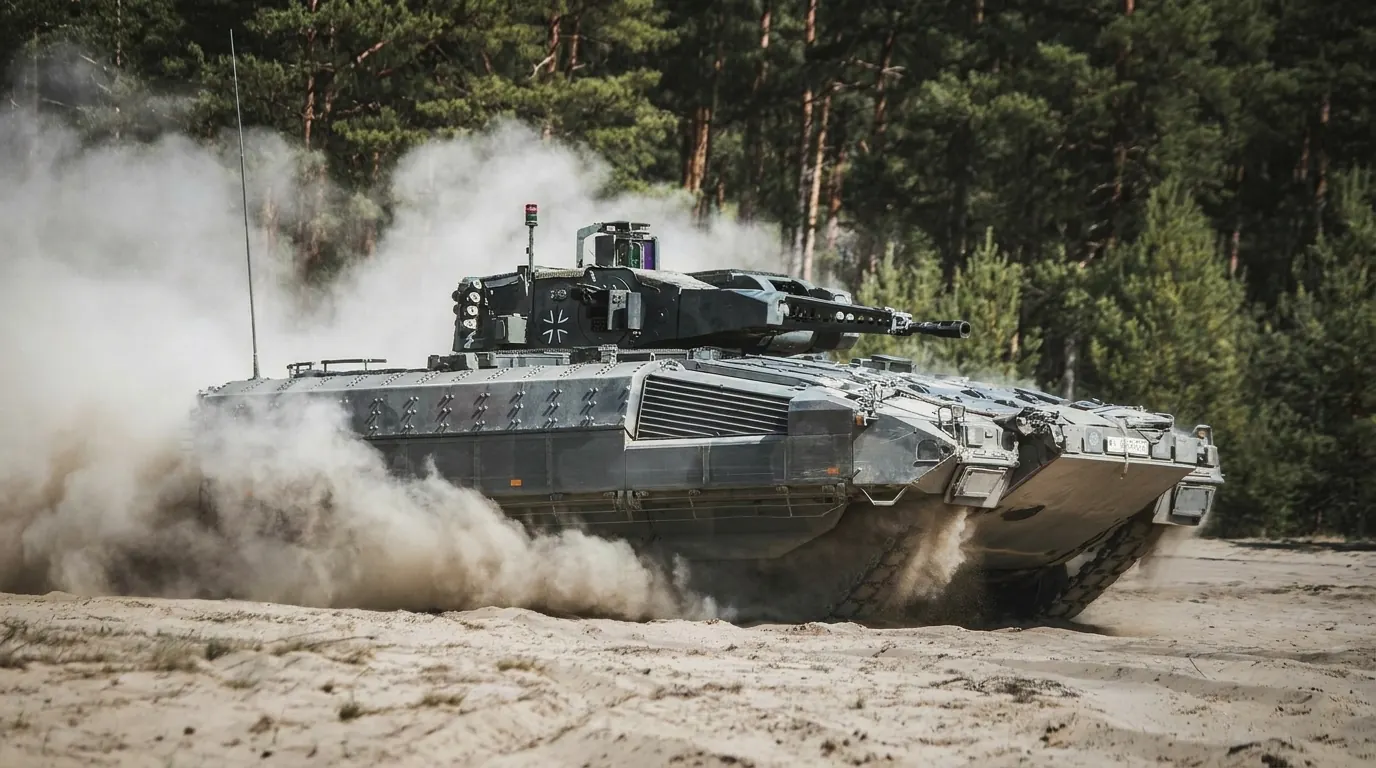
The Puma IFV ranks among the most technologically advanced infantry fighting vehicles currently operated by European armed forces. Developed by Projekt System & Management (PSM), a joint venture involving Rheinmetall and KNDS Deutschland, it was designed to provide German mechanized infantry with exceptional protection and firepower.

Its primary weapon is a 30mm MK30-2/ABM automatic cannon, capable of firing armor-piercing and programmable airburst ammunition. The vehicle also carries a 5.56mm MG4A1 machine gun and two MELLS anti-tank guided missiles.
Protection is another major advantage. Its modular armor configuration allows the vehicle to adapt to different threat environments, while its unmanned turret keeps the commander, gunner, and driver inside the protected hull.
Under the hood, the Puma uses an 800 kW (1,088 hp) diesel engine. Despite weighing approximately 43 tonnes in its heavier configuration, it reaches a maximum road speed of 70 km/h.
| Specification | Puma IFV |
| Country | Germany |
| Main armament | 30mm MK30-2/ABM |
| Secondary weapon | 5.56mm MG4A1 |
| Anti-tank weapons | 2 MELLS missiles |
| Engine power | 1,088 hp |
| Maximum speed | 70 km/h |
| Crew | 3 + 6 infantry |
Perhaps its greatest advantage is the integration of digital battlefield systems, connecting dismounted soldiers with their vehicle during operations.
However, its sophisticated design comes with substantial weight and logistical demands. Its six-person dismount capacity is also relatively limited.
Nevertheless, the Puma’s combination of protection, firepower, and digital technology makes it a leading contender among the world’s best IFVs.
2. CV90 Infantry Fighting Vehicle (Sweden)
The CV90 is one of Europe’s most successful infantry fighting vehicle families. Developed by Hägglunds, now part of BAE Systems, it was designed to operate in demanding Nordic environments where snow, forests, and difficult terrain challenge conventional armored vehicles.
Unlike the Puma, which emphasizes sophisticated protection and digital integration, the CV90 focuses on adaptability. Its modular architecture allows operators to configure different versions according to their military requirements.

Firepower is one of its strongest features. Depending on the variant, the CV90 carries a 30mm, 35mm, or 40mm automatic cannon. Certain configurations also incorporate anti-tank guided missiles, providing additional capability against heavily armored targets.
The latest CV90 MkIV introduces significant improvements, including a more powerful engine, upgraded electronic architecture, and enhanced situational awareness. Its engine can deliver up to 1,000 horsepower, depending on configuration.
One particularly interesting feature is the CV90’s ability to accommodate different mission requirements. Its family includes reconnaissance, command, air-defense, and armored personnel carrier configurations. This common platform helps operators simplify training, maintenance, and logistics.
| Specification | CV90 MkIV |
| Country | Sweden |
| Main armament | 30mm, 35mm, or 40mm (variant-dependent) |
| Engine power | Up to 1,000 hp |
| Maximum weight | Up to 38 tonnes |
| Infantry capacity | Up to 8 |
| Active protection | Available |
| Transmission | X300 heavy-duty |
The vehicle’s battlefield credentials also matter. CV90s have seen operational service in Afghanistan and Ukraine, giving the platform experience beyond controlled military exercises.
Its protection has evolved alongside these experiences. The latest generation offers improved ballistic and mine protection, with an active protection system available for selected configurations.
However, the CV90 isn’t without limitations. Different configurations have different capabilities, and additional armor can increase weight, affecting transportability and operating costs.
What makes the CV90 particularly impressive is its adaptability. Rather than relying on one supposedly perfect configuration, it offers military operators a platform that can evolve alongside changing battlefield requirements.
That combination of combat experience, modularity, and modern technology makes the CV90 one of the best infantry fighting vehicles in the world.
3. Lynx KF41 IFV (Germany)
The Lynx KF41 represents a newer generation of German armored warfare technology. Developed by Rheinmetall, it was designed around one central idea: an IFV should adapt to changing battlefield requirements rather than remain locked into a single configuration.
First unveiled internationally in 2018, the Lynx KF41 combines substantial firepower, modular protection, and considerable internal space. Unlike some competing vehicles, it can accommodate three crew members and up to eight fully equipped infantry soldiers.

Its weapon configuration depends on the customer’s requirements. The vehicle can carry a 30mm automatic cannon or a more powerful 35mm Wotan cannon. Selected configurations can also integrate Spike anti-tank guided missiles, giving the platform additional capability against armored targets.
Protection is another important feature. The Lynx uses modular armor packages that can be adapted to different operational environments. Its defensive architecture can incorporate active protection systems designed to counter incoming anti-tank threats.
Mobility comes from a Liebherr diesel engine producing approximately 1,140 horsepower. This gives the vehicle considerable power, particularly when operating with heavier armor and mission equipment. Its maximum road speed is approximately 70 km/h.
| Specification | Lynx KF41 |
| Country | Germany |
| Manufacturer | Rheinmetall |
| Main armament | 30mm or 35mm cannon |
| Secondary weapon | 7.62mm machine gun |
| Engine power | 1,140 hp |
| Maximum speed | Approximately 70 km/h |
| Crew | 3 |
| Infantry capacity | Up to 8 |
What makes the Lynx particularly interesting is its modular vehicle architecture. Its common drive module can support several mission variants, including command, reconnaissance, ambulance, and air-defense vehicles.
Hungary became its first NATO customer, ordering 218 vehicles across seven variants.
However, the Lynx has less extensive combat experience than older platforms such as the Bradley and CV90. Its long-term reliability and battlefield performance will become clearer through sustained operational service.
The Lynx KF41 earns its place through adaptability, internal capacity, and upgrade potential. It’s a vehicle designed not just for today’s threats, but for the battlefield requirements that may emerge tomorrow.
4. AS21 Redback IFV (South Korea)
The AS21 Redback is one of South Korea’s most ambitious armored vehicle projects. Developed by Hanwha Aerospace, it combines heavy protection, advanced electronics, and powerful weapons in a modern tracked platform.
Its development reflects an important shift in military thinking. Modern infantry fighting vehicles must survive threats that older designs rarely encountered, particularly anti-tank missiles, improvised explosive devices, and increasingly sophisticated drones.

The Redback addresses these challenges through a combination of passive and active protection. One of its most notable features is the Israeli-developed Iron Fist active protection system, designed to detect and intercept incoming anti-armor threats before they strike the vehicle.
Firepower is equally impressive. The Redback features a 30mm automatic cannon, typically integrated into a two-person turret, alongside a 7.62mm machine gun. It can also carry Spike anti-tank guided missiles, providing an additional weapon against enemy armored vehicles.
Another distinctive feature is its composite rubber track system. Compared with conventional steel tracks, these reduce vibration and noise while improving ride comfort for soldiers and crew members. This matters during extended operations, where constant vibration can affect both personnel and sensitive onboard equipment.
| Specification | AS21 Redback |
| Country | South Korea |
| Manufacturer | Hanwha Aerospace |
| Main armament | 30mm Bushmaster II |
| Secondary weapon | 7.62mm machine gun |
| Anti-tank weapons | Spike LR2 missiles |
| Active protection | Iron Fist |
| Infantry capacity | Up to 8 |
Australia selected the Redback in 2023 under its LAND 400 Phase 3 program, ordering 129 vehicles to replace its aging M113AS4 fleet. The vehicles will be manufactured locally, strengthening Australia’s domestic armored vehicle industry.
However, there’s an important qualification. As of November 2026, the Redback has not entered Australian Army operational service. The Australian National Audit Office reported outstanding technical risks involving mobility and lethality, with initial deliveries scheduled to begin in 2027.
The Redback’s biggest strength is its forward-looking design. Its combination of active protection, advanced sensors, programmable ammunition, and crew comfort makes it an impressive next-generation IFV.
Its operational maturity, however, still needs to catch up with its technological ambitions.
5. M2A4 Bradley IFV (United States)
The M2A4 Bradley may not be the newest infantry fighting vehicle on this list, but decades of operational experience have made it one of the most recognizable armored platforms in modern warfare.

Developed by FMC Corporation, the Bradley entered U.S. Army service in the early 1980s. Its original mission was straightforward: transport mechanized infantry while providing enough firepower to engage enemy vehicles and support soldiers during combat.
Its main weapon is the 25mm M242 Bushmaster automatic cannon. This weapon can engage infantry, lightly armored vehicles, and other battlefield targets using different ammunition types. The Bradley also carries a coaxial 7.62mm M240C machine gun and a dual-tube launcher for TOW anti-tank guided missiles.
The M2A4 variant introduces several improvements over earlier models. These include an upgraded engine and transmission, improved suspension components, enhanced electrical power generation, and modernized digital equipment.
Its 600-horsepower Cummins diesel engine provides the mobility needed to accompany armored formations across difficult terrain. The vehicle can reach approximately 61 km/h on roads, depending on operating conditions.
| Specification | M2A4 Bradley |
| Country | United States |
| Main armament | 25mm M242 Bushmaster |
| Secondary weapon | 7.62mm M240C |
| Anti-tank weapons | TOW missiles |
| Engine power | 600 hp |
| Maximum speed | Approximately 61 km/h |
| Crew | 3 |
| Infantry capacity | 7 |
The Bradley’s greatest advantage is its combat history. It served in the Persian Gulf War and Operation Iraqi Freedom, demonstrating its ability to support mechanized infantry in demanding operations.
Ukraine has also received Bradley vehicles, bringing the platform into another generation of high-intensity armored warfare.
However, its age presents challenges. Modern anti-tank weapons and drones expose vulnerabilities that require additional protection and tactical adaptation.
The Bradley remains relevant because it has evolved rather than stood still. Its combination of proven firepower, modernization, and operational experience secures its position among the world’s leading infantry fighting vehicles.
Comparison of the World’s Best Infantry Fighting Vehicles
Looking at individual vehicles tells only part of the story. The real differences become clearer when their specifications sit side by side.
The Puma prioritizes advanced protection and digital integration. The CV90 offers remarkable versatility, while the Lynx KF41 emphasizes modularity and passenger capacity. South Korea’s Redback brings modern defensive technology, and the American Bradley relies on decades of operational development.
Here’s how these five infantry fighting vehicles compare.
| Specification | Puma | CV90 MkIV | Lynx KF41 | AS21 Redback | M2A4 Bradley |
| Country | Germany | Sweden | Germany | South Korea | USA |
| Main cannon | 30mm | 30–40mm | 30–35mm | 30mm | 25mm |
| Engine power | 1,088 hp | 1,000 hp | 1,140 hp | ~1,000 hp | 600 hp |
| Road speed | 70 km/h | 70 km/h | 70 km/h | ~70 km/h | ~61 km/h |
| Combat weight | ~43 tonnes | Up to 38 tonnes | ~44 tonnes | ~42 tonnes | Variant-dependent |
| Crew | 3 | 3 | 3 | 3 | 3 |
| Infantry capacity | 6 | Up to 8 | Up to 8 | Up to 8 | 6 |
Which IFV Has the Best Overall Capabilities?
Each vehicle has a different advantage.
- Best protection: Puma, thanks to its sophisticated modular armor and integrated defensive architecture.
- Best versatility: CV90, with its extensive family of mission-specific configurations.
- Best upgrade potential: Lynx KF41, featuring a modular architecture and substantial growth capacity.
- Most promising next-generation design: AS21 Redback, with its Iron Fist active protection system.
- Most established combat experience: M2 Bradley, supported by decades of operational service.
One interesting detail emerges from this comparison. Engine horsepower doesn’t automatically determine battlefield mobility. The vehicle’s weight, suspension, transmission, and power-to-weight ratio matter just as much.
For example, the Lynx KF41 produces more horsepower than the CV90 MkIV, but its heavier configuration changes the overall equation.
Similarly, a larger cannon doesn’t guarantee better combat performance. Ammunition availability, targeting systems, stabilization, and crew training all influence effectiveness.
The best infantry fighting vehicle isn’t necessarily the one with the biggest numbers. It’s the one that delivers the right combination of capabilities when soldiers need it most.
