


Turkish Land Forces have expressed a requirement for a Class 2 UGV and Tekatron, one of the main national players in ground robotics, unveiled at EFES 2026, the main Turkish military exercise, its new W-UGV-I, a 4×4 wheeled platform designed to cope with the needs of the national army
Ground robotic is picking-up pace among armies, and the Turkish Land Forces are definitely looking for unmanned solutions to reduce the risk for the soldiers and increase units effectiveness. At the industry display linked to the EFES 2026 exercise Tekatron showcased its W-UGV-I, the “W” indicating a wheeled solution.
Among the requirements issued by the Turkish military we find cost effectiveness, with an eye on a reduced acquisition cost, and the capacity to easily scale up production should the need arise. The new platform ha a mass of 500 kg, is 2,300 mm long, 1,600 mm wide and 1,000 mm high, and has a 300 kg payload capacity.

Propulsion is fully electric, with one motor per wheel, powered by a set based either on LFP (Lithium Iron Phosphate) orNMC (Nickel Manganese Cobalt) batteries, the system being able of hot swap. Battery selection is left to the customer, depending on cost, lifecycle and operational needs considerations. Batteries ensure a 10-72 hours operational endurance, depending on payload and mission profile, and an operational range of over 100 km. Each motor has a nominal power of 12 kW, peak power being 20 kW. The motors currently used are not originating from Turkey, but Tekatron underlined that an R&D effort is underway and in perspective this should lead to a further increase in the product localisation. The propulsion solution adopted provides a 55 km/h maximum speed on road, off-road performances being ensured by double wishbone independent suspensions. The W-UGV-I is fitted with Michelin airless tires, the first time such type of solution is used in Turkey according to Tekatron. The choice went for Michelin X® Tweel® in the 26x9N14.
The Tekatron UGV is capable to cope with 60% grades, 30% side slope, can overcome a 30o mm vertical obstacle, a trench 600 mm wide, its 350 mm ground clearance ensuring a good off-road capability.
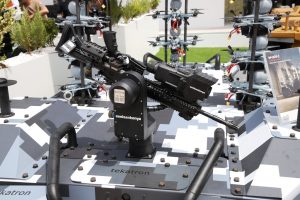
The Turkish Land Forces expressed the requirement for a UGV capable to transport and operate First Person View drones, three sets of four FPVs being visible, and to carry a light weapon station. On the prototype seen at EFES 2026 the weapon solution was provided by AselsanKonya in the form of its Akons Pan-Tilt, a less than 25 kg solution, without weapon, capable to be armed with 5.56 mm or 7.62 mm assault rifles, and with a ±30° elevation arc and a ±100° azimuth arc.
The W-UGV-I is teleoperated via wire or wireless command, in the latter case using radio or 4G/LTE links. This because the requirement does not currently includes autonomy. Should this become a requirement, for example for the export market, Tekatron is ready to team up with a third party for adding the autonomous brick.

The company produced two prototypes, the second one with minor improvements coming from the experience acquired with the first one. It is expected that the military will call soon for a comparative test campaign, a shortlist being considered possible before year end.
The modularity typical of the architecture selected makes it easy to scale-up the UGV to a 6×6 configuration. EDR On-Line understood this is already in the mind of Tekatron, although no requirement has yet been expressed by the national customer, something that might come soon or late.
Photos by P. Valpolini
