

JUST IN
“This is a tremendously successful summit.” So declared US President Donald Trump before departing the NATO Summit today. At the start of the two-day gathering in Ankara, the president delivered some post–Independence Day fireworks by criticizing allies on defense spending, again raising the prospect of seizing Greenland, and escalating the on-and-off conflict with Iran. But the meetings were cordial, and by the end, Trump was lauding NATO’s “unification.” In a brief communiqué, allies reaffirmed the Article 5 collective defense pledge and called on Iran to open the Strait of Hormuz, while announcing fifty billion dollars in new defense procurement and eighty billion dollars more for Ukraine. Our alliance of experts contributed their reactions below.
TODAY’S EXPERT REACTION BROUGHT TO YOU BY
- Jenna Ben-Yehuda: Executive vice president at the Atlantic Council and former US State Department official
- Torrey Taussig (@torrey_taussig): Director of the Transatlantic Security Initiative in the Scowcroft Center for Strategy and Security, and former director for European affairs at the White House National Security Council
- Andrew D’Anieri (@andrew_danieri): Associate director at the Eurasia Center
- Defne Arslan (@defnesadiklar): Senior director and founder of the Turkey Program and former chief Turkey economist at the US embassy in Ankara
Sign up to receive rapid insight in your inbox from Atlantic Council experts on global events as they unfold.
Taking the win
- Jenna credits the relatively positive vibes at Trump’s post-summit press conference in part to a slew of defense deals and the “royal welcome” the US president received from Turkish President Recep Tayyip Erdoğan.
- Among Europeans on the ground, Jenna found surprise and relief at Trump’s upbeat parting words, “though most with whom I spoke were quick to recognize that moments like these are fleeting, and they expect rockier terrain ahead.”
- Jenna notes that the communiqué “included mention of the Russian threat, important recognition of Ukraine, and continued affirmation of Article 5.” One senior allied leader told her that “we appear to have made it out alive.” Jenna adds: “In a moment of strain for the transatlantic partnership, many seem willing to call that a win.”
- Still, from the ground in Ankara, Torrey tells us that “we are witnessing the development of a stronger Europe in a weaker NATO.” While European allies have ramped up their defense spending, the Alliance overall is weakened “due to the lack of clear commitment and leadership from the United States.”
Industry in the spotlight
- The defense industry was the “honorary thirty-third member” of NATO this week, Jenna reports from Ankara, where leading transatlantic defense contractors mingled with allied officials at the Defence Industry Forum on Tuesday.
- Drawing on her observations at the forum and conversations with senior leaders, Torrey says that despite lingering shortcomings, “Europe is thinking about its own defenses in a fundamentally different way than it was a year ago.”
- Why is that? Jenna says the allied “urgency” has resulted as much from “a belligerent Russia—especially with its deepening ties to China, North Korea, and Iran” as it has from “Trump’s own demands that the Alliance do more and fast.”
- The big question is the future of US force posture in Europe, which is under a Pentagon review. Jenna picked up “palpable nervousness” among Europeans “that future US troop reductions could continue to surprise allies before those gaps can be filled by new European commitments.”
Unity on Ukraine
- Trump had a warm meeting with Ukrainian President Volodymyr Zelenskyy in which he voiced support for Ukraine’s long-range strikes into Russia and announced that Ukraine will be able to produce its own Patriot interceptor missiles. As a result, “Ukraine was the clear winner at this summit,” Torrey tells us.
- Andrew calls the Patriot news a “welcome surprise” that will have a battlefield impact in Ukraine with “increased sales for US companies” and “no adverse impacts on US supply chains.”
- The problem is the details so far are scarce. “No one—in Kyiv or Washington—at this point knows which components will be licensed for joint production,” Andrew points out, and it is unclear where the interceptors will be produced. “New production lines would be a ripe target for Russian ballistic missiles. Is it even possible to produce these securely and at scale in Ukraine?”
- One possible model the US and Ukraine could follow is the F-35 fighter jet, Andrew says, which has been licensed for joint production by US allies in Europe and Asia. “Those agreements yielded better capabilities for American partners, produced at a lower cost than US-based production but with profits repatriated back to US firms.”
Turkey’s time
- And another ally may soon join the F-35 program. Trump announced plans to lift sanctions imposed on Turkey in 2020 for purchasing Russian air-defense systems, opening the door for its F-35 reentry. “Now, renewed hope has emerged in Ankara that Turkey may eventually receive F-35s,” Defne says,“though legal and congressional hurdles remain.”
- Ahead of the summit, Trump said that he probably would not have attended if not for Erdoğan hosting it. Defne tells us that Turkey used the summit—and the “Trump factor”—to make “major bilateral defense gains” with the US and bring in Middle Eastern leaders, such as Syrian President Ahmed al-Sharaa: “Ankara demonstrated that it sits at both the literal and figurative crossroads of the global security architecture.”
Further reading
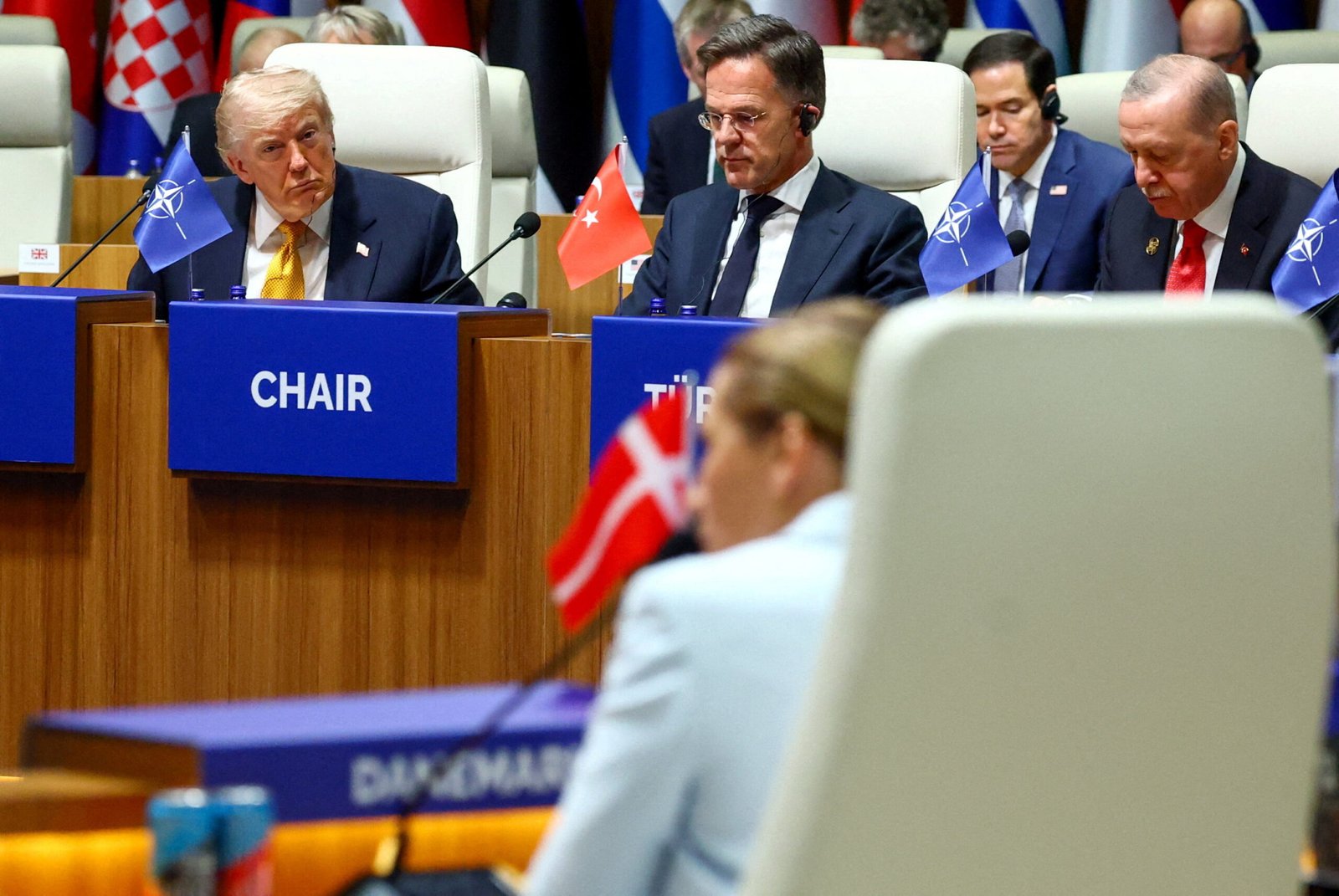
Image: US President Donald Trump looks at Denmark’s Prime Minister Mette Frederiksen as they attend a meeting of the North Atlantic Council (NAC) during the NATO leaders’ summit in Ankara, Turkey, July 8, 2026. REUTERS/Yves Herman TPX
