

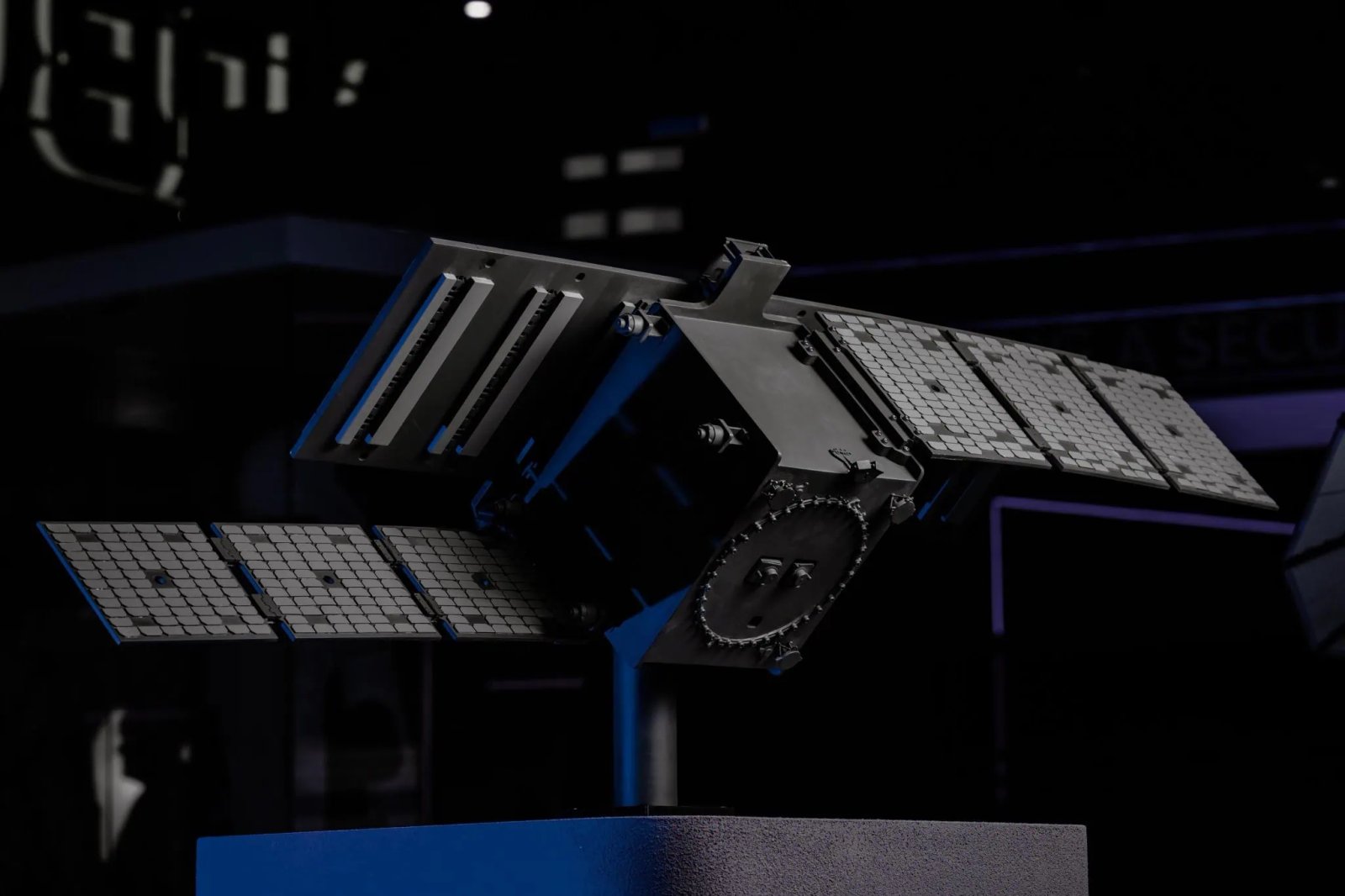
With outer space recognised as a warfare domain, many countries are seeking sovereign capabilities in that realm. One such is the UAE, which recently completed the critical design review of its first synthetic aperture radar payload for a satellite.
Passing of this milestone in late October 2026 cleared the way for flight hardware to commence manufacture. Indeed, Mohsen Al Awadhi, Director of the Space Missions Department at the UAE Space Agency, said: “The validation of the Sirb-1 design moves the programme into its most demanding phase, in which every subsystem must be built, integrated and tested to the standards required for operation in space.”
The preliminary design review for the satellite – called Sirb-1 – was satisfactorily completed in April 2026. The payload manufacture, assembly, integration and testing activities are being conducted in conjunction with Orbitworks and the Technology Innovation Institute (TII), with the satellite’s launch slated for 2028.
As outlined in the UAE’s National Space Strategy 2030, the Sirb programme addresses two national priorities for the UAE: accessing reliable earth observation data under all conditions, and development of a domestic space industry. The project involves a consortium established in 2023 and headlined by the UAE Space Agency and Edge’s space subsidiary Fada as prime contractor.
This project therefore includes the design and delivery of both the satellite and mission control infrastructure necessary to capture high-resolution radar images for disaster response, environmental monitoring and national security applications.
SAR constellation
During a recent media tour hosted by the Edge Group, Renato Bellarosa, Vice President of Engineering at Fada, explained to Asian Military Review and several other outlets that the roadmap comprises three Sirb synthetic aperture radar (SAR) satellites providing a ground sample distance (GSD) of 15cm.
Unlike optical satellites, SAR birds use radar to capture imagery by day or night, giving the attendant advantage of “seeing” through various environmental conditions.
Bellarosa said, “We’re currently selecting the launch service provider,” after a plan to originally employ SpaceX was redirected because of bottlenecks. He said a tender evaluation board for the launch service is currently in progress. “We’ve already identified good candidates, but we still have to define exactly where to go.”
Last year, Edge selected Singaporean firm ST Engineering and Italian entity MetaSensing to help the programme technically. The former will manufacture the spacecraft in Singapore. Payload integration will occur in the UAE, before being dispatched to Singapore approximately one year from now for final integration.
ST Engineering is a strategic partner for Edge, and a relationship was also established with the Singapore Space Agency last year.
Building space foundations
In its development of space capabilities, Bellarosa said Fada had achieved mission authority, the first layer in establishing sovereignty. It is now implementing the next phases comprising the ground segment and data analytics.
The UAE’s ground segment will include likely an initial four ground stations possessing 5.5m antennas operating in the S, X and Ka bands, as well as an optical ground station. These stations are Edge initiatives rather than the result of a contract from the UAE.
After that comes hardware mastery, including payload design authority, and satellite and bus design and integration. Fada envisages it will perform bus design for Sirb-2 and Sirb-3. Future steps in the UAE’s roadmap are local manufacturing and even space launches.
The UAE also wants a multispectral electro-optical satellite in low earth orbit. Its first step was to acquire a Satellogic bird already in orbit, and Fada is currently operating this one offering 70cm GSD. Bellarosa explained, “This satellite represents a first step for us to learn how to operate electro-optical and how to get images, how to extract information. This programme will have a subsequent step, which we’ll be producing ourselves, together with a partner: a satellite with a higher-resolution payload.”
The target is for this satellite to have a GSD of 50cm, and it is tentatively scheduled for launch in 2032. Bellarosa said Fada is in the process of starting its tender process.
Reality creates requirements
The UAE was subjected to Iranian air attack after the USA launched its war against Tehran in February 2026.
Waleid Al Mesmari, President – Advanced Sensing at Edge, told AMR and others, “You know, with recent events, I think that’s also given us more fuel to try to push on all the technology stacks, or the technology value chain, whether that would be the space segment or the midstream segment or the downstream segment.”
Asked whether the UAE is thinking of signals intelligence and radio frequency sensing satellites, Al Mesmari replied, “You know, we’re still evaluating a particular partner. It’s of interest to us. The technology could lend itself to different operational envelopes in the civil side and security side. We expect, at least within the next three to four years max, we’ll be able really to have a space asset in orbit.”
With such a belligerent neighbour across the Persian Gulf, Al Mesmari was asked whether the UAE is planning a satellite with an infrared (IR) payload that can detect missile launches. “I think it’s a technology that maybe we’ll need to look at. It’s not in our roadmap as of today.”
He added, “While we have not started our programme when it comes to an IR-specific payload, I think we have the right partners that could lend itself and provide us with the right imagery access.” He added that such a launch detection capability would derive from government-to-government partnerships. “It’s definitely something on the horizon for us.”
In the meantime, Al Mesmari promised the UAE would have more X- and S-band ground-based radars within the next two years. Edge is working with Elbit Systems and Indra respectively for these two types of radar.
Salem Butti Al Qubaisi, Director General of the UAE Space Agency, concluded: “Sirb represents a new approach to delivering national space programmes, one that places UAE companies and national talent at the centre of developing advanced space capabilities. By combining government investment and strategic direction with the expertise of our national industry, we’re building a sustainable, competitive space sector where Emirati companies take the lead in developing and delivering complex missions.”
by Gordon Arthur
