

VICENZA, Italy – Caserma Ederle served as the battleground for a rigorous three‑day Italian‑American partnership event, bringing together more than 50 Soldiers from the U.S. Army’s 16th Finance Battalion, 21st Theater Sustainment Command, the 529th Military Police Company, and a visiting team from the Italian Army’s NATO Rapid Deployable Corps – Italy and 33rd Reggimento Ambrosiano Sept. 23–25.
What unfolded was far more than a friendly contest. It was a demanding test of strength, precision and teamwork designed to push both sides to their limits while deepening interoperability between allied forces, according to Capt. Nicholas J. Zilhaver, 16th Finance Sustainment Brigade.
“The purpose of this training exchange is interoperability and partnership. The best part is seeing Italian Army Soldiers and U.S. Army Soldiers working together, talking and building deeper relationships,” Zilhaver said. “The second major benefit is understanding differences and similarities between our armies, what the U.S. Army does differently, what aligns and where gaps need bridging.”
The idea for the challenge emerged a year earlier in Baumholder, Germany, when the brigade commander convened a weeklong forum with company commanders and partner forces from across Europe.
“The entire week back then focused on interoperability between American and partner forces,” Zilhaver said. “We met Italian commanders, talked about what we could do together and decided a competition would be the best way to test ourselves. Here we are today, and it’s exactly the kind of event we hoped for.”
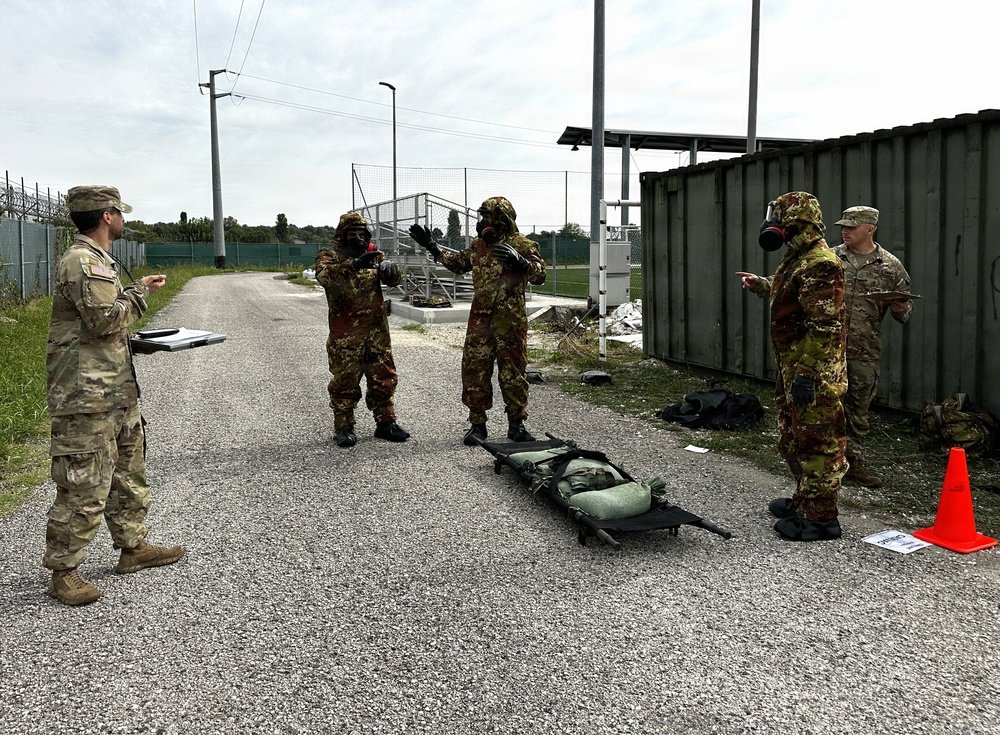
Each unit fielded nine competitors, organized into three‑person teams, moving through lanes intentionally designed to be uncomfortable. Soldiers donned full chemical‑protection suits, carried heavy litters, sprinted between obstacles and shifted rapidly from physical exertion to precision tasks.
The goal was to simulate the cognitive and physical strain of real operations, and to see how teams responded under pressure. For the Italian Army, the event fit naturally within their operational mission. Capt. Luca De Cicco, leading one of the Italian teams, said the challenge strengthened existing ties
.
“This activity is extremely beneficial for both of our armies,” he said. “We have nine competitors from the Bersaglieri infantry and logistics company. Shooting, running, marching, CBRN and land navigation are skills we all share. It may be the beginning of a new series of collaborations.”
For many Italian Soldiers, the competition offered a first chance to work closely with American noncommissioned officers and junior Soldiers in a tactical environment. Italian NCO, Maresciallo Francesco Murgia, said that interaction was one of the most valuable aspects.
“Competing with foreign units is always special,” he said. “It pushes you to train harder before the event and to compete harder during it. And personally, I had never worked directly with U.S. Soldiers of different ranks. This was a real opportunity.”
Murgia’s team found the chemical, biological, radiological, and nuclear lane the toughest. “The stretcher weighed 100 kilograms,” he said. “We had to evacuate a simulated casualty for 300 meters in full CBRN gear, then immediately move to grenade throwing and timed tasks. Everything was in sequence and under pressure. It took a lot of breath, a lot of effort.”
On the American side, Sgt. Ryan K. Owen of the 529th Military Police Company, 18th MP Brigade, said the competition mirrored the cooperation his unit practices daily.
“We operate every day with the Carabinieri, so we’re familiar with working alongside Italian forces,” he said. “But this was a great opportunity to support and strengthen that partnership.”
Owen agreed that the final lane was the most punishing partly due to wearing mission-oriented protective posture gear and doing burpees — a full-body exercise combining a squat, a pushup, and an explosive jump. “Full MOPP Level 4, every obstacle, high heat, it tested mental and physical toughness,” he said. “We carried a litter, did burpees, ran and moved through tasks. Everything was timed, and there were penalties if you missed obstacles or targets. For me, the burpees were the hardest.”
Despite the competitive spirit, camaraderie defined the event. Soldiers cheered for each other across languages, swapped techniques, compared equipment and joked about who would take home bragging rights. The scoreboard mattered, but not as much as the shared experience.
By the final afternoon, fatigue was visible, but so was pride. Teams gathered for the closing land‑navigation circuit, the last test of speed, accuracy and teamwork.
Murgia captured the friendly rivalry of the day, saying with a smile, “For now, we’re winning. We’ll see how it ends.”
Owen echoed the event’s purpose: “It’s great to be out here building partnership with them.”
Three days, dozens of tasks, nine competing teams and more than 50 Soldiers engaged – one purpose: to train together, compete together and grow together as allies.
