

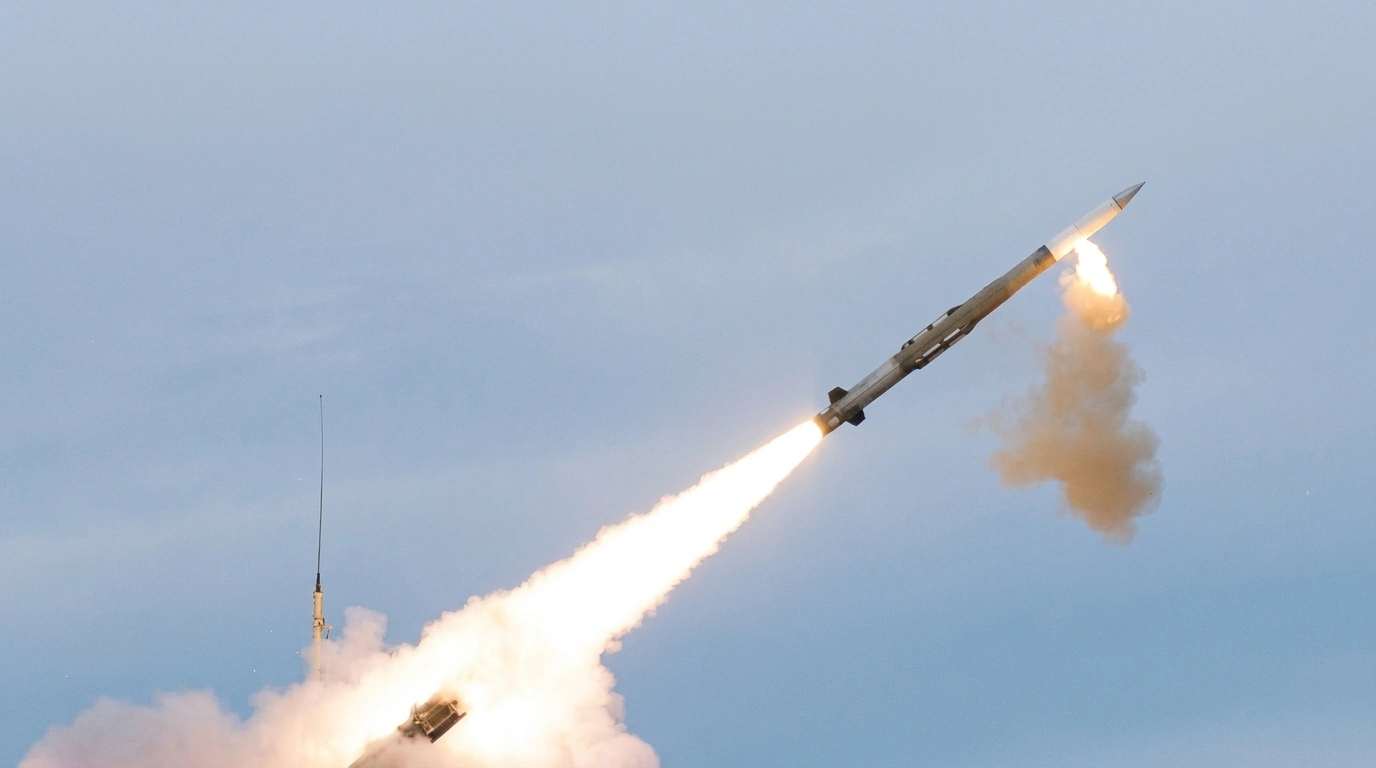
A missile does not have to be the biggest weapon in the launcher to be the most interesting.
The PAC-3 missile takes a very different approach to air and missile defense. Instead of relying mainly on a large explosive charge, it is built around hit-to-kill technology, where the interceptor aims to collide directly with an incoming threat. That requires a very different design, from its active radar seeker to the small control motors that help steer it during the final moments of an engagement.
The PAC-3 missile is part of the Patriot air defense system, but it should not be confused with the entire Patriot system itself. Patriot is the larger network of radars, launchers, command systems and interceptors. PAC-3 is one of the most advanced interceptors within that architecture.
And the story does not stop with the original PAC-3 missile.
The newer PAC-3 MSE, or Missile Segment Enhancement, adds a more powerful propulsion system and other changes intended to improve range, altitude and maneuverability. That version has become a major focus of U.S. and allied procurement.
There is a good reason for that attention. In 2026, the United States is pushing to expand PAC-3 MSE production dramatically, reflecting the growing demand for modern missile-defense interceptors.
So what actually makes the PAC-3 missile different?
The answer is not one feature. It is the way its seeker, propulsion, guidance and hit-to-kill design work together inside the Patriot system.
What Is the PAC-3 Missile?
The easiest way to understand the PAC-3 missile is to forget the idea that it is simply a newer Patriot.
PAC-3 missile was built around a different interception problem. Instead of depending mainly on a blast-fragmentation warhead, it uses hit-to-kill technology, meaning the interceptor is designed to collide directly with the incoming target. That shift drove changes across the missile, including its seeker, control system and airframe.
The result is a smaller interceptor with unusually high maneuverability. CSIS describes the PAC-3 missile as a clean-sheet departure from the earlier Patriot and PAC-2 design. It uses an active Ka-band radar seeker and a forward section containing 180 solid-fueled attitude-control motors. Those motors give the missile fine control during the terminal part of an engagement.
That is the part many quick explanations miss.
The PAC-3 missile is an interceptor, not the entire Patriot system. Patriot includes the radar, command-and-control equipment, launchers and missiles working as one system. PAC-3 is one of the most capable interceptors that can be used within that architecture.
The family has also changed over time. The original PAC-3 missile was followed by the PAC-3 Cost Reduction Initiative, or CRI, and then the PAC-3 Missile Segment Enhancement, or MSE. The MSE version adds a two-pulse solid rocket motor and improvements intended to increase agility, range and altitude.
This matters when reading defense reports. A headline may simply say “PAC-3,” while the actual missile involved is PAC-3 MSE.
The distinction is not academic. Lockheed Martin says more than 2,500 PAC-3 MSE missiles have been produced, with production continuing to expand. Seventeen nations have selected PAC-3 CRI or MSE.
PAC-3 missile also has a history that reaches back several decades. The Army selected the Extended Range Intercept Technology, or ERINT, design as the basis for PAC-3 development in 1994. The interceptor then entered operational service in the early 2000s.
So when people ask what makes the PAC-3 missile different, the answer starts with its basic philosophy.
It was designed to make the interceptor itself the precision instrument of the engagement, rather than simply delivering a large blast near the target.
PAC-3 Missile Specifications and Design
The PAC-3 missile is smaller than many conventional air-defense interceptors, but its compact design is packed with guidance and control technology.
Public figures vary between PAC-3 missile variants, so the table below focuses on commonly documented characteristics and clearly separates the MSE upgrade.
| Specification | PAC-3 / PAC-3 MSE |
| Missile family | PAC-3 |
| Main modern variant | PAC-3 MSE |
| Intercept method | Hit-to-kill |
| Seeker | Active Ka-band radar |
| Propulsion | Solid rocket motor |
| MSE motor | Two-pulse solid rocket motor |
| Guidance | Onboard guidance and active radar |
| Launcher load | Up to 12 PAC-3 MSE |
The most important upgrade is the two-pulse motor used by PAC-3 MSE. It gives the interceptor additional propulsion during flight, helping maintain the energy needed for longer-range and higher-altitude engagements.
The missile also uses aerodynamic fins and small attitude-control motors for precise maneuvering. Lockheed Martin identifies 180 attitude-control motors in the PAC-3 missile design.
Its active radar seeker handles the final part of the engagement, while the Patriot system provides tracking and guidance support earlier in the flight.

So the PAC-3 missile’s specifications tell a clear story. The missile is not built around carrying a large warhead. Its design puts the emphasis on sensing, maneuvering and direct interception.
How Does the PAC-3 missile Hit-to-Kill System Work?
The PAC-3 missile’s defining feature is simple to describe but difficult to engineer: it tries to hit the incoming target directly.
That is the idea behind hit-to-kill. Instead of relying mainly on a proximity-fuzed blast to send fragments toward a target, the PAC-3 missile uses its own speed and mass to deliver a direct impact. The U.S. Army describes the PAC-3 missile as a terminal-homing, hit-to-kill interceptor designed for tactical ballistic missiles and other air threats.
Why does that matter?
A ballistic missile warhead can be a small and difficult target. A direct collision gives the interceptor a very different way to transfer energy into that target. The original PAC-3 missile was developed around this problem after the Army concluded that conventional blast-fragmentation methods faced challenges against smaller, faster ballistic missile targets.
The missile has to make that collision happen without human steering from the ground. Its active radar seeker helps detect and track the target during the terminal phase, while onboard guidance works with information provided by the Patriot system.
Then comes the tricky part: maneuvering.
The PAC-3 missile uses a set of small attitude-control motors in its forward section. The Army’s technical material identifies 180 such motors on the PAC-3 design. They give the interceptor very fine control over its orientation, which is essential when the closing geometry changes rapidly.

Think of it less like throwing a spear and more like making a last-second correction to a dart already moving at extreme speed.
And hit-to-kill does not mean every PAC-3 missile engagement is identical. The interceptor family has also been developed for different threat types. Early PAC-3 material describes a kinetic hit-to-kill approach for ballistic missile targets, while the broader system has also retained capabilities for cruise missiles and aircraft.
That distinction matters because “hit-to-kill” is often treated as the whole story.
It isn’t.
The real advantage comes from the combination of high-speed flight, active sensing, precise guidance and extreme terminal maneuverability. Remove any one of those pieces and the concept becomes much less useful.
That is what makes PAC-3 missile more than a fast missile. It is a precision interceptor built around making the final seconds of an engagement count.
What Makes PAC-3 MSE More Advanced?
PAC-3 MSE is not a completely different interceptor. It is a substantial upgrade built around the same hit-to-kill idea, with more energy and better control available during the engagement.
The biggest change is propulsion.
The Missile Segment Enhancement, or MSE, uses a two-pulse solid rocket motor. Rather than treating the motor as one continuous source of thrust, the design divides propulsion into two stages. That gives the interceptor more useful energy later in flight, which can help it maneuver against difficult targets at greater distances and altitudes. Lockheed Martin identifies increased range, altitude and agility among the key improvements of the MSE configuration.
The change also affects the missile’s control surfaces. PAC-3 MSE uses larger fins and upgraded actuators, giving the interceptor more control authority during flight. That sounds like a small hardware change, but it matters when an interceptor has to make rapid corrections while closing on a maneuvering target.
There is another reason the MSE upgrade matters: energy at the right moment.

A missile can have plenty of speed shortly after launch and still face a harder problem near the end of its flight. A target may be farther away, moving differently than expected or forcing the interceptor to make larger corrections. The second motor pulse gives MSE another source of thrust during flight rather than putting all of the propulsion into the initial boost.
And this is where I think the usual “PAC-3 missile has more range” explanation misses the point. Range is useful, but range by itself does not make an interceptor better. The real gain is having enough energy and maneuverability to remain effective when the geometry becomes difficult.
PAC-3 MSE also retains the core features that define the family, including its active radar seeker and hit-to-kill approach. The upgrade did not throw away the original concept. It strengthened the parts that determine how effectively the interceptor can reach the target.
That helps explain why MSE has become the focus of current production.
It is not simply a PAC-3 missile with a longer flight path. It is a more capable version of the same basic interceptor architecture, designed to give Patriot more room to handle demanding air and missile-defense engagements.
How Does PAC-3 Work With the Patriot System?
A PAC-3 missile does not operate alone. Its real advantage comes from being part of the Patriot air defense system, where radar, command systems and launchers work together to create a single engagement chain.
The Patriot radar is the first major piece. It detects and tracks airborne threats, giving the system the information needed to build a firing solution. That data is passed through the Patriot command architecture, which manages the engagement and provides information to the interceptor after launch.
This is where the PAC-3 missile’s design becomes useful.
The missile carries its own active radar seeker, so it does not depend entirely on the ground radar for the final part of the engagement. As it approaches the target, its onboard seeker can take over the job of tracking the threat and guiding the interceptor toward the final intercept point. The missile also receives updates through the Patriot system before reaching that stage.
Think of the ground system as the coordinator and the PAC-3 missile as the precision instrument.
The launcher matters too. Modern Patriot launchers can be configured for different interceptor loads. A single M903 launcher can carry up to 12 PAC-3 MSE interceptors, depending on the configuration. That is a major difference from configurations using larger Patriot interceptors, which occupy more launcher space.
But launcher capacity is not the same thing as available defense.

A Patriot battery still depends on radar coverage, command-and-control capacity, interceptor inventory and the ability to keep the system supplied. Twelve missiles on one launcher sound impressive until the threat environment becomes large or prolonged.
That is why PAC-3 missile should be viewed as part of a wider architecture rather than a standalone missile.
The radar finds and tracks. The command system processes the engagement. The launcher provides the launch platform. PAC-3 missile then brings its own seeker, guidance and maneuvering systems into the final phase.
And the architecture is flexible. Patriot can employ different interceptor types, allowing commanders to match the available missile to the threat and mission. PAC-3 missile adds a specialized hit-to-kill option that is particularly important for ballistic missile defense.
That combination is the real strength of Patriot.
The missile gets most of the attention, but PAC-3 missile works because the entire system is built to get the right information to the right interceptor at the right time.
Why Is Demand for PAC-3 MSE Rising in 2026?
The biggest PAC-3 missile story in 2026 is not a new seeker or a new motor. It is production.
The United States is trying to build far more PAC-3 MSE interceptors because modern air defense can consume missiles much faster than factories can replace them. Recent conflicts have made that problem hard to ignore. Ukraine continues to seek additional Patriot interceptors, while demand for air-defense systems has also increased among U.S. partners. Reuters reported in September that Ukraine was still facing shortages of Patriot ammunition as it prepared for another period of heavy missile attacks.
Washington has responded with a major production push.
In January 2026, Lockheed Martin and the U.S. government announced a seven-year framework intended to raise annual PAC-3 MSE production capacity from roughly 600 to 2,000 missiles. Lockheed Martin said it had already delivered 620 PAC-3 MSE interceptors in 2025.
Then came a much larger commitment.
On July 29, the U.S. government awarded Lockheed Martin a seven-year contract modification worth up to $53.86 billion, bringing the total multiyear contract value to $58.62 billion. The company said the program is intended to triple production capacity by the end of 2030.

That tells us something about modern missile defense. A highly capable interceptor is only useful if enough are available when the threat arrives.
And PAC-3 MSE is not being produced for the United States alone. Lockheed Martin says demand is coming from U.S. forces, allies and partner nations, while European countries are also examining ways to improve local maintenance and sustainment of PAC-3 systems.
There is a less obvious problem here, too.
Building 2,000 missiles a year is not just about adding workers to one factory. The supply chain has to expand with it. In September, Reuters reported that Lockheed Martin received its first batch of Patriot interceptor components from GM Defense only 22 days after the companies signed a manufacturing agreement.
So the PAC-3 MSE story in 2026 is really about capacity.
The technology matters. But when a country needs thousands of interceptors, the ability to manufacture, maintain and replace them becomes part of the weapon’s capability itself.
