

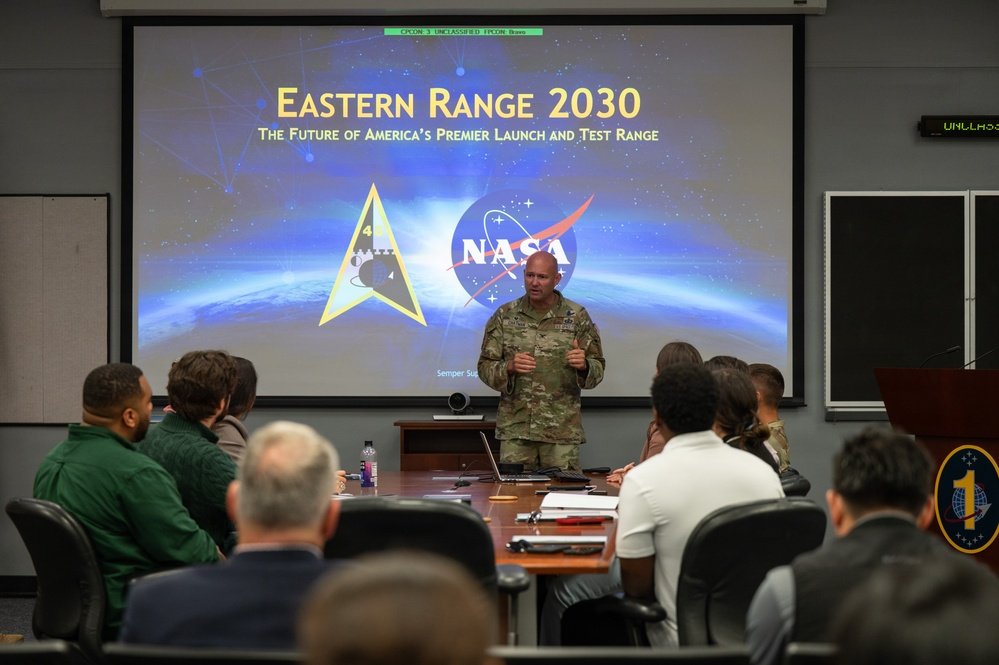
During the visit, staff members toured the Morrell Operations Center, where they received an overview of the organizations, capabilities, and infrastructure required to execute launch operations across the Eastern Range.
The tour included the Mission Control Room, where the 1st Range Operations Squadron oversees launches from the Eastern Range. Staff members also met with U.S. Air Force Col. Douglas Oltmer, commander of the 45th Weather Squadron, to learn how weather forecasting and monitoring support safe and successful launch operations.
Inside the Morrell Operations Center, U.S. Space Force Col. Brian Chatman, commander of Space Launch Delta 45, and U.S. Air Force Lt. Col. Evan Mines, commander of the 45th Civil Engineer Squadron, briefed the group on ongoing and planned infrastructure efforts at Cape Canaveral SFS and Patrick Space Force Base. The discussion focused on expanding launch capacity, strengthening collaboration across the Space Coast, and developing resilient systems capable of sustaining future mission demands.
The need for those investments is driven by continued growth in launch activity. While SLD 45 supported 109 launches in 2025, the Space Coast is projected to support as least 607 launches in 2035. This potential 457% increase in launch cadence requires sufficiently updated capacity across the range’s facilities, utilities, transportation networks, and support services.
Launch operations depend on more than the launch vehicle and pad. Fuel, electrical capacity, heavy-vehicle traffic, transportation routes, and other supporting systems must be able to meet increasing mission demands across the Cape.
Cape Canaveral SFS and NASA’s Kennedy Space Center are separate installations, but coordination among SLD 45, NASA, and commercial launch partners remainsessential to executing the launch mission. This integration enables the Space Coast to support civil, commercial, research, and national security space activities.
As launch activity increases, the Eastern Range will continue developing infrastructure that supports safe, reliable, and responsive launch operations. Staff members observed ongoing construction efforts across Cape Canaveral SFS during their visit.
Concentrating significant space infrastructure in one area provides operational efficiencies, but it can also create vulnerabilities during natural disasters or other disruptions. Expanding redundant routes, utilities, and support systems across the Space Coast can improve resiliency and help ensure launch operations can continue under a wider range of conditions.
The ability to protect and defend the mission is also central to the Eastern Range’s future. Safeguarding the installation, personnel, and critical infrastructure that enable launch operations helps preserve the capability to support national objectives when and where needed.
“We need to be able to launch where we want and when we want,” Mines said. “Infrastructure resiliency and redundancy are paramount for ensuring an uninterrupted launch cadence.”
Construction at Patrick SFB also supports the people who sustain the launch mission. Improvements to installation facilities, transportation networks, and support services can strengthen the health, morale, and readiness of Guardians, Airmen, civilians, and families while helping the base maintain the workforce required for a demanding operational tempo.
“Where we are today is not where we are going to be tomorrow,” said Chatman. “The ongoing construction efforts at Patrick SFB and Cape Canaveral SFS aim to meet the nation’s needs of tomorrow.”
By increasing awareness of these requirements, congressional staff members can better communicate to members of Congress the importance of continued support for the Eastern Range and its planned infrastructure efforts.
The Space Coast’s launch capabilities support national objectives across defense, research, civil space, and commercial missions, helping maintain the Eastern Range as the World’s Premier Gateway to Space.
