

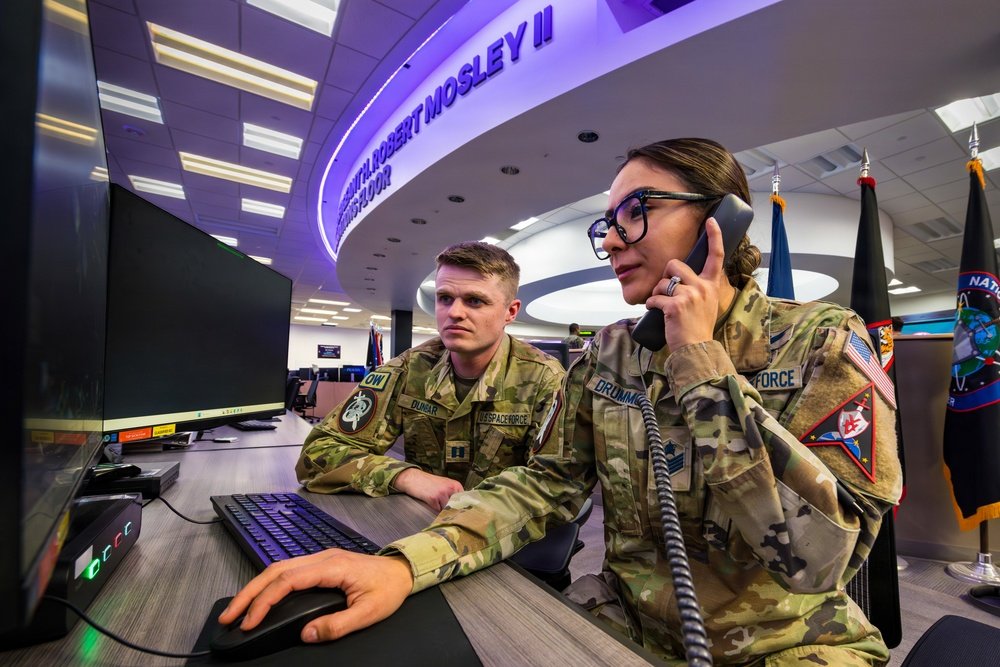
SCHRIEVER SPACE FORCE BASE, Colo. — As adversaries continuously field aggressive counterspace weapons—ranging from destructive anti-satellite capabilities to reversible jamming and blinding lasers threatening U.S. and allied systems—the difference between acting now and acting minutes later can determine mission success. Operating across U.S. Space Command’s area of responsibility, which stretches from 100 kilometers above the Earth’s surface out to infinity, the person best positioned to make that decision is not always the highest-ranking, but they are the most qualified.
Combat Delta 1-15—the vital “shield” for U.S. Space Forces – Space and the Combined Joint Force Space Component—is putting that idea into practice by delegating operational authorities to combat squadrons led by young Guardians who are commanding and controlling space operations in real time.
The approach is rooted in “mission command,” the backbone of the U.S. Space Force command and control that builds common understanding across combat formations and empowers them to take independent action based on commander’s intent rather than waiting for every decision to move up and down the leadership chain, according to the Chief of Space Operations’ 29th CSO Notice to Guardians published July 10, 2024.
While speaking at the Space Symposium in April 2026, Lt. Gen. Richard Zellmann, USSPACECOM deputy commander, highlighted the need to accelerate decision-making while simultaneously preserving critical assets.
“Ideally, you want to enable the most junior people in your formation to make the decision so that you do not get stuck with 1,000 decisions to make at a very senior level,” Zellmann said. “We have to do that because of the speed of the decisions that are going to have to be made in the future, and you need to train to be ready for that environment. But on the other hand, we don’t have the ability to just wantonly use a spacecraft’s fuel for training every day. Our challenge going forward is to find a way to build that training and readiness so our Guardians can be delegated the authorities they need.”
For Space Force Lt. Col. Tyler Paffett, CDEL 1-15 director of operations, speed is a driving consideration.
“We can’t be paralyzed by analysis or not having time to staff courses of action or decisions through layers of command,” Paffett said. “The pace of the threat environment compels S4S to move from a passive support posture to active domain control, and that requires accuracy and speed. Senior leaders must establish objectives, define acceptable levels of risk and provide subordinate leaders with the authorities necessary to act. We must continue to decentralize and delegate.”
From service to combat
Five combat squadrons currently operate under the CDEL 1-15 construct, bringing critical Space Force capabilities together for operational employment. These encompass Space Domain Awareness to detect and characterize orbital threats and Orbital Warfare to maneuver and actively defend high-value space assets. Space Force Combat Forces Command organizes, trains and equips combat-ready forces before presenting them to S4S for operational employment through the Space Force Generation, or SPAFORGEN, model.
Once presented, these units fall under the tactical control, or TACON, of CDEL 1-15. Instead of operating as isolated administrative units, they are integrated tightly into the fight as tactical counterspace forces.
Some crews, such as those in Combat Squadron 9-1—associated with CFC’s 1st Space Operations Squadron, who conduct OW missions, have intelligence and cyber operators packaged into their ranks when they are employed by S4S. While each squadron’s structure and mission may differ from the other, they are all putting the same fundamental concept into practice: Give trained Guardians clear intent and the necessary authorities, then trust them to execute.
For Space Force Capt. Tristan Dunbar, CS 9-1 commander at Schriever SFB, that responsibility is a daily reality.
As with the authority entrusted to military aviators, a junior-grade officer flying an aircraft does not necessarily wait for a colonel or general officer to direct every tactical action as conditions change. The pilot understands the mission, commander’s intent and established authorities, then applies training and experience to the situation in front of them.
Combat squadrons do the same. As uniquely and specifically trained space warfighters, these Guardians possess the elite technical mastery required to outmaneuver and counter hostile threats in a highly contested domain.
“Historically, space has largely been top-down driven. However, to be effective in campaigning and win in conflict, we must be agile,” Dunbar said. “People like me are put through a rigorous vetting and selection process to ensure those entrusted with operational authorities have the experience, judgment and leadership ability necessary to execute the mission flawlessly.”
That authority extends beyond combat squadron commanders to the enlisted Guardians executing the mission.
“It feels incredible, albeit somewhat daunting, being able to make those decisions,” said Tech. Sgt. Tieran Bonner, Combat Squadron 2-18 enlisted leader—associated with CFC’s 18th Space Defense Squadron, who is stationed at Vandenberg SFB, Calif. “People never want to make the wrong decision in hindsight, but our leadership gives us clear intent and restraints when it comes to mission execution. They have the utmost faith that we likely have more information and context at the time to make those decisions at our level. And if we make a mistake, we own it and rapidly implement lessons learned knowing they have our backs.”
Delegating authority accelerates response times and ensures the U.S. maintains the tactical advantage. By establishing clear boundaries and commander’s intent, senior leaders ensure that subordinate squadron leaders are prepared to act decisively.
“This is how you train the next generation,” Paffett said. “It’s important that we give our leaders the trust and authority to make sound, rapid decisions in a dynamic environment.”
Learning as they operate
Once Guardians enter the commit phase of the SPAFORGEN model, they seamlessly transition to these combat squadrons for employment under S4S—frequently operating in the exact same physical location and alongside the same personnel, but under a distinct set of operational command authorities.
“Operating under S4S is how we fully integrate into the rest of the joint force,” Dunbar said. “The clear operational command authorities enable us to focus entirely on delivering combat-relevant space effects in the fight for space superiority.”
Although missions vary across the squadrons, unit leaders can face many of the same questions. Lateral communication provides opportunities to compare experiences and share hard-won wisdom across mission areas.
Stationed in Maui, Hawaii, Space Force 1st Lt. Jacquelyn Harsha, Combat Squadron 2-15 officer in charge—associated with CFC’s 15th Space Surveillance Squadron, and her team are in the early stages of establishing a combat squadron. Once established and presented, her unit will bridge real-time SDA rapid threat characterization.
“Speaking with the other combat squadron leaders has been imperative in solving problems,” Harsha said. “We can learn a lot from units like the 20th SPSS who are very similar to us in their assets and mission planning. But we can also learn just as much from other units, their leadership, management approaches and how we all fit together into this bigger chain.”
CDEL 1-15 leaders maintain frequent touchpoints with combat squadron leaders to understand their challenges, provide advice and share experience.
“Our role is to propel combat squadron success by continually fostering shared awareness of the mission and intent so they can adapt to a dynamic environment and rapidly exploit opportunities as they manifest… Along the way we provide mentorship, context and the top cover these combat squadron leaders need to execute,” said Space Force Col. Bryan Bell, CDEL 1-15 commander. “My job is to make sure our combat squadron commanders have what they need to keep tactical decisions at the tactical level. Time and again, when it’s time to act, they’ve proven themselves up to the task.”
Success in this model hinges on a balance of trust and humility, where senior leaders know when to mentor versus empower, and junior leaders know when to act versus when to elevate. The impact of this approach may extend beyond today’s operations.
Building tomorrow’s leaders
Officers and noncommissioned officers entrusted with real-world operational responsibility are making decisions, managing risk and operating within commander’s intent earlier in their careers, gaining experiences that Space Force Chief Master Sgt. Matt Imschweiler, CDEL 1-15 senior enlisted leader, believes will change the future forces’ leadership for the better.
“These combat squadron leaders are going to be better colonels and chiefs than we are… it’s a night and day difference,” Imschweiler said. “We’re building a strong, empowered warfighting culture. Giving Guardians the training, authority and trust to do their job will ultimately help the force move faster today while developing the leaders who will command it tomorrow.”
For more information on how the U.S. is competing for space advantage, read the U.S. Space Command Space Warfighting Environment 2040.
