

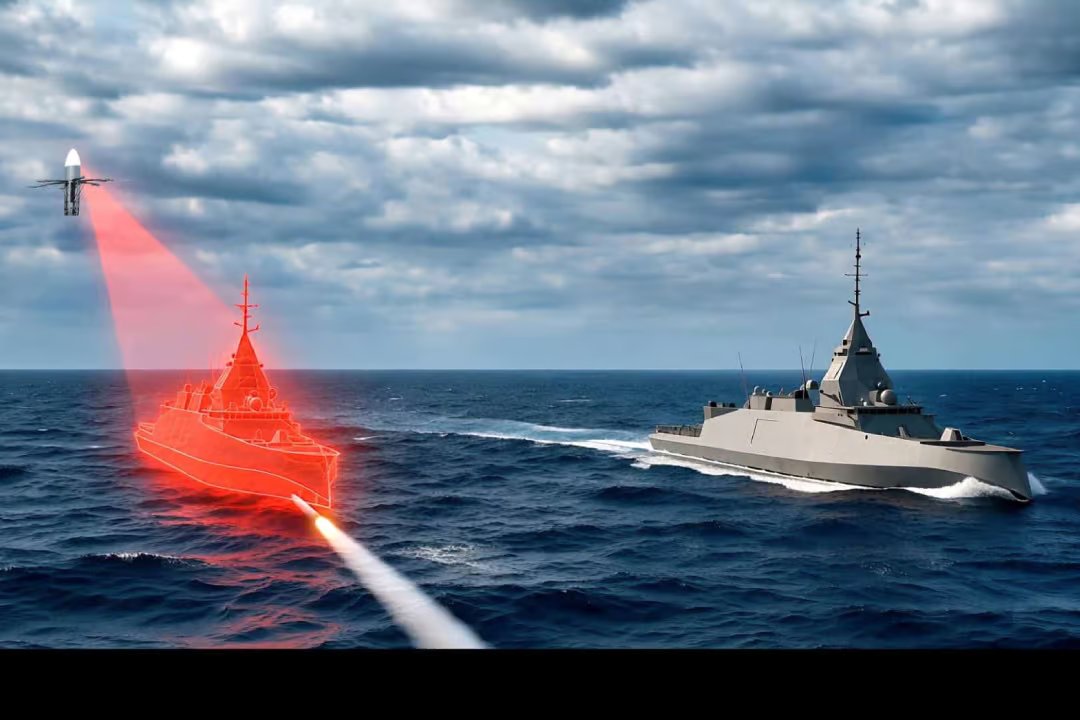

Recent years have witnessed the growing interest of navies in active decoys as a mechanism to engage radar-guided anti-ship missiles.
The 1982 Falklands Conflict, during which the United Kingdom liberated the eponymous islands from Argentine occupation, fixed the radar-guided Anti-Ship Missile (AShM) in the mind of sailors and the public alike as a potent threat. Three British ships were sunk and damaged by the Aerospatiale/MBDA Exocet series air/ground-launched AShMs in the war. 46 sailors lost their lives to these weapons, scores more were injured and traumatised. Since the conflict, AShMs have struck naval vessels on several occasions, the human and materiel costs chronicled in the table below.
Successful Anti-Ship Missile Attacks Since the Falklands War
| Vessel | Flag/Type | Date and Location | Missile Used | Outcome | Casualties |
| Waheed | Libyan Navy ‘La Combattante IIA’ class fast attack craft | 24th March 1986, Gulf of Sidra | Boeing AGM-84 Harpoon | Sunk | Unknown |
| Ain Zaquit | Libyan Navy ‘Project 1234/Nanuchka II’ class corvette | 25th March 1986, Gulf of Sidra | Boeing AGM-84 Harpoon | Sunk | All hands |
| USS Stark | United States Navy ‘Oliver Hazard Perry’ class frigate | 17th May 1987, Persian Gulf | Aerospatiale/MBDA AM-39 Exocet | Heavily Damaged | 37 killed, 21 injured |
| IRIS Sahand | Islamic Republic of Iran Navy ‘Saam/Alvand’ class frigate | 18th April 1988, Strait of Hormuz | Boeing AGM-84 Harpoon | Sunk | 45 killed |
| INS Hanit | Israeli Navy ‘Sa’ar-5’ class corvette | 14th July 2006, Off Beirut, Lebanon | CASIC C-802 | Damaged | Four killed, multiple injured |
| Swift | United Arab Emirates Navy ‘Swift’ class logistics vessel | 1st October 2016, Bab-el-Mandeb Strait, Yemen | CASIC C-802 | Heavily Damaged | Up to four injured |
| Moskva | Russian Navy ‘Slava’ class cruiser | 13th/14th April 2022, Black Sea | Luch Design Bureau R-360 Neptune | Sunk | Up to 40 killed, multiple injured and missing |
| Spasatel Vasily Bekh | Russian Navy ‘Project 22870’ class armed rescue tug | 17th June 2022, Black Sea | Boeing RGM-84 Harpoon | Sunk | Up to 23 killed, over ten injured and missing |
Contemporary threats
Today ongoing conflicts, most notably the continuing war in the Persian Gulf between Israel and the United States, and the Islamic Republic of Iran, continue to feature radar-guided AShMs as dangerous threats. According to Armada’s own collated figures concerning AShM use in that conflict, Iran may have launched between three and five AShMs against US Navy vessels operating in this stretch of water. Fortunately, these attacks have been unsuccessful. This figure, however, is dwarfed by the number of anti-ship missiles thought to have been launched by Iranian proxies since the start of hostilities: To date, Houthi insurgents in Yemen may have launched up to 80 Iranian-supplied AShMs since late 2023. These attacks have not only been directed against US Navy assets operating in the Red Sea and Gulf of Aden areas, but also against allied navies such as those of France and the United Kingdom, deployed to these regions. Any future conflicts involving the US, or allied nations, against the People’s Republic of China or Russia are likely to see significant AShM use by those latter nations in a bid to erode US and allied maritime superiority.
Countermeasures
Radar-guided anti-ship missiles began to be deployed en masse by navies across the world following the dawn of the missile age at the end of the Second World War. As these weapons were deployed, so countermeasures were developed as a riposte. Standard tactics to this end include the use of electronic attack systems to jam or spoof the missile’s Active Radar Homing (ARH) seeker usually transmitting in X-band (8.5 gigahertz/GHz to 10.68GHz) and above. Electronic attack tactics focus on inundating the missile seeker with noise to the extent that weapon loses its lock on the target.
Alternatively, the missile is spoofed using tactics like Range/Velocity Gate Pull-Off (R/VGPO). R/VGPO tactics sample incoming radar signals from the missile as it approaches its target. Samples are used to draft counterfeit radar echoes transmitted into the ARH seeker to confuse it regarding the target’s range and speed. Another spoofing tactic includes the use of Radar Corner Reflectors (RCRs). These are large inflatable devices placed on the surface in proximity to the target. When deployed the RCRs work to either provide a more appealing target via the creation of a more attractive radar cross section thanks to the reflector’s design. RCRs can also be used to create a myriad of tempting targets to confuse the seeker and cause the missile to engage the corner reflector rather than the ship.
The use of active decoys, that is projectiles which contain an electronic attack payload designed to jam or spoof an incoming AShM, is not new. The most famous of these active decoys is arguably BAE Systems’ Nulka which entered service with the US Navy in 1999 and with the Royal Australian Navy two years later. Nulka is designed around a rocket containing an electronic attack payload. When an incoming AShM is detected, Nulka is launched from the ship. The electronic attack payload transmits RF signals to mimic a surface combatant luring the missile away from its target. As the decoy is fired some distance from the ship, the AShM will be pulled away from its target as it pursues the more lucrative prospect presented by the decoy.
Daupin OBAD
Since 2023 France’s Direction Générale de l’Armement (DGA/General Armament Directorate), in conjunction with Thales and Lacroix, has been developing the Dauphin (Dolphin) Off-Board Active Decoy (OBAD). Dauphin is an active decoy containing an electronic attack payload housed in an Uncrewed Aerial Vehicle (UAV) which can be launched from a ship. The DGA is managing the project with Thales providing the electronic attack payload and Lacroix the UAV. The choice of a UAV, as opposed to a rocket, allows the decoy to be placed in the optimum position relative to a potential target to engage the incoming AShM. The missile target maybe the launching vessel, or another ship. Moreover, a UAV may offer potentially longer loiter times compared to a rocket, and an uncrewed aerial vehicle can be recalled to a vessel if not engaged by the threat.
Armada understands from DGA, Lacroix and Thales officials that the electronic attack payload employs a solid state design, as opposed to vacuum tubes, to provide the outgoing RF signal. A Digital Radio Frequency Memory (DRFM) enclosed within the payload generates the spoofing waveforms which are transmitting using a high-power amplifier. Thales officials shared that the existing electronic attack payload design will engage X-band AShMs ARH seekers. Future developments of the payload could see targeted radar frequencies expand into Ku-band (13.4GHz to 14GHz/15.7GHz to 17.7GHz) and beyond. These so-called millimetric wave frequencies are proving popular with AShM ARH seeker engineers as they depict targets in detail. Such accuracy ensures the radar guides the missile to its intended target, the RCS of which is matched against a pre-loaded internal memory, as opposed to an unintended aimpoint. The officials continued that the decoy’s DRFM can create waveforms supporting R/VGPO tactics. Furthermore, the decoy can transmit a similar RCS to the target to confuse the missile seeker or provide a more tempting RCS.
Introduction
Work over the coming months will finalise the Dauphin project definition, DGA officials shared. The next steps in the Dauphin programme call for flight tests to commence in circa 2027. Work still needs to be done to develop a shipboard decoy launching system. Videos depicting the decoy’s deployment show it being sent aloft using a rocket charge before the UAV’s rotors are deployed and the aircraft begins manoeuvring and hovering. As the decoy has been entirely developed in France using French components the design is free from the strictures of the US International Traffic in Arms Regulations (ITAR).
Current contractual arrangements cover the decoy’s definition and flight testing. Any decision on the Dauphin’s formal procurement is yet to be taken and will need a separate contract, as will the decoy’s integration on Marine Nationale (French Navy) surface vessels, DGA officials continued. Should the navy proceed with procurement, it will need to develop a concept of operations for the decoy’s use and incorporate Dauphin into Marine Nationale doctrine. It would seem likely that the decoy would be deployed in concert with shipboard jamming/spoofing capabilities and other countermeasures like chaff, alongside kinetic effects like surface-to-air missiles and close-in weapons systems. Assuming a decision to procure and deploy Dauphin is taken by the Marine Nationale, based on the timetable for the flight trials, the decoy could be protecting French naval vessels from circa 2030.
by Dr. Thomas Withington
