


The dependence of Russian airpower on timely meteorological information to support operations in the Arctic represents a potential vulnerability for electronic warfare and cyberattack.
Regular readers of Armada’s electronic warfare webpages and monthly newsletter will be aware of our coverage of Russia’s Integrated Air Defence System (IADS) produced in conjunction with EW Analytics LLC. The Russian Aerospace Force’s Aviation Guidance Points (AGPs) have been of particular interest. AGPs are used as control and reporting centres for Russia’s IADS with each of the country’s Military Districts (MDs) having several.
Aviation Guidance Points feed their Recognised Air Picture (RAP) into the larger, federated RAP produced by each MD’s Air and Air Defence Forces Army (AFADA). The AFADA is the operational/strategic command for all air forces and air defence forces within that military district. It is highly likely that the RAPs produced by the radars equipping each AGP are sent upwards from the MD to the strategic level to provide a detailed, strategic view of Russian airspace and air approaches.
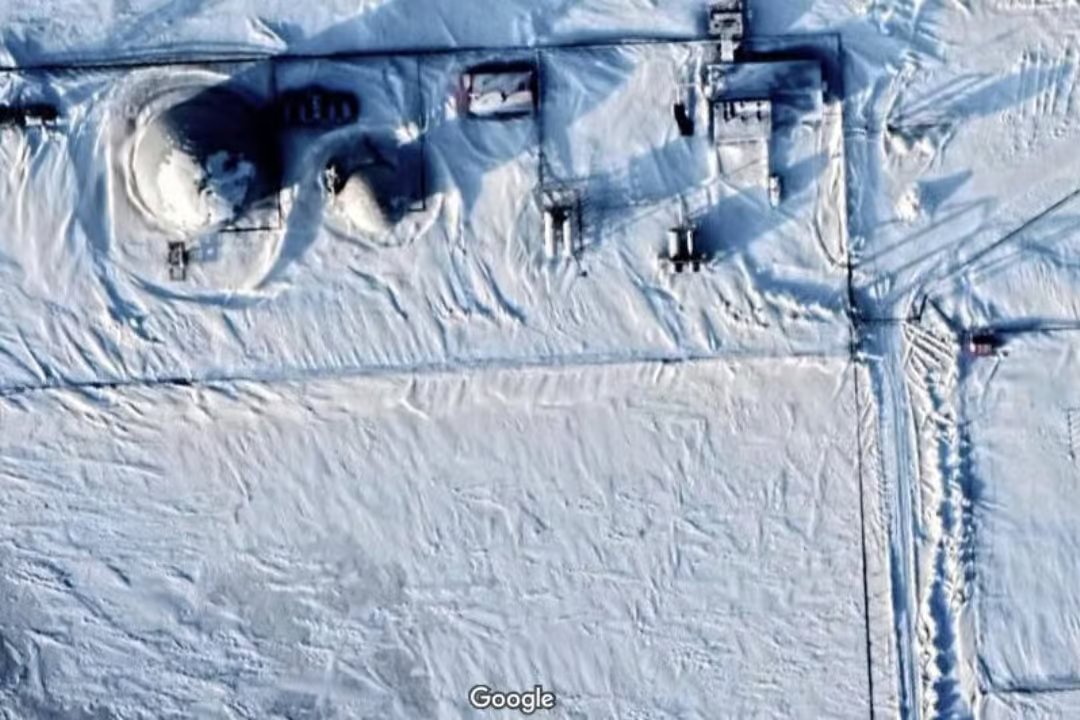
Nagurskoye airbase located on Alexandra Land in the Arctic Ocean’s Franz Josef archipelago is home to the Arctic Trefoil AGP. This facility has assumed increasing strategic importance given the emerging tensions between the North Atlantic Treaty Organisation (NATO) and Russia in the far north. As EW Analytics LLC’s analysis makes clear, the AGP at Nagurskoye airbase would play a key role directing MiG-31 (North Atlantic Treaty Organisation/NATO reporting name Foxhound) series combat aircraft against NATO warplanes in the event of a confrontation in the Arctic. The analysis continues that the Nagurskoye AGP is responsible for the airspace and air approaches over the Franz Josef archipelago, the Barents Sea and North Pole.
Sopka-2
A key capability deployed at this AGP, and others around Russia, is the 12A6 Sopka-2 radar. The Sopka-2 is an S-band (2.7 gigahertz/GHz to 2.85GHz) multipurpose system that can be used for ground-based air surveillance, fire control/ground-controlled interception and air traffic control. As EW Analytics LLC’s investigations have previous noted, the radar has a range of circa 243 nautical miles/nm (450 kilometres/km). It can detect a target at around 328,084-feet/ft (100,000-metres/m) altitude at approximately 65nm (120km). Targets at circa 32,808ft (10,000m) altitude can be detected at ranges of 216nm (400km). Importantly, these figures do not specify the Radar Cross Section (RCS) of the target. Target RCS will influence detection ranges and altitudes.
The Sopka-2 is joined by an 1RL131 Terek (Spoon Rest-D) Very High Frequency (VHF: 133 megahertz/MHz to 144MHz/216MHz to 225MHz) ground-based air surveillance and PRV-13 (Odd Pair) S-band height-finding radars at the facility. The 12A6 is believed to have only rudimentary electronic counter-countermeasure performance. It is possible that the 1RL131s and PRV-13s are used as back-ups should the 12A6 experience jamming. They may also provide additional track data to enrich the ACP’s RAP.
Weather prophets
Recent analysis produced by EW Analytics LLC posits that the Arctic Trefoil facility receives meteorological data via the R-441 Liven vehicle-mounted satellite communications system deployed at the base. The Liven constellation is thought to provide C-band (5.925 gigahertz/GHz to 6.425GHz uplink/3.7GHz to 4.2GHz downlink), S-band (2.025GHz to 2.110GHz uplink/2.2GHz to 2.290GHz downlink) and X-band (7.9GHz to 8.4GHz uplink/7.25GHz to 7.75GHz downlink) connectivity. This meteorological data probably includes information gathered by Russia’s Arktika-M meteorological satellite constellation. These satellites are optimised to gather Arctic weather data.
Meteorological information collected by Arktika-M satellites is processed by Russia’s SRC Planeta earth observation satellite organisation. SRC Planeta is part of the country’s Federal Hydrometeorological and Environment Monitoring Service. The meteorological data provided to the Arctic Trefoil AGP is particularly important for mission planning and execution in this part of the world, EW Analytics LLC’s analysis continued.
Additional weather situational awareness can be supplement by data collected via the Sopka-2’s weather channel which can detect cloud formations “and determine their type and spatial structure (and) measure the direction and speed of their movement”. The radar’s weather channel can also detect precipitation and thunderstorms. A local facility, known as Weather Station 200340 collocated at the Arctic Trefoil base, generates additional weather information.
Assessment
Russia’s strategic reliance on meteorological data, particularly in Arctic regions, provides a potential centre-of-gravity that could be exploited by NATO and allied nations in times of tension and/or war with Russia. Targeting meteorological facilities at the Arctic Trefoil, seeking to jam the Sopka-2’s weather channels and attacking the R-441 SATCOM links the facility depends on for Arktika-M information could help to deprive Russian airpower of the weather information it would depend on for air operations. Information technology infrastructure that SRC Planeta relies on process to Artika-M data could also present a potentially lucrative cyberattack target.
As EW Analytics LLC’s analysis predicts “(a) cold (war) front will arrive in the Arctic bringing with it the potential for electronic warfare/cyber activity impacting Russian meteorological infrastructure that supports military operations in the ‘High North’’’. To learn more, visit EW Analytics LLC’s website at
by Thomas Withington
