

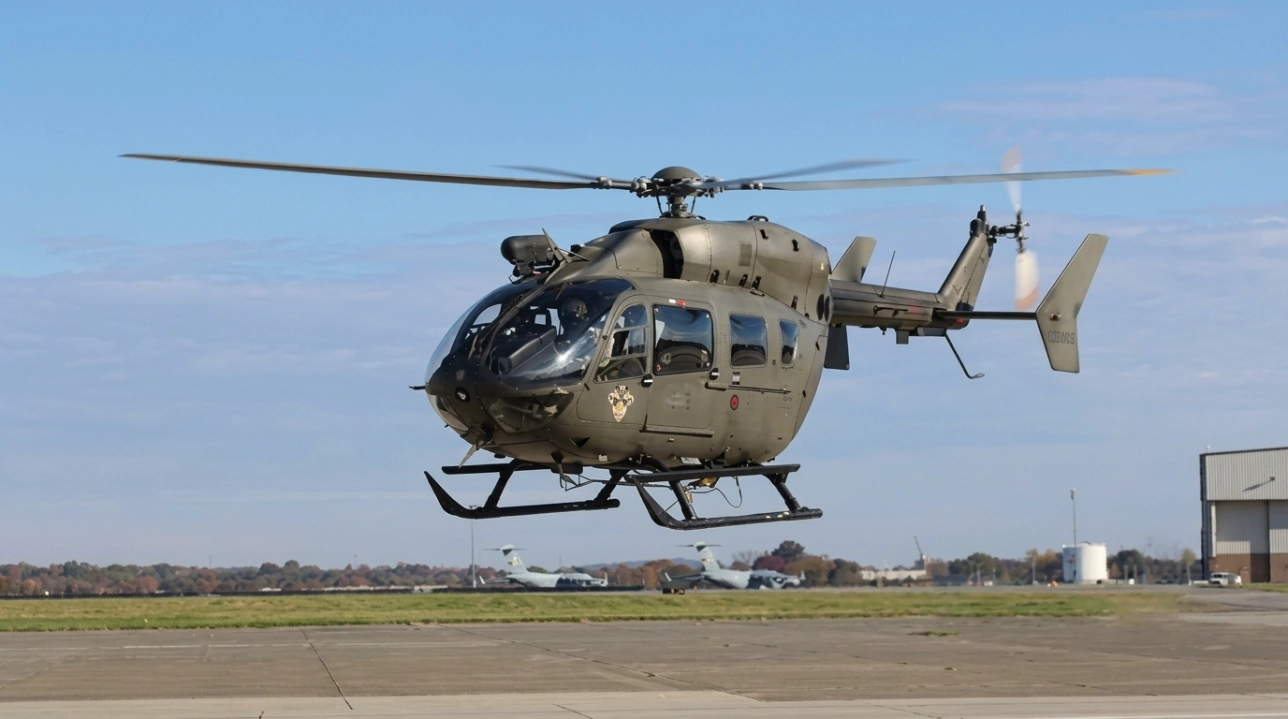
When a military helicopter spends more time supporting people than chasing targets, its value can be easy to overlook. But in the United States, some of the most important aviation missions happen far from a battlefield.
That is where the UH‑72 Lakota has carved out its niche.
Designed as a light utility helicopter for the U.S. Army, the UH‑72 Lakota is built around a rather practical idea: provide a dependable aircraft for missions that need flexibility, availability and relatively straightforward operation. Search and rescue, medical evacuation, reconnaissance, training and homeland-security support are among the roles associated with the platform.
The story behind the UH‑72 Lakota is just as interesting as the helicopter itself. Rather than starting with a completely new military design, the U.S. Army selected a commercial off-the-shelf platform derived from the Airbus EC145. That decision shaped almost everything that followed, from procurement and maintenance to the way the helicopter has evolved.
The UH‑72 Lakota first entered Army service in 2007 after being selected under the Light Utility Helicopter program. Since then, the fleet has accumulated more than 1.6 million flight hours, according to Airbus, while the helicopter has expanded across Army and Army National Guard operations.
And there’s an important detail here: the UH‑72 Lakota was never intended to be a miniature version of a heavy combat helicopter.
Its strength lies elsewhere.
It is the helicopter that can be called upon for a rescue mission, a training sortie, a domestic emergency or a support task without requiring the footprint of a mu
Why Did the U.S. Army Choose the UH‑72 Lakota?
The UH‑72 Lakota began with a problem that had little to do with battlefield firepower. The U.S. Army needed a modern light helicopter for everyday missions, while much of its existing fleet was built around older airframes and increasingly demanding support requirements.
Instead of developing another clean-sheet military helicopter, the Army took a different route.
In 2006, it selected the EC145-based Lakota under the Light Utility Helicopter program. The concept was straightforward: use a mature commercial platform and adapt it for military requirements. That approach reduced the need to develop an entirely new airframe and offered the Army a helicopter already supported by an established industrial ecosystem.
The choice also reflected the type of missions the UH‑72 Lakota was expected to perform.
This was not intended to be a heavily armed frontline aircraft. The Army positioned the UH‑72 Lakota for roles including general support, reconnaissance, command and control, search and rescue and medical evacuation, particularly in environments where a larger combat helicopter was unnecessary.
That distinction is important.
Think of the UH‑72 Lakota less like a military pickup built for rough combat zones and more like a dependable fleet vehicle: it needs to be available, adaptable and relatively straightforward to maintain because its workload is constant.
Read also: Eurocopter Tiger: How Powerful Is This Attack Helicopter?
The Army National Guard also became an important part of the UH‑72 Lakota story. Its domestic mission set includes emergency response and other support activities where a light utility helicopter can provide mobility without the operating footprint of a larger platform.
So the Army’s decision was ultimately about matching the aircraft to the job.
The UH‑72 Lakota wasn’t designed to do everything. It was designed to handle a large category of routine and domestic aviation missions efficiently and that focused purpose would become central to its long-term value.
What Are the UH‑72 Lakota Specifications?
The UH-72 Lakota may look compact beside helicopters such as the UH-60 Black Hawk, but its specifications reveal why the Army selected it for a different class of work. This is a light utility platform designed to balance useful payload, speed, range and operating efficiency.
The UH-72A has a maximum gross weight of about 7,903 pounds and a useful load of roughly 3,953 pounds. Its published maximum cruise speed is around 145 knots, while its range is approximately 370 nautical miles under specified conditions. The aircraft is powered by two Turbomeca Arriel 1E2 turboshaft engines.
| Specification | UH-72A Lakota |
| Type | Light utility helicopter |
| Engines | 2 × Turbomeca Arriel 1E2 |
| Maximum gross weight | ~7,903 lb |
| Useful load | ~3,953 lb |
| Maximum speed | ~145 knots |
| Range | ~370 nautical miles |
| Service ceiling | ~13,181 ft |
| Fuel capacity | ~229 gallons |
Numbers like these are useful, but they don’t tell the whole story.
The UH‑72 Lakota’s design philosophy is about usable capability rather than sheer size. Its twin-engine arrangement provides the power needed for utility operations while giving the aircraft the configuration expected for missions where reliability and operational flexibility matter.
The cabin is another important part of the equation. Depending on the configuration, the helicopter can be adapted for passengers, medical evacuation, cargo or other support roles. That flexibility allows operators to change the aircraft’s purpose without fundamentally changing the platform.
And this is where the UH‑72 Lakota becomes interesting.

Its specifications don’t compete with heavy military helicopters on payload. They don’t need to. The UH‑72 Lakota occupies a different space; one where a relatively light aircraft can handle frequent support missions without bringing the size and complexity of a much larger helicopter.
In other words, the numbers make more sense when viewed through the missions the Lakota was actually built to perform.
What Makes the UH‑72 Lakota a Reliable Helicopter?
Reliability sounds simple until you have to keep an aircraft available day after day. For a utility helicopter, the real test isn’t how impressive it looks on a specification sheet. It is whether crews can count on it when a training mission, rescue call or domestic support task appears on short notice.
That is where the UH‑72 Lakota has built much of its reputation.
One reason is the aircraft’s commercial heritage. The UH‑72 Lakota is derived from the Airbus EC145 family, meaning its basic architecture came from a helicopter already developed for demanding civilian operations. The Army’s decision to use a commercial off-the-shelf (COTS) platform also reduced the need to create an entirely new helicopter and allowed the military to benefit from an established production and support system.
The numbers provide some useful context. Airbus reports that the UH‑72 Lakota fleet has accumulated more than 1.6 million flight hours, while the company has highlighted fleet availability above 90 percent.

Those figures matter because availability is the quiet currency of utility aviation.
A helicopter sitting on the ground for maintenance cannot conduct a rescue, carry personnel or train a new crew. A platform that can spend more time available for missions creates value even when its individual flights aren’t particularly dramatic.
The UH‑72 Lakota’s twin-engine configuration also fits its utility role. It provides the aircraft with two sources of propulsion while supporting the performance requirements of a light helicopter.
But reliability isn’t just about having two engines or a strong airframe.
It’s the combination of design maturity, maintainability, fleet experience and availability that makes the UH‑72 Lakota particularly useful. And that becomes clearer when we look at what the helicopter is actually asked to do.
What Missions Does the UH‑72 Lakota Perform?
The UH‑72 Lakota was not built around a single mission. Its real strength is the ability to switch jobs without requiring the size or complexity of a heavy military helicopter.
For the U.S. Army and Army National Guard, that flexibility covers a surprisingly broad range of work. The Army identifies the UH‑72 Lakota for general support, reconnaissance, command and control, search and rescue and medical evacuation, particularly in permissive environments.
Search and rescue is one of the easiest roles to understand. When someone needs help in difficult terrain or during an emergency, a light utility helicopter can provide rapid access while carrying the personnel and equipment needed for the mission.

The same basic idea applies to medical evacuation. The UH‑72 Lakota can be configured to transport patients and medical personnel, turning the helicopter into a flying link between an incident site and medical facilities.
Then there is reconnaissance.
The UH‑72 Lakota’s relatively compact size and maneuverability make it useful for observation and support tasks where a larger aircraft may be unnecessary. It can also perform command-and-control duties, giving personnel an airborne platform from which to coordinate activities.
Training is another major part of its workload.
A military helicopter fleet needs aircraft that can keep pilots and crews proficient without consuming the resources of a larger combat platform for every training requirement.
How Does the UH‑72 Lakota Support Domestic Operations?
The UH‑72 Lakota spends much of its working life far from the image most people associate with military helicopters. Instead of operating over a battlefield, many Lakotas are used for missions that begin with a phone call from a state, federal or local emergency organization.
That makes the helicopter particularly relevant to domestic operations.
The Army National Guard is a major part of this story. Because Guard units operate within individual states as well as supporting national missions, their aircraft can be called upon for emergencies ranging from search-and-rescue operations to disaster response.
The UH‑72 Lakota’s light utility design fits this environment well: it can move personnel and equipment while operating from locations that may not require the infrastructure associated with larger helicopters.
Its usefulness becomes especially apparent during natural disasters.

Floods, wildfires and severe storms can disrupt roads and isolate communities. A helicopter can bypass those damaged transportation networks, providing access when ground vehicles are slowed or simply cannot get through. The UH‑72 Lakota can support observation, transportation and coordination while other agencies concentrate on the response itself.
Search and rescue is another natural fit.
Whether the challenge involves difficult terrain or an isolated emergency, the aircraft can provide an aerial platform for crews working to locate and assist people. Its medical-evacuation capability adds another layer, allowing appropriately configured aircraft to support the movement of patients.
There is also a less visible role: training.
Army and National Guard crews need regular flying experience, and a dedicated light utility platform can handle many training and support requirements without tying up larger helicopters designed for more demanding missions.
That is the UH‑72 Lakota’s domestic advantage.
It doesn’t need to be the biggest helicopter in the fleet. It needs to be available, adaptable and close to the communities it may be called upon to support. For domestic aviation, those qualities can matter just as much as raw performance.
Why Does the UH‑72 Lakota Use a Commercial Off-the-Shelf Design?
The most unusual thing about the UH‑72 Lakota may not be its twin-engine layout or light utility role. It is the decision behind the aircraft itself: the U.S. Army chose a helicopter with strong commercial roots instead of developing a completely new military design.
That approach is known as commercial off-the-shelf (COTS) procurement.
The UH‑72 Lakota is derived from the Airbus EC145, a helicopter already developed for civilian operators. For the Army, that meant starting with an established aircraft rather than paying for the long development cycle associated with a clean-sheet military platform. The Army selected the EC145-based design in 2006 under its Light Utility Helicopter program.
Why does that matter?
Think of it like buying a proven commercial vehicle and then fitting it for a specialized job. The basic machine already exists, production processes are established and engineers have accumulated experience operating and maintaining it. The military can then adapt the platform around its own requirements.

That doesn’t make the helicopter automatically simple. Military operations still demand specialized equipment, training and maintenance procedures. But the COTS approach can reduce some development risk while providing a pathway for incremental improvements.
It also creates an interesting relationship between civilian and military aviation.
Because the underlying helicopter belongs to a commercial product family, technological improvements can continue as the wider platform evolves. The UH-72B, for example, incorporates technologies associated with the newer H145 generation, including updated avionics and flight-control systems.
For the Army, that means the UH‑72 Lakota isn’t frozen in the technology of its original introduction.
Its commercial DNA provides a development pathway that can continue over time.
And perhaps that is the biggest lesson from the UH-72 Lakota program: sometimes military capability doesn’t have to begin with a military-only design. A mature commercial platform, adapted carefully for the job, can become a surprisingly useful part of a military fleet.
How Has the UH‑72 Lakota Evolved Since Entering Service?
The UH‑72 Lakota did not remain exactly the same helicopter the U.S. Army selected in 2006. Its story has been one of gradual evolution, with the platform adapting as the Army’s requirements and available aviation technology changed.
The first production aircraft entered Army service in 2007, beginning what would become a large light-utility helicopter fleet. Rather than being treated as a short-term procurement, the UH‑72 Lakota gradually became integrated into Army and Army National Guard aviation operations across the United States.
The scale of that experience is significant. Airbus says the UH‑72 Lakota fleet has accumulated more than 1.6 million flight hours, providing a substantial operational base for understanding the aircraft, its maintenance requirements and its different mission configurations.
Then came the next major step.

The UH-72B builds on the newer H145 generation of the aircraft, bringing changes that include a five-blade main rotor, a Fenestron shrouded tail rotor and updated Helionix avionics. The newer configuration also incorporates Safran Arriel 2E engines and a four-axis autopilot, giving the Lakota family a significantly more modern technological foundation.
That evolution is worth watching because it shows how the original COTS philosophy continues to influence the program.
Instead of replacing the Lakota concept entirely, newer technology can be incorporated into an established platform family. The result is a helicopter that retains its light utility identity while gaining capabilities from a newer generation of commercial aviation technology.
The Lakota has also attracted interest for potential future applications beyond its traditional crewed roles, including unmanned concepts derived from the H145 platform.
So the UH‑72 Lakota’s development has been less about dramatic reinvention and more about steady modernization.
That may sound less exciting than introducing an entirely new aircraft, but for a utility helicopter expected to serve for years, incremental improvement can be exactly the point.
