

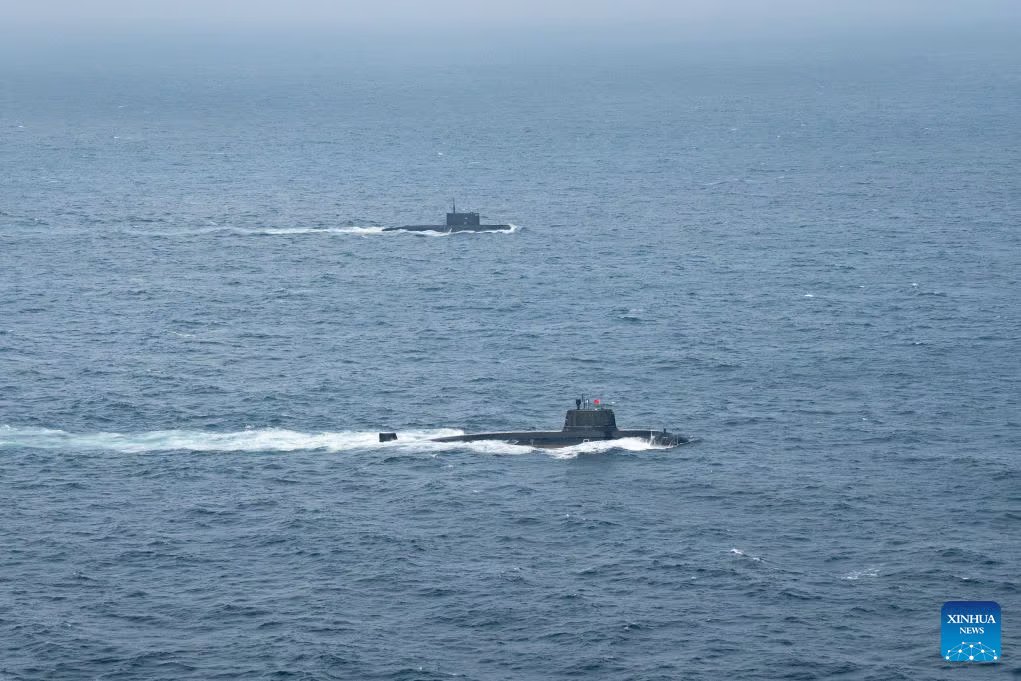
China and Russia expanded their naval cooperation by integrating submarines into the latest Joint Sea-2026 exercise, held from 6-13 July, and underscoring growing interoperability between the two navies.
For the first time since the exercise series began in 2012, a People’s Liberation Army Navy (PLAN) Type 039B submarine and a Russian Navy’s Kilo-class submarine, Ufa on this occasion, participated in the weeklong drills.
In all, the naval exercise involved ten ships from the two navies.
Previous Joint Sea exercises have largely centred on surface combatants, with operating areas gradually extending beyond the “near seas” into the Western Pacific. Earlier iterations have seen Chinese and Russian warships transit strategic waterways such as the Tsugaru Strait between Japan’s Honshu and Hokkaido islands, and the Luzon Strait south of Taiwan.
China’s Ministry of National Defense said this year’s exercise focused on joint reconnaissance, air and missile defence, anti-surface warfare and joint submarine search-and-rescue operations.
The PLAN deployed the Type 055 destroyer Anshan, the Type 052D destroyer Kaifeng, the Type 054A frigate Wuhu, the Type 903 replenishment ship Kekexilihu, the Type 926 submarine support and rescue ship CNS Yangchenghu, and an unnamed Type 039B submarine.
Russia’s Pacific Fleet contributed its flagship, the Slava-class cruiser Varyag, the Steregushchiy-class corvette Rezky, the Project 21300 submarine rescue ship Igor Belousov, and the Kilo-class submarine Ufa.
The inclusion of submarines marks a notable expansion in the scope of Sino-Russian naval cooperation, reflecting increasing operational trust in one of the most sensitive areas of naval warfare.
The participation of dedicated submarine rescue vessels from both navies also suggests an emphasis on developing common procedures for undersea operations.
The exercise followed a joint patrol by Chinese and Russian strategic bombers in late June over waters near Japan and South Korea. Such activities highlight the growing frequency and complexity of military cooperation between the two countries.
Right after the exercise, Japan’s Ministry of Defense said on 19 July that three Chinese ships and the Russian Rezky were operating within its exclusive economic zone. Furthermore, Kaifeng conducted live-fire drills 180km southwest of Okinotori Island.
Tokyo lodged a protest with China and highlighted the danger posed to maritime navigation of such gunnery activities.
by Chen Chuanren
