

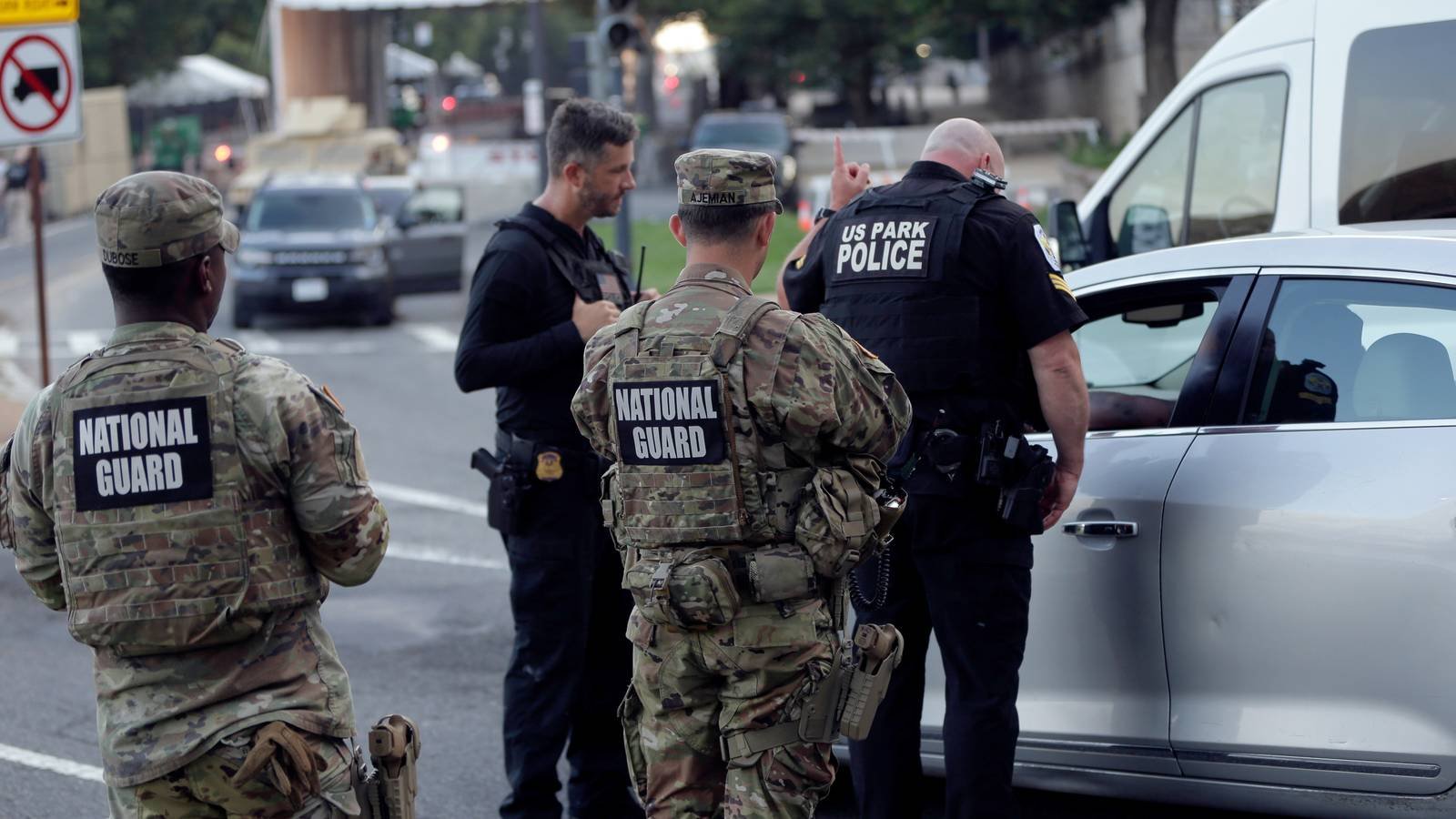
The National Guard members patrolling Washington, D.C., this summer operate under a specific set of limitations. They can detain people; they cannot arrest them. That line, and where it falls, is now the subject of a $3 million legal claim filed by a decorated Army combat veteran who says Idaho guardsmen crossed it outside her home.
Anna King, a retired Army captain and recipient of the Purple Heart and Bronze Star, filed the administrative claim July 28 against the Department of Defense and the Idaho National Guard.
She alleges that guardsmen detained her without cause, forced her to the ground and handcuffed her so tightly that they ruptured a ligament in her wrist. The claim was filed under the Federal Tort Claims Act by the American Civil Liberties Union of the District of Columbia and the law firm Levy Firestone Muse.
One day after the incident, on May 9th, she was formally charged with two misdemeanor counts of assaulting an officer stemming from her physical struggle with the Guardsmen.
King has pleaded not guilty, and because she has not been convicted, her criminal case and her civil tort claim now sit on separate legal avenues. Each describes the same few minutes on a Washington sidewalk in irreconcilable terms.
Detain, but Not Arrest
That distinction at the center of the case is a key feature of how these particular National Guard deployments work. They are federally funded but remain under the command of their state governors rather than the president, according to reporting by NPR and analyses by the Brennan Center for Justice.
Since they have not been federalized, they are not a police force. Patrolling and detaining are within their powers, but they cannot make arrests; they do, however, operate alongside sworn officers who can.
A War Department official, speaking on background, described the framework to Military.com in similar terms. District of Columbia National Guard members serving under Title 32 are providing support to the Metropolitan Police Department and federal law enforcement agencies. The official also noted that they are accompanied by those officers in the course of their duties, and are required to follow the D.C. National Guard’s rules for the use of force.
ACLU told Military.com that King’s attorneys will argue the guardsmen exceeded even that authority. It is the ACLU’s understanding, the organization said, that the National Guard was not authorized to conduct the kind of enforcement action that took place outside her home.
The legality of the deployment itself is currently being contested. A federal judge ruled in November that the District was likely to succeed in its argument that the administration exceeded its statutory authority in sending the Guard to patrol the city, and the case is ongoing. Since then, the deployment has been extended into 2029.
The Alleged Claims
King’s account is laid out plainly in her claim. It begins on the evening of May 8, as she sat on a bench outside her apartment. On her patio were signs opposing the Guard’s presence in the city, including one that read “Occupation: Troops Out.”
Guardsmen approached her, her claim said, without explaining why or presenting a warrant. When she tried to go back inside, she was blocked. According to the filing, the guardsmen surrounded her, forced her toward the concrete, pressed their weight onto her back and cuffed her wrists behind her with plastic restraints that she said were fastened extraordinarily tightly.
She screamed in pain, the claim said, and one guardsman pressed a knee into her back and pulled her arms upward. They held her on her stomach until Metropolitan Police officers arrived, the claim said. The officers tried to remove the plastic cuffs, found them too tight, and replaced them with metal ones.
King said the encounter ruptured one or more ligaments in her wrist, requiring surgery, and left her arm in a cast with little feeling in her thumb. A combat veteran who deployed to Iraq and has been treated for post-traumatic stress disorder, she said the episode reactivated it. “We are not at war with Americans, and my porch is not a war zone,” she said in a statement released with the claim.
According to the ACLU, King was medically discharged from the Army with significant service-related injuries and has coped with their physical and emotional toll largely through making art. The wrist injury from the May 8 detention, the organization said, has sharply limited her ability to do that work, damaging what it called one of her most important sources of healing.
Another Case Pending
A stated reason for the detention appears in King’s own filing. A police officer, the claim said, later told one of her neighbors that she was suspected in an assault on a guardsman two days earlier. Her attorneys called that accusation baseless and noted she was never charged over it.
She was, however, charged in connection with the original encounter itself. Court records show King was charged May 9 with two misdemeanor counts of assaulting an officer, tied to the detention described in the claim. She has not been convicted.
The ACLU stated that they reject that charge. King was “baselessly accused of assaulting the very people who were assaulting her,” the organization said, and video of the encounter shows she did no such thing. Her criminal defense attorneys will contest the charge, the group said, while it pursues the tort claim. “We remain committed to seeking accountability for the harm done to Ms. King,” the ACLU said.
The War Department declined to address the specific allegations to Military.com, including King’s claim that she was targeted for her protest signs.
They also would not say whether the guardsmen involved remain on duty or whether the incident is under investigation. As a matter of longstanding policy, the official said, the department does not comment on ongoing litigation.

One of Many
King’s claim is not an isolated one. The ACLU and its affiliates said they filed 54 such claims on July 28 across 17 states and Washington, D.C., against the conduct of federal law enforcement and deployed troops. Taken together, the organization said, the claims expose what it called a pattern of civil rights violations and abuse of power tied to the Trump administration’s agenda.
Idaho is just one of many states that have sent Guard members to the capital as part of the Joint Task Force overseeing the deployment. As of July 28, according to the D.C. National Guard, 99 Idaho guardsmen were there.
What remains is a single encounter that has split into two legal cases pulling in opposite directions. A criminal charge and a $3 million claim, both drawn from the same stretch of sidewalk, are now waiting on a decision as to which account holds.
