

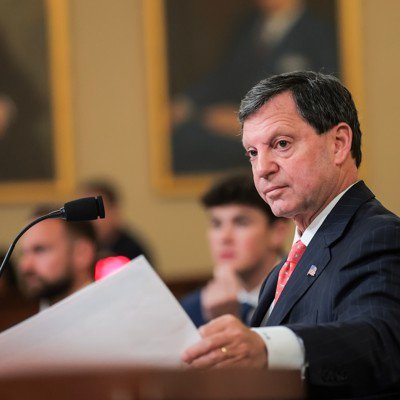
Social Security Commissioner Frank Bisignano on Wednesday touted a year of “transformation” at the beleaguered agency, touting improved service metrics and deflecting repeated questions regarding changes to their underlying methodology.
Bisignano testified before a joint session of the House Ways and Means Committee’s Social Security and work and welfare subcommittees, excoriating the Biden administration and former Commissioner Martin O’Malley for what he called a “failed service model” in the agency’s push in 2024 to encourage Americans to make an appointment ahead of visiting a field office.
“Before I arrived in May of 2025, SSA had four different leaders in five months and was an agency in turmoil,” he said, frequently overwhelming his microphone. “The American people endured a failed service model with the Biden administration’s so-called appointment-focused service, which turned people away who traveled to our field offices.”
But O’Malley told Government Executive after the hearing that’s not true: the agency specifically warned field office workers not to turn away any person seeking walk-in services.
“Yeah, that’s totally false,” he said. “We were doing everything we could to encourage people to make appointments, but we also admonished many times that no one is ever to be turned away. It’s similar to what we did with the [Motor Vehicle Administration in Maryland], which is we told people, ‘Hey, you should make an appointment,’ but we never turned anyone away.”
Indeed, a 2024 message to SSA employees regarding the Appointment Focused Service initiative makes clear that field offices can and should continue to provide walk-in service. Language on ssa.gov similarly still strongly encourages people make appointments in advance.
“SSA is expanding appointments (phone, video or in-office where appropriate) to enhance our service delivery and improve the customer experience,” the transmission states. “We will continue to promote online services and will not refuse in-person customer service at our [field offices and Social Security card centers]. By scheduling most in-person customers for appointments, we can minimize wait times, promote online and automated services, and ensure that staff can focus on delivering quality service to each customer.”
Bisignano also continued to tout purported improvements in customer service metrics, which have been hotly disputed by advocates and the agency’s unions due to recent changes to how those statistics are measured.
“[We’ve reduced] the average speed of answer on the 800 number to the lowest level in a decade to under 5 minutes in May 2026—an 89% reduction from an all-time monthly high of 42 minutes in fiscal year 2024,” he wrote in his written testimony.
But those figures are misleading for two reasons. First, the 42-minute average wait time figure dates back to November 2023; by the end of 2024, average 1-800 wait times had fallen to 12 minutes. The second problem is that last summer, Bisignano changed SSA’s methodology for calculating call wait times by omitting the time customers who elected to be called back rather than be put on hold waited for their call back, instead calculating their wait time as “zero.”
Last December, the Social Security Administration’s Office of the Inspector General released a report noting this change—and that those who elected to use the 1-800 number’s call-back feature waited an average of one hour 49 minutes to be served—but ultimately found the agency’s published metrics to be “accurate.” And in March, The Washington Post reported that an earlier draft calculated a new “total wait time” metric that reflected those people’s waits alongside those who elected to stay on the phone, but it was removed before publication.
American Federation of Government Employees Council 220 President Jessica LaPointe, whose union represents field office and teleservice center employees, said in a statement Wednesday that Bisignano’s metrics paper over a staffing crisis. The agency has lost more than 7,000 employees since Trump returned to office last year, bringing its headcount to a 59-year staffing low, which dates back to before the creation of Supplemental Security Income, and the agency has reassigned around 2,500 field office employees to man the 1-800 number to spread the workload.
Rep. Gwen Moore, D-Wis., pressed Bisignano on his reassignments.
“We have 2,500 employees with specific skillsets all removed and put on the 800 number so when people do call, depending on who answers, they might not have the answers or the skillset to help them, and so they don’t get the proper answers,” Moore said. “[Is] the 800 number and the shuffling of staff—is that supposed to realize some efficiencies that we haven’t seen?”
“I think a good way to think about this whole situation is that we used to have 400 people on the phone at 8 a.m. and that was not a sufficient number,” Bisignano said. “That was predating me, the era you well remember when we told people that appointments were needed.”
“Well then why are people waiting 46 minutes and then when they do get somebody, that person can’t answer questions because they weren’t put through to the right benefits officer?” Moore asked. “Do you think the 1-800 number thing is a magic bullet in place of not having enough employees?”
“What I think in fact is with the right amount of staff in the right places—” he responded.
“Well I don’t agree with you on that,” Moore interjected.
“You wouldn’t know how to manage 50,000 people anyway,” Bisignano said.
Rep. Don Beyer, D-Va., asked Bisignano about training standards for the field office-turned call center employees, citing Government Executive’s February reporting that the materials instructed workers to suggest that “suicide is only one option” if they encounter callers who express ideation toward self harm.
“These employees used to get months of training and then would shadow a full time phone operator, but now they’re getting three hours’ training and placed on the phones basically the same day,” Beyer said. “These are bizarre and dangerous instructions.”
“I think we amended that message, and, by the way, we got that from an authority and went back to the authority,” Bisignano said. “If you want to make that what this hearing is about, that’s kind of fine. We can talk about that one line, we can also talk about the fact that your wait times are down 76%, we can also talk about how field office visits were down 3%.”
“I just wanted you to say you were addressing the issue,” Beyer said.
“We addressed it four months ago when it occurred,” Bisignano said.
