

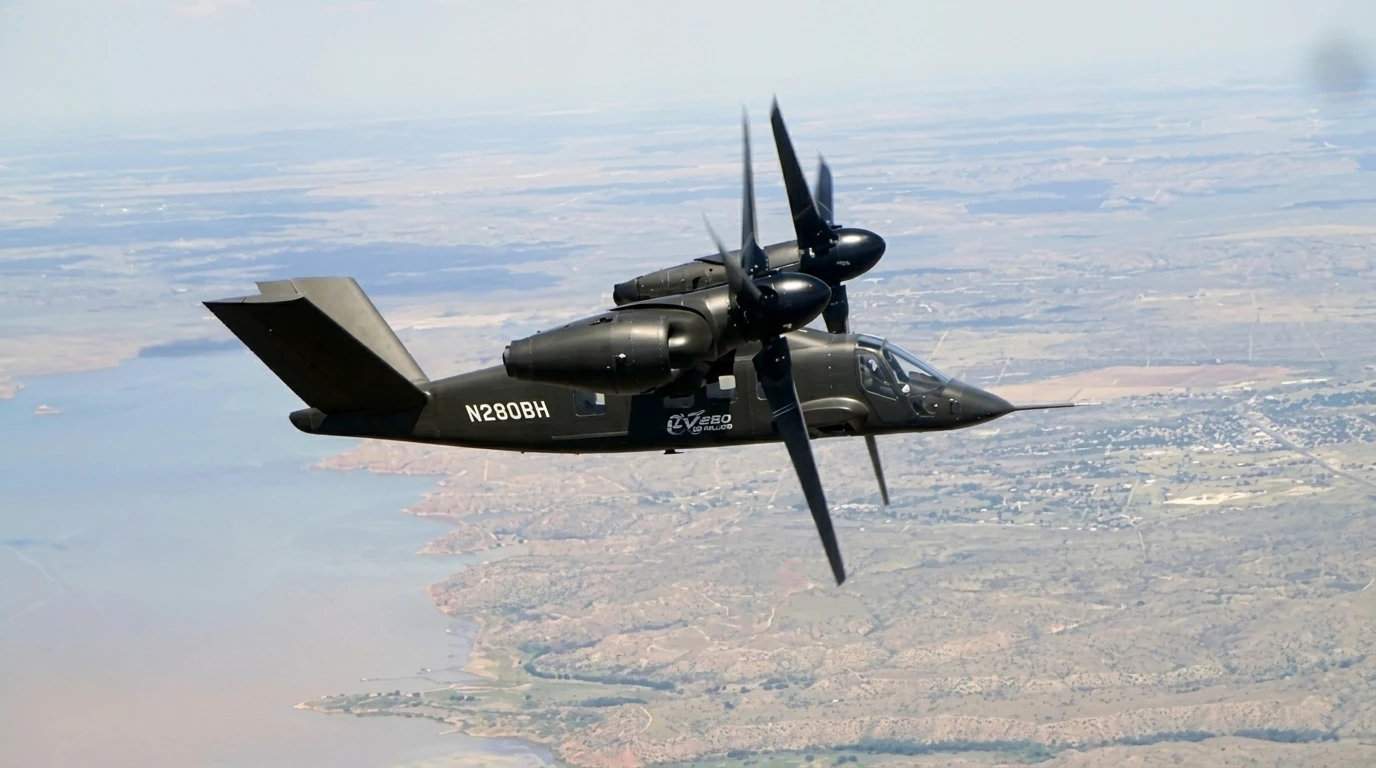
Picture this: a battlefield where distance stops mattering. Troops deploy hundreds of miles faster than expected, missions unfold before the enemy even realizes what’s happening, and helicopters, well, they start to feel a bit… outdated. That’s exactly the kind of shift the Bell MV-75 Cheyenne II is built to deliver.
The MV-75, developed by Bell Textron, isn’t just another military aircraft, it’s a rethinking of how air assault works. At first glance, it looks like something caught between a helicopter and an airplane. That’s because it is.
This tiltrotor design allows it to take off vertically like a helicopter, then tilt its rotors forward and fly like a turboprop aircraft.
The result? A machine that can cruise at speeds around 280 knots (over 500 km/h), roughly double that of the aging UH-60 Black Hawk it’s set to replace.
But speed is only part of the story. Range, survivability, and mission flexibility all get a serious upgrade.
The MV-75 Cheyenne II emerges from the U.S. Army’s push under the Future Long Range Assault Aircraft (FLRAA) initiative, a program aimed at preparing for conflicts where agility and reach matter more than ever.
And here’s the interesting part: this isn’t just about better specs on paper. It’s about reshaping strategy. When your aircraft can go farther, faster, and land almost anywhere, the entire map changes.
So the question isn’t “what is the MV-75?”
It’s, what kind of warfare does it make possible?
What Is the Bell MV-75 Cheyenne II?
If you strip away the buzzwords and military jargon, the MV-75 Cheyenne II is essentially a bold answer to a simple problem: helicopters haven’t kept up with the pace of modern warfare.
They’re reliable, sure, but slow, range-limited, and increasingly vulnerable. The MV-75 steps in as something different. Not an upgrade. More like a category shift.

At its core, the MV-75 is a tiltrotor aircraft, built on the proven foundation of the Bell V-280 Valor. That lineage matters. The V-280 wasn’t just a concept, it logged test flights, hit speed targets, and quietly proved that this hybrid design could work in real-world conditions, not just simulations.
So what makes the MV-75 distinct? For one, its rotors tilt, but its engines don’t. That might sound like a small engineering tweak, yet it reduces mechanical complexity and improves reliability compared to older tiltrotors like the V-22 Osprey. Less moving mass, fewer headaches. In theory, anyway.
It’s also deeply tied to the Future Vertical Lift (FVL) strategy, which isn’t just about replacing aircraft, it’s about rethinking how air mobility supports ground forces. Faster insertion, longer reach, fewer refueling stops. That kind of flexibility changes mission planning in ways that aren’t always obvious at first glance.
In short, the MV-75 isn’t trying to be a better helicopter. It’s trying to make helicopters feel… obsolete.
Technical Specifications of the MV-75 Cheyenne II
Numbers don’t tell the whole story, but with the MV-75 Cheyenne II, they come pretty close.
What stands out isn’t just raw performance; it’s how those numbers combine to create something unusually balanced. Speed without sacrificing range. Payload without crippling efficiency. That kind of mix is harder to pull off than it sounds.
Much of what we know comes from the aircraft’s roots in the Bell V-280 Valor, which acts as a baseline for the MV-75’s expected performance. While final operational specs may evolve, the current figures already paint a pretty clear picture of what this aircraft is capable of.
| Specification | MV-75 Cheyenne II (Estimated) |
| Crew | 4 (pilot, co-pilot, crew chiefs) |
| Troop Capacity | ~14 soldiers |
| Cruise Speed | ~280 knots (≈520 km/h) |
| Maximum Speed | 300+ knots |
| Combat Radius | ~500–800 nautical miles |
| Maximum Range | ~2,000+ nautical miles |
| Takeoff/Landing | Vertical (VTOL capability) |
| Configuration | Tiltrotor |
Now, here’s where it gets interesting. That 2,000+ nautical mile range doesn’t mean it always flies that far in one go, it means commanders have options. Routes can be adjusted. Missions can stretch deeper. Refueling points become less predictable, which, strategically speaking, is a big advantage.
The troop capacity, sitting around 14, might not seem revolutionary at first glance. But when you factor in speed and distance, those 14 troops can be inserted faster and farther than before. It’s less about how many, and more about how quickly they get there.

There’s also the vertical takeoff capability, which keeps it flexible in tight or undeveloped environments. No runway needed. Just space… and a plan.
Put it all together, and the MV-75 isn’t chasing extremes. It’s optimizing the middle ground, and doing it unusually well.
Development Timeline of the MV-75 Cheyenne II
The story of the MV-75 Cheyenne II isn’t a straight line, it’s more like a series of quiet breakthroughs that gradually built momentum. Long before the name “MV-75” existed, the real work was happening behind the scenes with the Bell V-280 Valor.
When it first took to the skies in 2017, it wasn’t trying to win headlines. It was trying to prove a point: that a tiltrotor could be faster, more efficient, and less mechanically complicated than what came before. And over time, flight after flight, it did exactly that.
Then came the moment that changed everything.
In December 2022, under the Future Long Range Assault Aircraft (FLRAA) initiative, the U.S. Army selected Bell’s design as the foundation for its next-generation assault aircraft.
That decision didn’t just pick a winner, it effectively set the direction for Army aviation for decades. Speed and range were no longer experimental goals; they became baseline expectations.

The aircraft’s identity started to solidify soon after. By 2025, it officially received the MV-75 designation, and in 2026, it was given the name “Cheyenne II.”
That name carries a bit of historical weight, echoing the AH-56 Cheyenne, a bold but ultimately canceled program from the past. There’s something fitting about revisiting that ambition, this time with technology that can actually deliver.
Looking ahead, the timeline points toward operational service around 2030 or 2031. Not tomorrow, but not far off either.
In the world of military aviation, that’s practically imminent. The MV-75 didn’t arrive overnight. It earned its place, one milestone at a time.
Key Features and Capabilities of the MV-75
Here’s where the MV-75 Cheyenne II really starts to flex. On paper, the specs look impressive. In practice? They quietly rewrite what’s possible in air assault operations.

Speed That Changes the Clock
Traditional helicopters move at a pace that feels almost… cautious.
The MV-75 doesn’t. With cruising speeds around 280 knots (≈520 km/h) and the ability to push beyond 300 knots, it compresses time in a way commanders actually notice. A mission that once took 90 minutes might now take 40. That’s not just faster, it’s strategically disruptive.
Range Without Constant Refueling
Range is where things get interesting. The MV-75 is designed to operate at distances that would normally require forward staging bases. We’re talking hundreds of nautical miles deeper reach without stopping. That reduces reliance on vulnerable refueling points, something that’s become a big deal in modern, dispersed battlefields.
Tiltrotor Advantage (Done Smarter)
Unlike older systems, the MV-75 borrows a refined approach from the Bell V-280 Valor, keeping engines fixed while only the rotors tilt.
Compared to the V-22 Osprey, this design reduces mechanical strain and simplifies maintenance. It’s one of those behind-the-scenes improvements that doesn’t make headlines, but absolutely matters over thousands of flight hours.
Digital Backbone & Modular Design
This aircraft isn’t locked into today’s tech. Built with a modular, open architecture, the MV-75 can evolve, new sensors, updated avionics, even mission-specific upgrades without redesigning the whole platform.
Think of it less like a finished product and more like a system that keeps updating itself.
Put simply, the MV-75 isn’t just faster or farther, it’s built to stay relevant longer. And that might be its most underrated advantage.
Missions and Use Cases of the MV-75
So what does the MV-75 Cheyenne II actually do when it’s not sitting in a hangar looking futuristic? This is where things get practical, and a bit more interesting than spec sheets.

Long-Range Assault (The Core Mission)
At its heart, the MV-75 is built for one job: getting troops into places that used to be… inconveniently far. Think deep insertion missions where distance once forced armies to rely on multiple staging points. With the MV-75, units can launch from safer locations and still reach contested zones quickly.
It changes the rhythm of operations. Fewer stops. Less exposure. More surprise.
Medical Evacuation (MEDEVAC)
Speed matters most when time is running out. The MV-75’s ability to cover long distances quickly means injured personnel can be evacuated faster than ever before. In real terms, shaving even 20–30 minutes off evacuation time can dramatically improve survival rates. It’s not flashy, but it’s arguably one of the aircraft’s most human impacts.
Tactical Resupply in Dispersed Warfare
Modern battlefields aren’t neat lines anymore. Units spread out, operate independently, and often need supplies delivered in unpredictable locations. The MV-75 can carry cargo over long distances without relying on fixed bases, making it ideal for supporting these scattered forces.
Humanitarian and Disaster Response
Interestingly, the MV-75 isn’t limited to combat. Its vertical takeoff and long range make it useful in disaster zones, earthquakes, floods, remote rescues. It can reach areas where infrastructure is damaged or nonexistent, bringing aid faster than traditional aircraft.
In a way, the MV-75 feels less like a single-purpose aircraft and more like a flying toolkit, adaptable, quick, and always a bit ahead of where it’s expected to be.
MV-75 Cheyenne II vs Black Hawk: A Real Shift, Not Just an Upgrade
Comparing the MV-75 Cheyenne II to the UH-60 Black Hawk is a bit like comparing a high-speed train to a rugged pickup truck. Both are useful. Both get the job done. But they operate in completely different lanes.
The Black Hawk has been the backbone of U.S. Army aviation since the late 1970s, reliable, versatile, and battle-tested across decades of conflicts. It’s the kind of aircraft that became trusted not because it was perfect, but because it consistently showed up and performed.

Still, time has a way of exposing limits. Speed tops out around 150–160 knots, and range constraints often require forward refueling or staging areas.
Enter the MV-75, and suddenly those limitations feel… noticeable.
With cruising speeds near 280 knots, the MV-75 can cover roughly twice the distance in the same time window. That means fewer stops, less logistical overhead, and a reduced window of vulnerability. It’s not just about arriving faster; it’s about being harder to predict and harder to intercept.
Here’s a clearer side-by-side view:
| Capability | MV-75 Cheyenne II | UH-60 Black Hawk |
| Cruise Speed | ~280 knots | ~150 knots |
| Combat Radius | 500–800+ nm | ~300 nm |
| Deployment Time | Significantly shorter | Moderate |
| Survivability | Higher (less exposure time) | Proven but slower |
But the real difference isn’t just numbers, it’s doctrine. The MV-75 allows missions to launch from farther away, reducing reliance on vulnerable forward bases. That shifts how operations are planned from the ground up.
So no, this isn’t a simple replacement. It’s more like the rules of the game quietly changing, and the Black Hawk, for all its legacy, just doesn’t play at that speed.
Future Impact of the MV-75 on Military Aviation
The MV-75 Cheyenne II isn’t just a new aircraft, it quietly resets expectations. Not with a dramatic breakthrough, but through steady advantages that start to compound over time.
The biggest shift is reach. With its speed and extended range, the MV-75 allows forces to launch from farther away and still arrive faster.
That changes how bases are positioned and reduces reliance on vulnerable forward locations. In simple terms, the battlefield stretches, without adding new infrastructure.
Survivability improves too, though not in the traditional armored sense. The MV-75 spends less time in dangerous airspace, which naturally lowers exposure to threats. It’s a subtle edge, but across multiple missions, it adds up.
This aircraft also aligns with the broader goals of the Future Vertical Lift (FVL) initiative, which focuses on faster, more flexible air mobility. The idea isn’t just replacement, it’s transformation.
And here’s the real impact: mindset. When speed and distance are less limiting, mission planning evolves. Operations become more flexible, less predictable, and often more effective.
So the MV-75 doesn’t just improve performance, it nudges military strategy in a new direction.
