

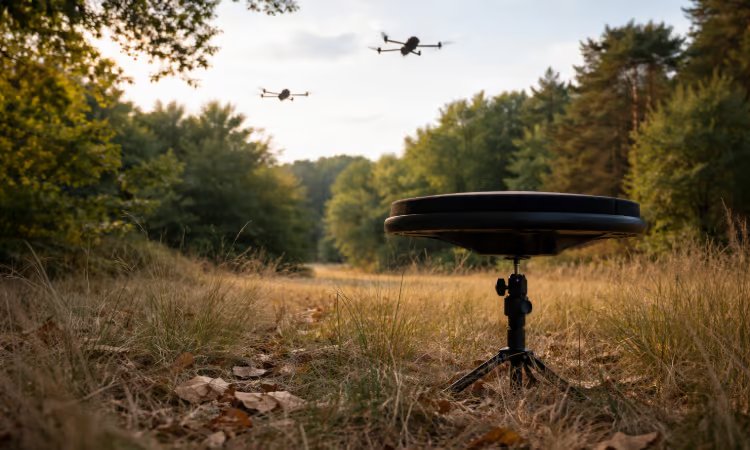

BeephoniX, a Dutch defence technology company specialising in passive acoustic drone detection, has announced a development partnership with Swedish Unattended Ground Sensor (UGS) specialist Bertin Exensor to co-develop Orbis, a new acoustic drone detection sensor integrated into Bertin Exensor’s established Flexnet surveillance platform.
The collaboration brings together BeephoniX’s expertise in acoustic signal processing, machine learning and passive drone detection with Bertin Exensor’s nearly 40 years of experience developing military surveillance technology. Orbis extends the capabilities of Flexnet beyond traditional ground-based threat detection, introducing an additional layer of acoustic intelligence to identify, classify and track low-flying drones.
Flexnet is Bertin Exensor’s established Unattended Ground Sensor (UGS) platform, combining wireless, battery-powered sensors, cameras and command-and-control software to provide early warning and situational awareness across military and security environments. Each sensor, camera and gateway operates as a network node, communicating with other devices through a self-adapting wireless mesh network to deliver detection information to operators.
Through Orbis, BeephoniX’s AI-driven passive acoustic drone detection technology is integrated into this existing architecture, extending Flexnet’s surveillance capabilities from ground-based threats into low-altitude airspace. Designed to complement the platform’s seismic, magnetic, thermal and optical sensors, Orbis enables acoustic drone detection information to be incorporated into a shared operational picture, allowing military users to strengthen counter-UAS awareness through an established, scalable surveillance network.
At the heart of Orbis is BeephoniX’s passive acoustic sensing technology, which uses advanced signal processing and machine learning to identify the distinctive sounds produced by drone motors and rotors. Detection distance: 7-inch FPV drone up to 150 meters and battery life up to 30 days. Unlike radar or radio-frequency detection, acoustic sensing does not emit detection signals or depend on communications between a drone and its operator, making it particularly valuable against autonomous, low-flying and fibre-optic-controlled threats.
Designed for discreet, battery-powered deployment, Orbis can be incorporated into Flexnet’s existing wireless mesh architecture, allowing multiple sensors to be distributed across an area of interest and detection data to be combined with other surveillance technologies. The collaboration reflects the growing importance of scalable, layered counter-UAS systems as military forces seek to protect personnel, installations and critical infrastructure against increasingly accessible drone threats.
Klaas-Jan Kakebeeke, CEO and Co-Founder of BeephoniX, said: “No single technology can solve the drone detection challenge on its own. Effective counter-UAS defence depends on bringing together specialist capabilities that complement one another, and that is exactly what this collaboration is designed to achieve. By combining our expertise in passive acoustic intelligence with Bertin Exensor’s established Flexnet platform, we are helping extend drone detection into wider, interconnected surveillance networks. Orbis demonstrates how European defence companies can work together to develop practical, scalable solutions to an increasingly urgent threat.”
Marcus Rosenqvist, VP of Sales at Bertin Exensor, said: “Extending our Flexnet UGS platform with passive and remote acoustic drone detection, such as Orbis, is a natural evolution to counter current and future threats in the battlefield. Bertin Exensor has a long and proven track record developing advanced passive sensor technologies. BeephoniX’s specific expertise in designing miniaturised acoustic UAS detection devices complements Bertin Exensor’s core competence as a world-leading UGS Systems provider. The Orbis project is a great example of a successful cooperation where strategic and business-related targets align.”
