

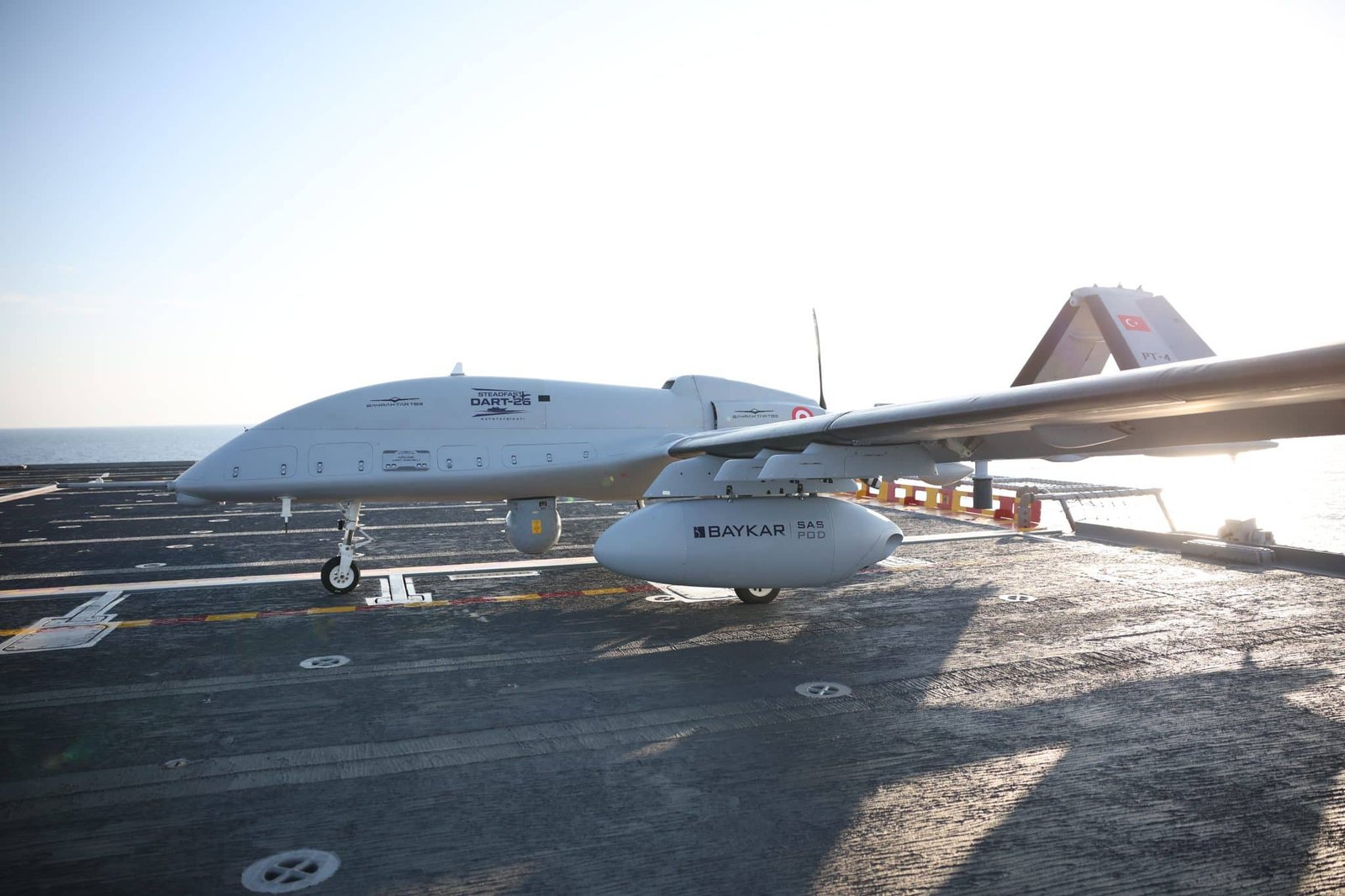
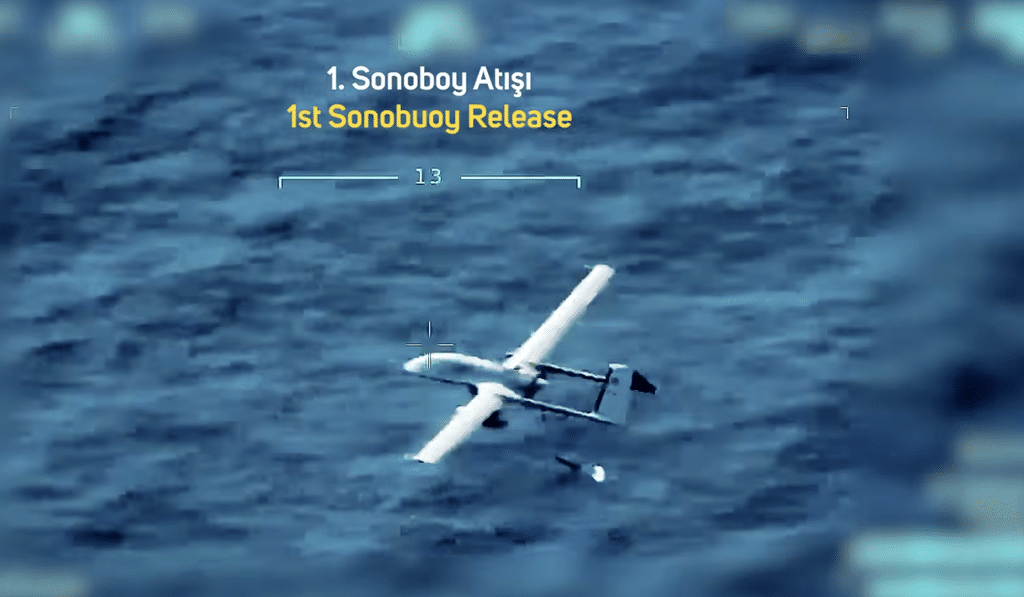
Baykar’s carrier-capable unmanned combat aerial vehicle, the Bayraktar TB3, has successfully completed a live sonobuoy deployment test during the Turkish Navy’s Denizkurdu-I/2026 exercise.
Operating from the flight deck of the amphibious assault ship TCG Anadolu in the Eastern Mediterranean, the TB3 launched two sonobuoys from a newly revealed wing-mounted dispenser pod and coordinated directly with a Turkish Navy maritime patrol aircraft.
The milestone marks the first time a Turkish-made unmanned aerial vehicle has deployed sonobuoys in an operational maritime environment.
According to an official release issued by Baykar Technologies, the flight took place as part of coordinated anti-submarine warfare (ASW) drills conducted simultaneously across the Black Sea, the Sea of Marmara, the Aegean, and the Eastern Mediterranean between September 20 and 25. The TB3 carried Baykar’s indigenously developed Sonobuoy Dispenser System (designated the SAS POD) under its wing. Beyond deploying the expendable acoustic sensors, the TB3’s onboard sonobuoy processing architecture processed acoustic telemetry gathered both from its own dropped buoys and from sensors deployed by a manned MPA operating in the area, relaying underwater acoustic tracking data to the command net in real time.
While Turkish aerospace contractor TUSAS had previously showcased its twin-engine Aksungur MALE UAV fitted with a sonobuoy pod at domestic IDEF exhibitions and later unveiled concepts at NAVDEX 2023 to integrate lightweight torpedoes, public progress on that platform’s sub-surface payload suite stalled. Baykar’s test leapfrogs those initial efforts, cementing TB3 as the first Turkish unmanned aircraft to achieve live sonobuoy deployment.
Baykar’s press release did not disclose the specific variant of sonobuoys dropped during the exercise. However, during World Defense Show (WDS) 2026 in Riyadh, Aselsan CEO Ahmet Akyol told Naval News that airborne drops of the indigenous Aselbuoy family from an unmanned platform were imminent. The successful deployment during Seawolf indicates that Turkey’s parallel efforts in uncrewed carrier aviation and acoustic sensor development have begun coalescing into joint field trials.
Globally, demonstrated airborne sonobuoy release from medium-to-large unmanned airframes remains an elite club. Outside General Atomics Aeronautical Systems’ MQ-9B SeaGuardian, the Bayraktar TB3 is only the second known unmanned platform to demonstrate live sonobuoy drops and integrated acoustic telemetry processing.
Naval News comments
Anti-submarine warfare remains one of the most resource-intensive and tactically unforgiving domains in modern naval warfare. The fundamental tactical objective in ASW is keeping surface combatants outside the effective engagement envelope of hostile torpedoes. Once a submarine closes inside weapon release range, surface ships lose tactical initiative and face severe survivability challenges.
To mitigate that vulnerability, task groups rely heavily on airborne assets, principally fixed-wing maritime patrol aircraft (MPAs) and shipborne ASW helicopters. MPAs lay sonobuoy barriers across choke points and suspected patrol boxes to track and localize contacts, while helicopters deploy dipping sonars to sanitize specific sectors ahead of the fleet. Yet manned aviation has well-defined operational ceilings. Crew fatigue, mechanical limits, and flight cycle constraints restrict on-station presence to single-digit hours before platforms must peel off for fuel or crew rotation.
This is precisely where the TB3 changes the operational balance. With endurance profiles extending past 30 hours, long-loitering UAS can maintain persistent surface search and surveillance over high-threat choke points. For non-nuclear conventional submarines (SSKs), that unblinking eye removes safe windows to surface or snort, preventing battery recharge cycles and severely constraining their tactical mobility.
Adding sonobuoy deployment, monitoring, and telemetry relay capabilities transforms the UAV into an organic acoustic node within the fleet’s combat management architecture. It offers task group commanders a dependable third airborne vector for localized ASW screens without committing high-value manned aircraft or exposing frigates to torpedo danger zones.
Crucially, because the TB3 is built specifically for short-deck STOBAR operations aboard TCG Anadolu, this capability travels with the expeditionary strike group. Anadolu is no longer merely a drone carrier or amphibious assault platform; equipped with a persistent acoustic search wing, the flagship effectively becomes an offshore ASW hub capable of projecting wide-area submarine denial screens far beyond coastal radar umbrellas.
