

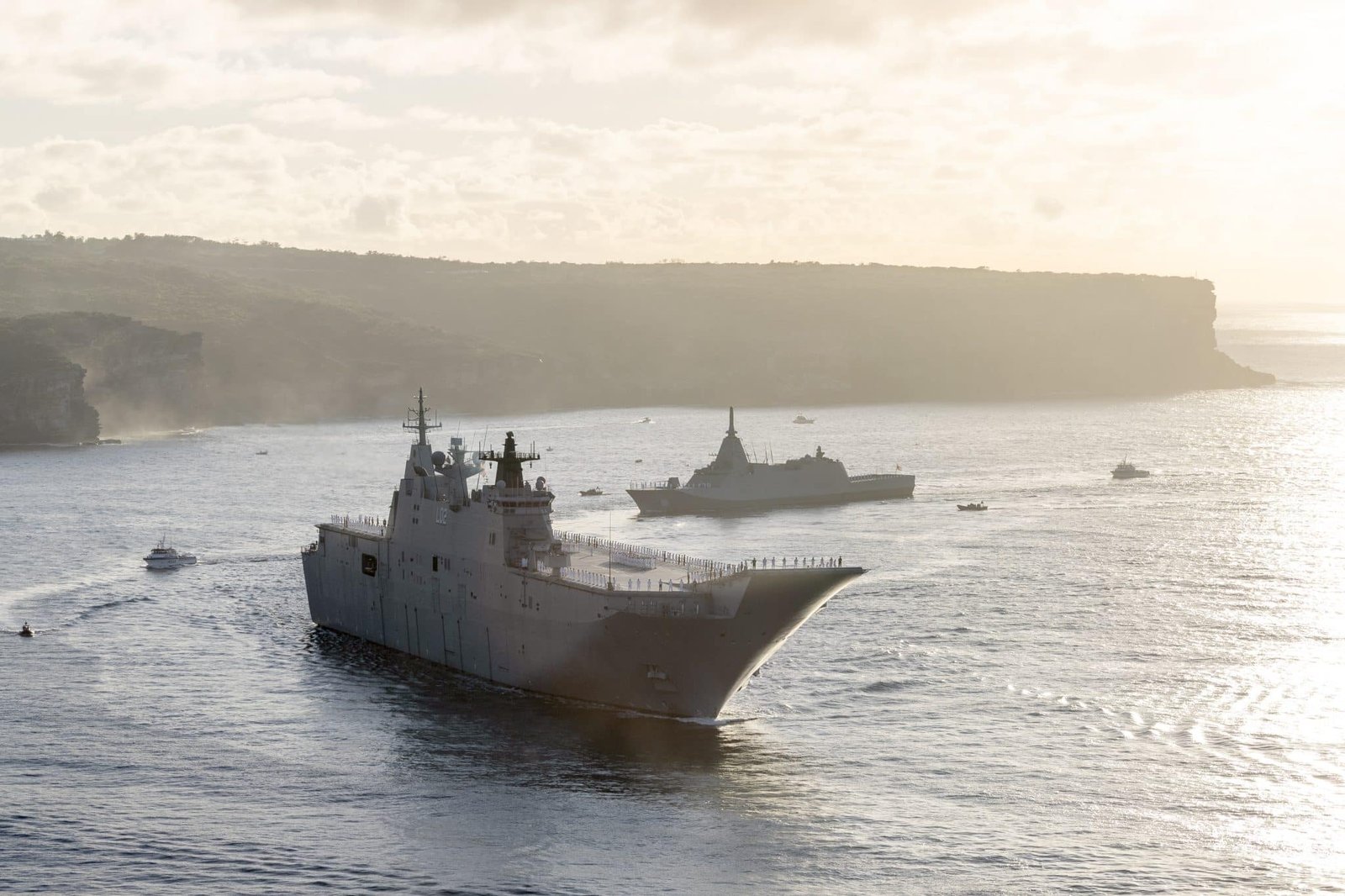
The Australian government published the biennial National Defence Strategy (NDS) and the corresponding Integrated Investment Program (IIP). The publication occurs amidst a background of conflict in the Middle East and a shifting American national security posture across regions directly affecting Australia and the Indo-Pacific region.
The NDS communicates the Australian government perspective on the perceived global strategic environment. The release signals broad policy measures Canberra intends to implement over a decade of public spending. The “whole of government”-approach also includes civil preparedness, resource security and industrial policy. The IIP outlines in more detail relevant spending on defence, both intended and authorised, complementing NDS policy points.

For RAN the NDS and IIP editions this year do not include drastic changes compared to pendants published in 2024. The NDS recognizes strategic competition between China and the United States as a major factor in the Australian security environment. Compared to 2024, some efforts do see substantial increases in spending. Meanwhile niche capabilities, especially mine warfare, appear to have taken a backseat in budgetary priorities.
AUKUS takes centre stage across both papers. The bulk of spending for acquisition unsurprisingly goes towards AUKUS Pillar 1, purchasing nuclear powered submarines for the Australian Navy. Notably, Canberra projects total expenditure on Defence until FY35 to effectively double. Spending on acquisitions will substantially increase its proportional share. At present, this element amounts to a third of the total budget. By FY 2035 this share will increase to almost half of al defence spending. In contrast, sustainment is projected to increase less rapidly, in line with a more modern fleet. Government also expects workforce costs to grow very moderately. This assessment seems remarkable given existing and anticipated recruitment challenges. Additionally the requirement for a substantial increase in qualified personnel operating new capabilities also appears to drive an increase in expenses.

Submarine- and frigate-expenditure looming large
The IIP features substantial increases in planned investments for nuclear powered submarines under AUKUS Pillar 1 and the new general purpose frigates from fiscal years 2026 to 2035, in comparison with the previous version in 2024 for the timeframe from 2024 to 2033. Total investment, planned and approved, for nuclear powered submarines is set to increase to between A$71 and 96 billion, compared to the IIP 2024 figure of A$ 53-63 billion.
Expenditure for the general purpose frigates, now contracted with Japan for the “Upgraded Mogami” or 06FFM, will rise from the previously declared A$7-10 billion until FY 2033 to A$15-20 billion until FY 2035. The Defence Minister’s media release announcing the “locking in” of contracts for the first three Upgraded Mogami-class frigates, to be build in Japan, does not mention a contract value.


Australian media meanwhile reports that the originally communicated figure now intends to purchase the first three frigates, in addition to undefined “associated upfront costs” for the program. The Australian government has yet to detail a breakdown of costs in official communication. In any case the total value for the entire effort under SEA 3000 remains unknown at this time.
Another effort taking a large share of the naval budget is the Collins life extension-program, also known as LOTE (life of type extension). Despite scaling back of the previously more ambitious modernisation of Collins in tandem with the shelved Attack-class procurement financial commitments for keeping the ageing submarines in service into the 2040s will rise from A$ 4-5 billion in the IIP 2024 to now A$ 7.8-11 billion. Collins had previously attracted media attention over more severe than expected wear and tear, including corrosion issues on some hulls.
Moderate spending on drones despite noted importance
Working up to the release of this years NDS and IIP, Minister for Defence Richard Marles emphasised a government intention to allocate a more significant amount of spending towards uncrewed capabilities. In the naval realm this concerns the Ghost Shark-development by Anduril for a large underwater drone, and the Speartooth large UUV made by C2 Robotics. The MQ-28A Ghost Bat UCAV complements these efforts in the aviation segment.

Nevertheless, expenditure on “subsea warfare and uncrewed maritime systems” is set to fall from previously allocated A$ 5.2-7.2 billion to now A$ 4.8-5.8 billion. Government continues to communicate an intention to acquire a “Large Optionally Crewed Surface Vessel”. LUSV in essence is a surface drone designed as a mobile missile magazine complementing surface forces. However, the original template for this ambition, the American LUSV-program, remains in limbo after several rounds of restructuring the development of both medium and large uncrewed systems in the United States. Accordingly, Australian budget projections, effectively a place-holder, have fallen from up to A$ 500 million to now A$300 million over ten years.
Mine warfare with good intentions, but no budget
Meanwhile recent conflict in the Middle East in the wake of the American-Israeli attack on Iran has underlined once again the spectre of mine warfare as concern both for military operations and the global economy. It is therefore interesting to observe that the Australian government does not mention additional spending regenerating ageing RAN mine countermeasures. As Naval News has reported, the shrinking fleet of Huon-class MCM vessels will not see any direct replacement. RAN officials have clarified that they do not consider recapitalisation of mine warfare vessels as a priority with a budget strained by other objectives.
Consequently, the 2026 IIP notes the relevance of mine warfare and reiterates already existing efforts purchasing deployable mine warfare kit under SEA 1778 Phase 1, and adding new “smart” sea mines from European vendor RWM Italia. However, the paper does not contain any further investments for maritime mining.
Large investments for shipbuilding and maintenance infrastructure
Naval infrastructure will also see considerable spending under the scope of government efforts developing the Henderson Defence Precinct in Western Australia. As outlined in the IIP, Canberra plans to spend up to A$ 25 billion over the next decade. In an initial step spending of A$ 12 billion will support construction of amphibious vessels, maintenance of surface combatants and expansion of facilities for submarine maintenance, including a new graving dock.

Henderson, a suburb of Perth and adjacent to Fleet Base West at HMAS Stirling, contains the bulk of naval shipbuilding and maintenance capacity based in WA. Of particular importance is shipbuilder Austal, situated within the precinct, which the Australian government has appointed as the “Strategic Shipbuilder” in agreements last year. Consequently, the company has now assumed development and construction of two new types of amphibious vessels under the LCM- and LCH-projects. Additionally Austal intends to build up to eight of the new Japanese general purpose frigates under SEA 3000. Finally, the shipyard aims to produce six LUSV, depending on international alignment in this regard as noted above.
Sea-based segment with lion’s share of long range strike-spending
Finally, across spending for all three services fulfilling an ambition of enhanced long range-strike assets for ADF the Australian Navy remains the runaway winner of budget allocations. RAN will receive up to A$17 billion over a decade to acquire Tomahawk land attack cruise missiles and NSM antiship-missiles. Purchases of SM-2 and SM-6 missile stocks for Hobart-class AAW destroyers and Hunter-class frigates also fall within this spending bracket. In comparison, the Australian Airforce as runner-up, will only receive up to A$ 1.5 billion for further air-launched strike and hypersonic capabilities. This allocation is down from over 7 billion earmarked in spending two years ago.
In conclusion the 2026 editions of the Australian National Defence Strategy and Integrated Investment Program contain little in terms of strategic changes on funding priorities. However, both papers illustrate the strong upward trend for budgetary committments by Canberra, and related pressures balancing spending priorities. The Australian government continues to advertise coming true on various aspirations, notably for the uncrewed element. Nevertheless, a projected near doubling of expenses to cover a rapidly growing field of acquisitions will remain a dilemma for future governments in Canberra to resolve.
