

Sponsored content by:

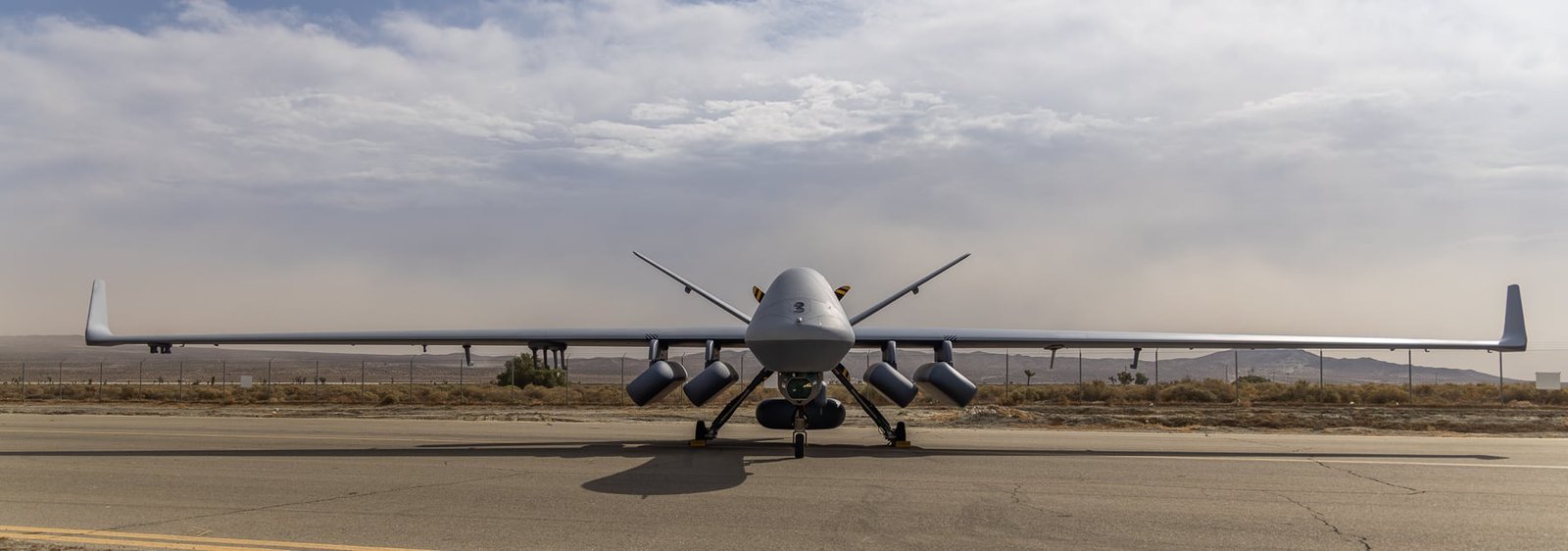
The threats facing the U.S. Navy and Marine Corps team are formidable and multiplying with each passing year. That’s why the MQ-9B SeaGuardian® unmanned aircraft system is designed to supercharge the operational capabilities of the U.S. Navy and Marine Corps, delivering unmatched endurance, multi-domain awareness, and operational flexibility to address the challenges of modern warfare.
SeaGuardian offers the best endurance of any aircraft in this class, making it a critical asset for intelligence, surveillance, reconnaissance, and targeting (ISR-T) missions. This capability enables persistent coverage over vast areas, allowing for continuous monitoring of adversary activities and pattern-of-life analysis.
The MQ-9B’s ability to integrate seamlessly with carrier strike groups, expeditionary strike groups, and other naval formations enhances its utility in joint and allied operations. MQ-9B’s extensive operational pedigree, with over 9 million flight hours logged in conditions ranging from permissive to denied, ensures its readiness for high-end conflict scenarios.
Multi-Domain Awareness in Pre-Conflict Phases
In pre-conflict phases, where deterrence and situational awareness are paramount, the MQ-9B excels with its advanced sensor suite.
Equipped with a multi-mode maritime radar, electro-optical/infrared systems, and signals intelligence payloads, SeaGuardian provides comprehensive intelligence across domains. This capability enables precise monitoring of maritime and littoral zones, ensuring decisionmakers have the information needed to act decisively.
MQ-9B’s anti-submarine warfare (ASW) configuration further enhances its utility. Its self-contained sonar suite, capable of deploying and monitoring sonobuoys, complements existing crewed platforms like the P-8A Poseidon. This integration allows the Navy to extend its reach into high-risk areas without risking costly systems and irreplaceable human lives.

Moreover, MQ-9B’s rugged airframe and advanced de-icing systems enable operations in extreme weather environments, from the Arctic to the Antarctic and everywhere in between.
Its ability to maintain a clear operational picture in degraded conditions, such as fog or mist, ensures mission success even in inclement weather. This capability is critical for maintaining a continuous presence in regions where the elements are unpredictable and can hinder traditional manned operations.
The forthcoming MQ-9B Short Takeoff and Landing (STOL) version will further expand operational flexibility. With the ability to operate from short or improvised runways, the STOL variant enhances power projection and sustainment in austere locations.
The SeaGuardian’s ability to operate to the left of a conflict—before hostilities escalate—makes it an indispensable tool for monitoring adversary activities and preventing escalation.
By providing actionable intelligence and enabling real-time decision-making, the MQ-9B helps the Navy and Marine Corps maintain a strategic edge in an increasingly complex global security environment.
Enhanced Capabilities in Conflict Scenarios
If conflict does arise, MQ-9B’s survivability and operational flexibility make it a vital asset.
GA-ASI recently announced plans to integrate long-range standoff weapons onto the MQ-9B, such as the AGM-158C Long Range Anti-Ship Missile (LRASM), which would enable the aircraft to engage targets from outside denied areas.
Additionally, the SeaGuardian’s advanced radar system complements the U.S. Navy’s net-enabled weapons– LRASM and the Naval Strike Missile – providing precise targeting and in-flight updates in contested environments. This capability allows the MQ-9B to deliver quality targeting data to both manned and unmanned systems, ensuring it plays a decisive role in joint and coalition operations. For ASW missions, MQ-9B can also be equipped to launch torpedoes, giving commanders the ability to detect and neutralize underwater threats at a moment’s notice.
MQ-9B fills critical gaps in ISR-T and maritime missions at a fraction of the cost of traditional methods, significantly enhancing the Navy’s effectiveness. By providing persistent surveillance and the ability to strike targets, the MQ-9B drives adversaries to adapt their operations, creating a strategic advantage for U.S. and allied forces.

MQ-9B’s modular payload and open architecture systems ensure adaptability for evolving mission requirements. From electronic warfare to communications relay, the aircraft can be configured to meet diverse operational needs. This flexibility is particularly valuable in high-stakes scenarios, where the ability to rapidly adapt to changing mission parameters can mean the difference between success and failure.
Its ability to deliver actionable intelligence, provide precision targeting, and adapt to evolving threats ensures that it remains a critical component of modern military operations.
By integrating advanced capabilities and maintaining a focus on survivability, the MQ-9B empowers forces to operate effectively in conflict scenarios.
Cost-Effective Modernization for Naval Forces
In an era of constrained defense budgets, the MQ-9B offers a cost-effective solution for modernizing ISR and strike capabilities. As a mature design derived from the most combat-proven medium-altitude long endurance UAS platform on earth, it delivers advanced sensors and payloads at a lower lifecycle cost compared to manned systems.
Furthermore, MQ-9B’s interoperability with allied forces strengthens partnerships and ensures seamless integration into joint and coalition operations. Many U.S. partner nations have already chosen to adopt MQ-9B, including the United Kingdom, Germany, Poland, Japan, Taiwan and India, which has made the MQ-9B the global gold standard in its class.
In today’s interconnected battlespace, where coalition efforts are the norm, this makes MQ-9B a natural choice for staying in step with U.S. allies and partners around the world.
Strategic Asset for Modern Conflict
The MQ-9B SeaGuardian represents a strategic asset for the U.S. Navy and Marine Corps, offering unmatched endurance, multi-domain awareness, and cost-effective modernization.
As a fully mature design derived from a proven legacy platform, the MQ-9B delivers generational-leap capabilities at a fraction of the cost of a clean-sheet design.
The MQ-9 system has proven unequivocally, time and again, that it provides an invaluable set of capabilities to the warfighter on today’s battlefield. GA-ASI stands ready to bring the next generation of this system to bear for the Navy and Marine Corps team as it defends U.S. global interests.
