

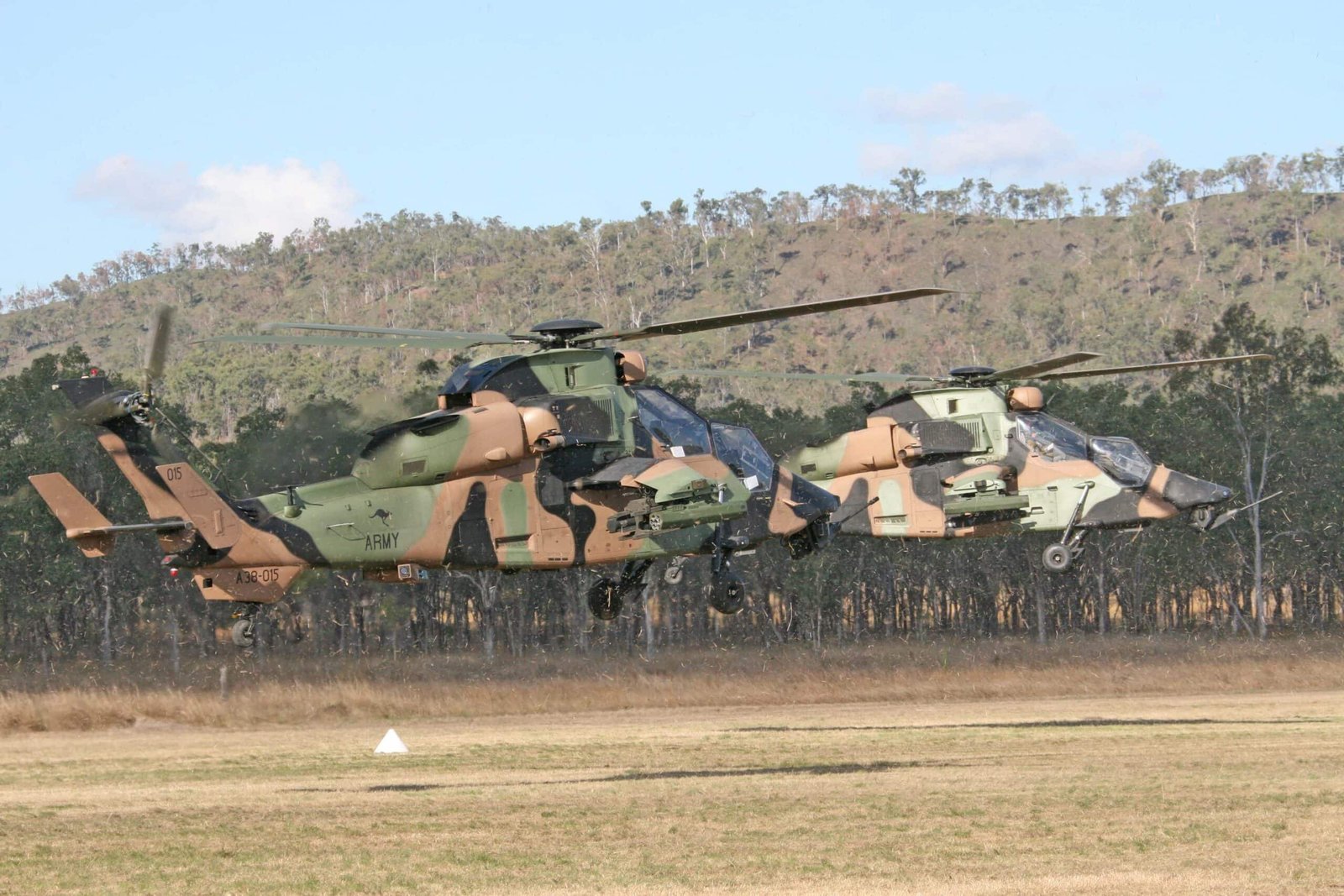
After a final flyover of Darwin on 24 September 2026, the Australian Army has stricken its remaining Airbus Tiger armed reconnaissance helicopters from active service.
Just a single troop of Tigers – believed to be four helicopters – was still flying in Darwin with the 1st Aviation Regiment. However, that regiment is now focused on inducting 29 Boeing AH-64E Apache Guardian helicopters.
Major General David Hafner, Commander Army Aviation, noted, “Our soldiers, aircrew and maintainers have achieved an extraordinary transition from the ARH Tiger to the Apache, while continuing to deliver training and operational outputs.”
A fleet of 22 Tigers was ordered under Project Air 87 in December 2021, and they entered Australian service in 2004. Eighteen aircraft were assembled in Australia.
The Tiger was an important step up for the army, since it took over the roles hitherto performed by the OH-58 Kiowa and an armed UH-1 Iroquois known as the Bushranger.
However, like the MRH90 from NHIndustries, the Tiger drew stern criticism from the Australian military. Its final operational clearance was granted on 14 April 2016, seven years behind schedule. Sustainment price tags and costs per flying hour were far greater than expected, whilst availability rates were lower than hoped.
The Department of Defence noted in a press statement about Australia’s “need to operate in an evolving threat environment, where advanced air defence systems, precision weapons and uncrewed platforms present challenges better suited to the capabilities of next-generation battlefield helicopters such as the AH-64E Apache”.
Heffner added, “The end of ARH Tiger flying operations is a significant moment for the 1st Aviation Regiment, but it also marks the beginning of an exciting new chapter as we continue our relocation to Townsville and further build Australia’s attack helicopter capability around the AH-64E Apache.”
Aussie Apaches performed their first live-fire iterations on home soil during Exercise Possum Guns in July this year. To date, six AH-64Es have been delivered, with all 29 due to be handed over by the end of 2029.

Lieutenant Colonel Jason Perrins, Commanding Officer of the army’s 1st Aviation Regiment, spoke to Asian Military Review about twin challenges – transitioning from the Tiger to the Apache, and moving the regiment from Darwin to Townsville.
Perrins shared: “I guess the good thing with the design of the move of the unit is it has been phased, and it’s not one big influx. Also, Darwin is focused on ARH. Then you come off ARH, go onto an Apache course in the US, move across to Townsville on return from that and focus on Apache. So they’re very much split as far as their focus goes. At this stage it seems to be working pretty well for the crews.”
Townsville-based 161 Reconnaissance Squadron now operates the Apache, while 162 Reconnaissance Squadron in Darwin can now begin to do so after relinquishing its Tigers. The split location between Darwin and Townsville meant two operational support squadrons existed, but these can merge with the Tigers retiring. The commanding officer believes the relocation to Townsville should be complete by the end of 2027.
Perrins assessed, “The Tiger was an outstanding attack platform, but it also just set the conditions for us for an easy transition to Apache. So, every time I’m out with the teams – whether it’s maintenance, ground crew or aircrew – they’ve all made the step reasonably easily, and the crews have transitioned fairly well.”
What is the fate of Australia’s 22 Tigers then? No official announcement has been made, but Ukraine is interested in them. Certainly, that would be more sensible than simply scrapping or burying them alongside Australia’s unwanted MRH90s.
Vasyl Myroshnychenko, Ukraine’s Ambassador to Australia, said last year about the possibility of receiving Tigers: “We’d be interested in having that conversation … And if those could be provided to Ukraine, we’ll be thankful.”
by Gordon Arthur
