

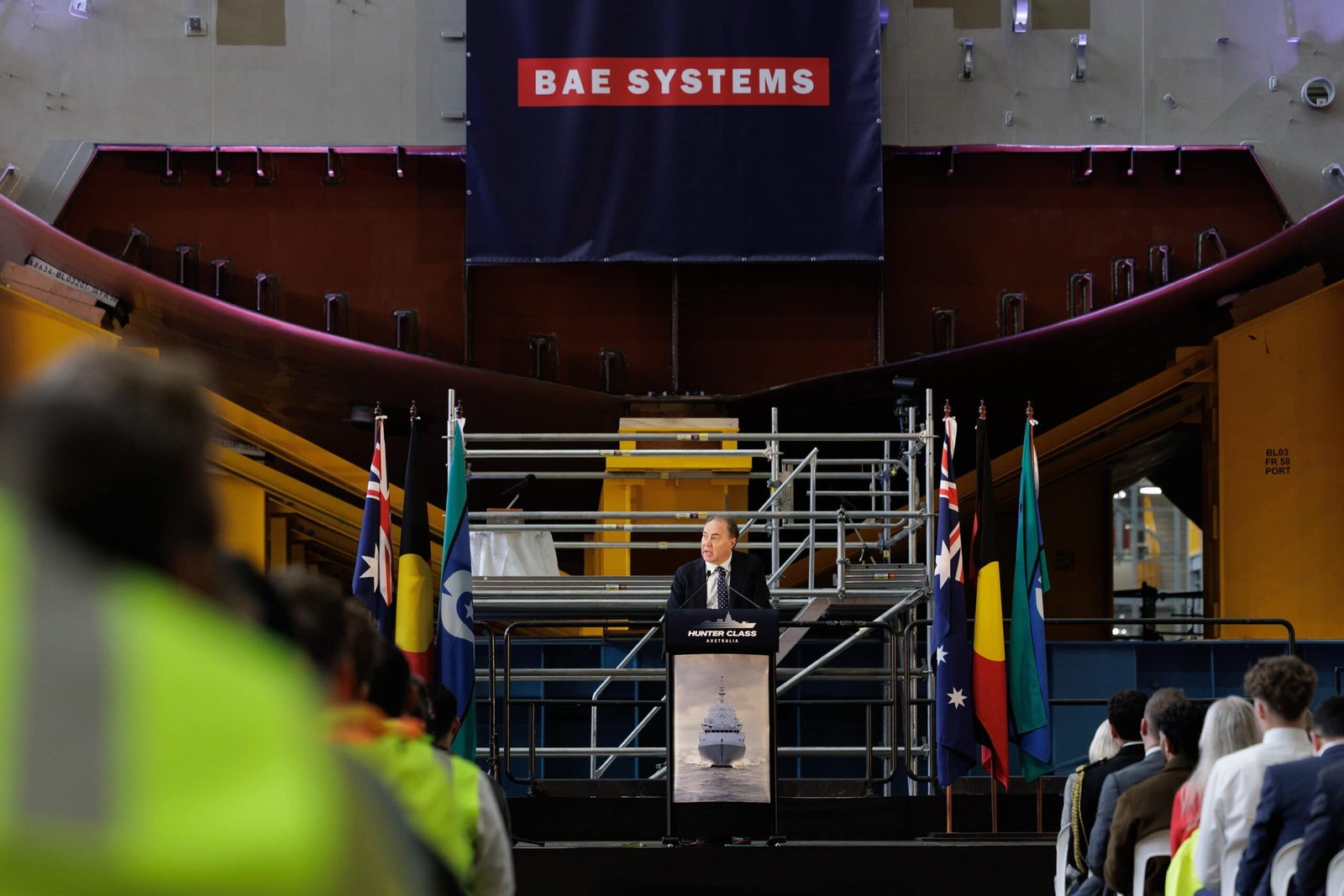
BAE Systems Australia formally laid the keel for the first Hunter-class frigate on 24 August 2026. The ceremony took place at Osborne Naval Shipyard near Adelaide in South Australia, coming eight years after the platform was selected in June 2018.
Two ship blocks, which form part of the keel, were displayed, and they will soon be joined by others as this first anti-submarine warfare frigate for the Royal Australian Navy (RAN) takes shape. Each frigate comprises 78 units that contribute to 22 blocks. Currently, 22 structural blocks are under construction.
David Shepherd, Managing Director of BAE Systems Australia – Surface Ships, said: “While today we have physically laid the keel of the first Hunter-class frigate, the Hunter programme itself has laid the foundations of a continuous naval shipbuilding and sustainment capability in Australia.”
Construction commenced on 21 June 2024 with first steel being cut. A production contract for the initial three frigates had been signed the previous day, six years after BAE Systems Australia was awarded Project Sea 5000.
A BAE Systems Australia spokesperson explained to Asian Military Review why the first production contract covered just three warships: “The intent of structuring the contract for multiple batches of three vessels was to allow for any further changes to the design if additional capabilities were to be incorporated.” Furthermore, it permits Australian suppliers – if they missed out on contracts for the first batch – to compete in the second round.

Defence Minister Richard Marles added: “The laying of the keel for the first Hunter-class frigate demonstrates tangible progress in the delivery of a more capable, lethal and resilient surface combatant fleet for Australia. The Hunter-class frigates will provide a world-class anti-submarine warfare capability, designed to operate in complex maritime environments.”
Tangible progress, yes, but this shipbuilding project has attracted numerous criticisms over its price tag and speed.
Arguments over the Hunter’s value-for-money proposition will doubtlessly reverberate for years to come, and these 8,200-tonne frigates could cost around A$9 billion (US$6.45 billion) each, based on Defence’s 2023-24 annual report.
Of course, if Australia bought off-the-shelf frigates directly from the UK, it would have twice as many ships but no input into its sovereign shipbuilding capacity.
Andy Coxall, Director Acquisition and Build at BAE Systems Maritime Australia, pointed out to AMR, “The cost for Hunter was never just about building ships – it was always about investing and rebuilding the [shipbuilding] capability. Included in Hunter costs were additional facilities costs – the shipyard, for example, where we worked with the Commonwealth to determine that there were shortfalls in the capability.” He further noted, “That’s the price of building an indigenous capability here and having Australians doing the work.”
A Defence spokesperson concurred: “Australia’s Hunter-class frigate programme budget provides for delivery of all fundamental inputs to capability, including works at the Osborne Naval Shipyard, not just the cost of the vessels.” Instead, the government owns the shipyard and it will be building advanced warships for the next 50 years.
Coxall asserted the RAN is “buying an enormous amount of additional capability, [and] the price was never about just building ships; it was re-establishing a capability in an area where we’d lost it.”

The frigate’s CEAFAR 2 active phased-array radar and integration of the Aegis combat management system and Saab’s 9LV interface also costs money. Key to the frigate’s anti-submarine capabilities is a Thales CAPTAS-4 S2087 variable-depth sonar system.
Regarding the platform’s growth margin, Coxall also said the Hunter “comes with enough margin to allow the navy flexibility, probably for the next 20-25 years of service … Because of the size and the margins we’ve built into the ship, it’s eminently upgradeable.” This could include directed-energy weapons in the future, for instance.
South Australia’s premier claimed more than 2,500 people are working at Osborne to build these ships. Peter Malinauskas acknowledged, “Recruiting the workforce for these tasks represents a massive challenge.” The government’s 2026 Defence Industry Development Strategy promised to help defence primes like BAE Systems to grow their apprentice and trainee workforce, starting later this year.
HMAS Hunter will be completed by June 2032, and commissioned in 2034. Thereafter, BAE Systems Australia will deliver frigates every two years.
This Hunter construction programme will thus run for 20 years, at which time the RAN will be looking to build replacements for the in-service Hobart-class destroyers.
by Gordon Arthur
