

A specter looms over the US Army: the threat of positional warfare. For four years, we have watched with growing concern as the Ukraine conflict—our clearest lens into future interstate combat—has settled into a grinding stalemate, a collision of World War I tactics and Star Wars technology.
The problem is well understood. The proliferation of unmanned systems has dramatically increased the density, lethality, and reach of the reconnaissance-fires complex. While the battlefield is not entirely transparent, it is sufficiently saturated with sensors that mounted formations are reliably identified, tracked, and engaged on the approach march under a compressed sensor-to-shooter cycle. This has transformed the doctrinal security zone into a modern no-man’s-land extending from fifteen to twenty-five kilometers in each direction from the zero line. No longer a space for traditional counterreconnaissance, the enemy projects effects forward into this security zone, creating a lethal, integrated multidomain obstacle belt. Armor has largely disappeared from this space, forcing formations to operate radically dispersed to survive.
The result is a crisis of mass. Army doctrine depends upon concentrating sufficient combat power at the decisive point to achieve overmatch, penetrate the enemy defense, and exploit faster than the enemy can recover. Yet the physical concentration required to generate that combat power presents the enemy reconnaissance-fires complex with precisely the signatures and targets it is optimized to destroy. Dispersion improves survivability, but at the cost of striking power, tempo, and shock. To succeed, forces must optimize dispersion and focus on concentrating effects rather than formations, but a degree of concentration remains an inherent requirement for offensive action.
The breakdown is fundamentally tactical. Formations can seize trenches, specific urban areas, and limited objectives; but concentrating enough combat power to survive the security zone fight, break through a composed defense, and exploit that success is prohibitively difficult. Thus, tactical actions cannot be linked together to produce operationally significant results, leading to a failure of operational art.
Even notably successful offensive operations, such as the Ukrainian 3rd Army Corps’ recent defeat of the 20th Combined Arms Army’s bridgehead over the Zherebets River, had little to do with maneuver warfare. They won through systematic, geometric interdiction and positional pressure along Jominian lines rather than breakthrough-driven cognitive shock, leaving no opportunity to transition to a decisive breakout-exploitation phase.
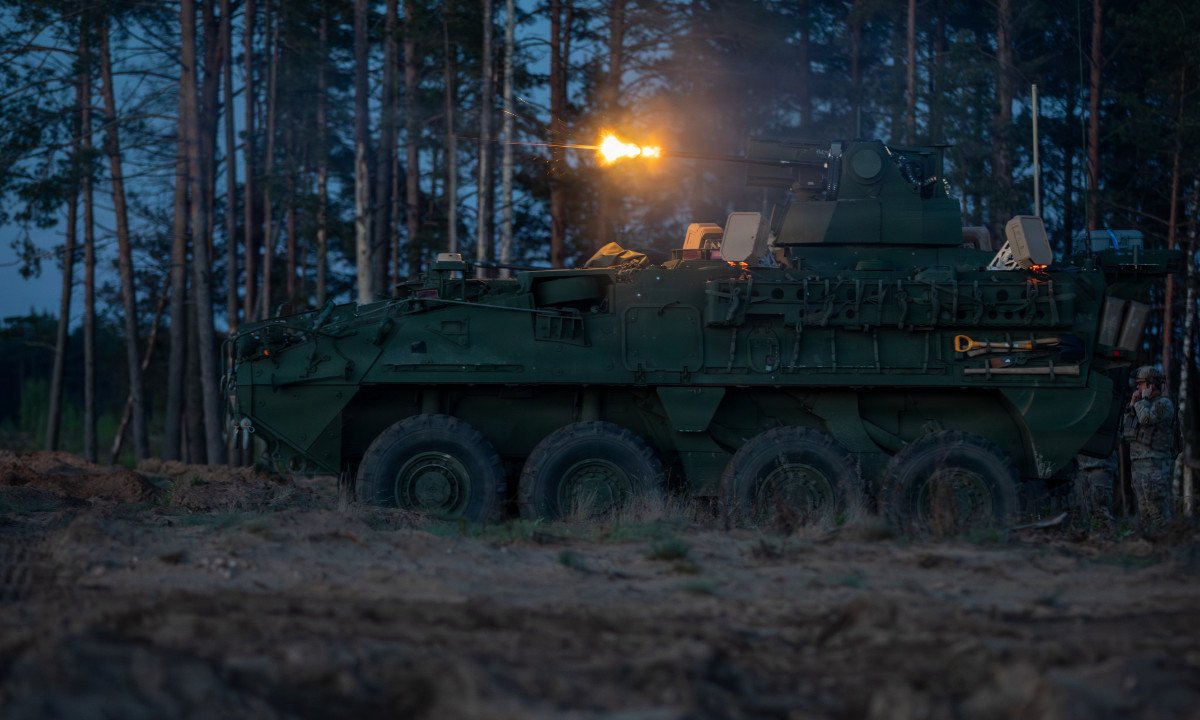
The brigade combat team sits at the center of this problem. As the formation responsible for the close fight, the brigade is the echelon confronting the tactical breakdown of maneuver. It cannot independently generate all the conditions necessary to restore maneuver but is the first echelon to fail if those conditions are absent. Our unit, 2d Cavalry Regiment, is at the frontier’s edge in the European operating environment, putting it in a unique position to understand this threat and begin adapting tactics, formations, and technologies to achieve a solution.
A Doctrinal Template for Restoring Maneuver: The Multidomain Breach
Conceptually, closing with the enemy through the reconnaissance-fires complex is comparable at the tactical level to collapsing antiaccess/area-denial networks at the operational level. The Army already possesses an operational approach purpose-built to disintegrate an enemy’s most integrated and lethal networks: multidomain operations.
Lieutenant General Thomas Feltey, commanding general of V Corps, coauthored a recent article describing a wave-based approach to fire and maneuver. In effect, this approach applies multidomain principles of converging layered suppression and protection to create a window of opportunity for maneuver. Under this construct, higher headquarters—corps and division—orchestrate the deep fight across Waves 1 through 3: systematically detecting the enemy system (Wave 1), shaping the battlefield by degrading key capabilities within the reconnaissance-fires complex and suppressing its return fire (Wave 2), and massing finishing fires at the decisive point to achieve shock (Wave 3).
Throughout these initial phases, the brigade combat team plays a vital dual role: It preserves its own combat power in dispersed, concealed positions while simultaneously contributing its sensing and striking capabilities to the higher fight. As the proponent of the close fight, the brigade’s decisive moment arrives in Wave 4: maneuver. Here, the brigade commits to deliver the decisive blow—penetrating compromised enemy defenses to secure far-side objectives and unlock the division’s pathway to operational depth.
From the brigade perspective, fighting in the security zone means a combined-arms breach of a multidomain obstacle. Enemy sensors, shooters, spectrum, command-and-control architecture, logistic throughput, and battle positions are projected forward into the security zone to deny freedom of maneuver before the brigade reaches the main defensive belt. Restoring maneuver requires attacking these mutually supporting capabilities as a system.
As the reconnaissance-fires complex functions as an integrated obstacle belt, 2d Cavalry Regiment’s approach, iteratively validated in force-on-force exercises under the Project Flytrap series, is to apply the breach fundamentals of SOSRA (suppress, obscure, secure, reduce, assault) as the tactical mechanism by which to break into and through the enemy system:
- Suppress: Prevent the enemy reconnaissance-fires complex from effectively engaging the breach force. Suppression is executed via the full range of new and traditional kinetic and nonkinetic fires, directed against the enemy’s ability to complete the reconnaissance-strike cycle. Division- and corps-level fires will be vital to integrate multidomain effects and range targets the brigade cannot reach. The purpose is not destruction for its own sake, but to reduce the coherence and responsiveness of the enemy reconnaissance-fires complex enough that it cannot immediately punish concentration and movement.
- Obscure: Degrade the enemy’s ability to sense the attacking force’s actions. Formations execute electromagnetic signature management, deploy multispectral camouflage, use decoy emitters, and conduct information operations. The desired effect is cognitive uncertainty.
- Secure: Protect the breach force from what survives. Layered, mobile protection focused on counter–unmanned aircraft systems and electronic warfare establishes a localized air-superiority umbrella at the point of penetration. Because of the inherent friction in war, the enemy reconnaissance-fires complex will never be perfectly suppressed; security requires sufficient protection to provide a margin of error that can convert partial suppression into usable freedom of maneuver.
- Reduce: Create a usable corridor through the reconnaissance-fires complex. Physically destroy key nodes influencing the point of penetration. The desired avenue of approach is rendered opaque to the enemy. Obstacle reduction may still be required, but it occurs inside this larger multidomain corridor. The lane is physical, temporal, and functional. It will inevitably close as the enemy reconnaissance-fires complex recovers from shock and reconstitutes.
- Assault: Dismounted and mounted forces rapidly flow through the reduced lane to regain offensive maneuver. The assault force closes with and destroys the surviving defenders, employing direct fire, maneuver, and shock effect. Tempo is vital in the assault to exploit the temporary corridor created through the enemy reconnaissance-fires complex before it closes.
The Brigade and Higher Headquarters Contract: Scaling Adaptation and Technical Integration
Operationalizing the multidomain breach requires a clear delineation of fights between brigade, corps, and division headquarters. Higher headquarters must degrade key enemy capabilities beyond the brigade’s reach and converge multidomain capabilities at the critical point to disrupt the enemy. This continuous protection layer ensures the brigade can maintain tempo during the breakthrough. Precisely defining those obligations is the major challenge facing Army doctrine today.
The multidomain breach also requires operationalizing new capabilities. Project Flytrap, the Army-directed mobile counter–unmanned aircraft systems series of exercises, is the primary adaptation vehicle utilized by 2d Cavalry Regiment. The Army must shift from consuming readiness for experimentation to building proficiency in warfighting capability with new tools. Moving beyond early-stage innovation, Flytrap scales minimum viable products to the battalion level and builds proficiency in executing a multidomain obstacle breach. Equipping formations with these adaptive capabilities enhances the survivability and effectiveness of basic battle drills today, establishing a tactical foundation that will accelerate institutional adaptation as future combat systems are fielded.
To fulfill the brigade’s end of the contract with higher echelons, the enterprise must deliver on technical integration. Tactical formations require headquarters reachback to aggregate multiple Army systems of record that produce common operational pictures to mitigate tactical leader cognitive overload. We must integrate sensor data directly into enterprise cloud services to enable rapid tactical decision-making and accelerate the kill chain. This integration underpins the commander’s ability to sequence waves of fires and maneuver at scale.
What the Brigade Delivers
Why go to this effort to restore maneuver? Because fires without movement remain sterile and indecisive. What the brigade delivers is penetration of the enemy’s defensive system—the tactical breakthrough.
Penetration is the purpose of the multidomain breach. It is not decisive in itself, but it opens the door for maneuver to create effects that fires alone cannot. Those effects are exploitation into the enemy rear areas and the seizure of key terrain in depth. This restores the operational logic of maneuver warfare, inducing cascading systems collapse in the enemy and turning a tactical breakthrough into an operational breakout.
Achieving the multidomain breach offers a distinct, doctrinal path away from attritional stalemate. The capability to execute this breach is actively scaling through Project Flytrap. The mandate now is to complete the network architecture, standardize the capability, and resume offensive combined arms maneuver.
Colonel Timothy A. Price is an infantry officer, the 84th commander of 2nd Cavalry Regiment, and a graduate of the Virginia Military Institute, Georgetown University, and the US Army War College.
Captain Patrick T. Visser is an infantry officer, the chief of plans of 2nd Cavalry Regiment, and a graduate of King’s College London.
Captain Andrew R. Carter is an armor officer, the former commander of 2nd Cavalry Regiment Multi-Functional Reconnaissance Troop, and a graduate of the United States Military Academy.
The views expressed are those of the authors and do not reflect the official position of the United States Military Academy, Department of the Army, or Department of Defense.
Image credit: Sgt. Nicodemus Taylor, US Army
