

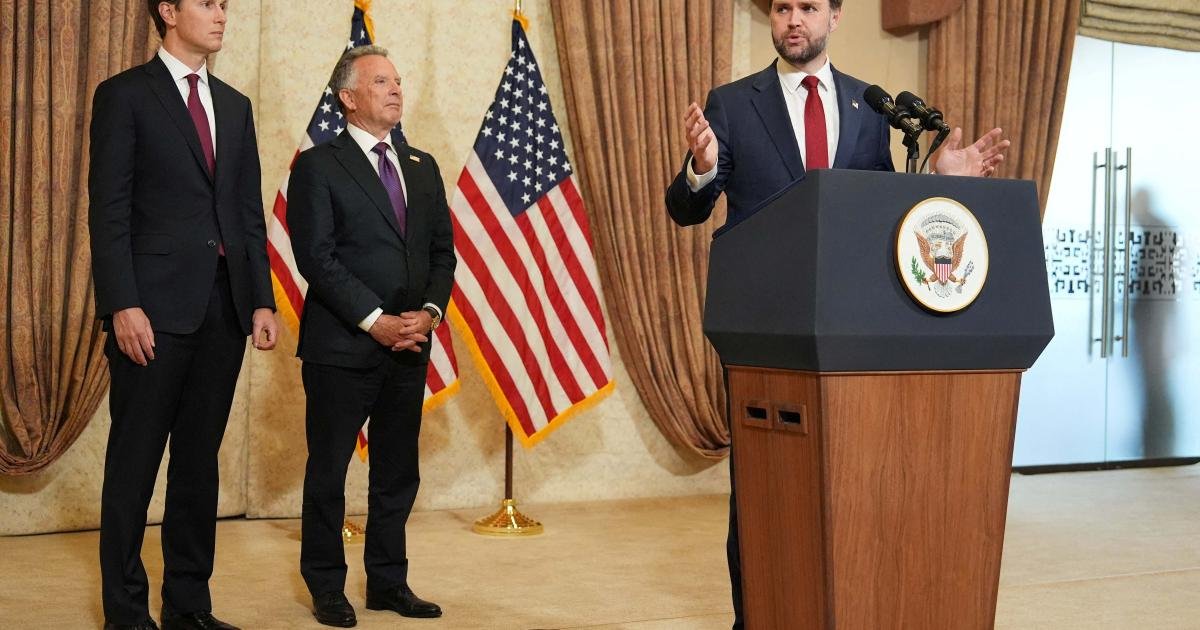
It is, at once, a time of great hope and great despair for anyone who wants U.S.-Iranian relations to improve. On the one hand, delegations from each country met in person last weekend for the first time in a decade, and they negotiated through the night in hopes of forging a lasting peace settlement. The leaders for each country’s team were not diplomats but powerful politicians—U.S. Vice President JD Vance and Mohammad Bagher Ghalibaf, speaker of the Iranian parliament—indicating just how seriously the countries are taking negotiations. But on the other hand, tensions between the two countries are extremely high as a result of the six-week U.S.-Israeli bombing campaign. And for all the fanfare, the most recent round of talks failed to produce a deal.
It isn’t hard to see why Tehran and Washington are struggling to reach an agreement despite all the energy they are investing in forging one. There is a proverbial “sea of blood” between the countries that makes compromise extremely challenging. This is largely Washington’s doing. Over the last year, the United States has gone to war against Iran not once but twice. It has killed Supreme Leader Ali Khamenei, dozens of top military commanders, and over a thousand civilians. It does not help that the United States and Iran have both stood by their maximalist positions.
But despite the current impasse in talks, the cease-fire between the countries remains in place. Discussions are set to continue, so a peace deal is still achievable. To get one, however, Tehran and Washington will need to rethink their approach to negotiations. Most obviously, the two governments will have to make compromises on the Iranian nuclear program and the future of the Strait of Hormuz. They will need to set up a more cooperative regional order. More broadly, however, Iran and the United States have to abandon the fantasy of completely vanquishing a longtime rival and realize they must respect each other’s interests. Both need to accept that the other is too powerful to be defeated. Continuing to pretend otherwise will just invite more crises and conflict, now and in the future.
INCONVENIENT TRUTHS
By now, the issues preventing a U.S.-Iranian peace deal are familiar. Washington wants Tehran to relinquish its enriched uranium, stop developing any more nuclear material, and cede control of the Strait of Hormuz. The Islamic Republic refuses to agree to any of these measures. For Iran, the right to enrich is tied up in questions of sovereignty, deterrence, and national pride. Tehran finds it deeply humiliating to be the only Nuclear Nonproliferation Treaty member that is facing demands to halt enrichment. The strait, meanwhile, is an essential strategic asset. It helps facilitate Iranian commerce and, as this war has shown, affords it geopolitical leverage.
But the negotiations failed for reasons that go beyond specific disagreements. They also failed because of differing perceptions of power. Iran entered the talks with a sense of resilience. It had, after all, withstood a combined U.S.-Israeli assault that Trump claimed would end in regime failure. The United States, however, also arrived at the table convinced it had the upper hand. Although frustrated by Tehran’s persistence, American leaders thought they had done incalculable damage to the Iranian military and security apparatus. They therefore assumed that sustained, maximum coercion could force Iran to make concessions. Both sets of perceptions are, at best, very flawed. But they have nonetheless made it extremely hard to break the deadlock.
The fact that the two parties are talking, however, suggests there is a path forward. And it must begin with preserving the cease-fire, because a return to hostilities might foreclose long-term negotiations. A cease-fire also helps generate at least some goodwill between the two countries: for example, it could allow for tangible confidence-building measures, such as humanitarian aid, partial sanctions relief, or technical maritime arrangements. For example, Tehran and Washington might set up a joint maritime corridor to make sure that food, medicine, and fuel reach Iranian shores. Tehran could also release imprisoned foreign nationals and let Red Cross workers into the country if Washington suspends certain sanctions for a temporary period.
An increase in trust would in turn help Iran and the United States forge a permanent agreement—provided they can take a different approach to negotiations. Rather than simply haggling over their demands to no avail, Tehran and Washington should begin the next diplomatic process by deciding on a shared end goal: stable, nonadversarial relations and, eventually, full normalization of ties. Iranian and American officials should, in other words, set out to create a dynamic in which they can resolve their disputes through direct diplomacy and cooperate on issues of common interest. This understanding will make compromise easier by clarifying for each party which redlines matter and which don’t.
Both countries need to accept that the other is too powerful to be defeated.
Each of the two sides will also need to abandon the assumption that it holds the advantage. Although both American and Iranian officials have made sweeping declarations of victory in the last two weeks, the truth is both Washington and Tehran hold powerful cards they can play should conflict resume. Iran is a large, mountainous country that is home to 90 million people who share thousands of years of history. It can endure even a sustained U.S. effort at regime change. But the United States maintains the world’s most powerful and well-funded military, and it can continue to apply harsh sanctions and other kinds of pressure. It can thus keep targeting Iran’s leadership and inflicting great harm on civilians.
Once they accept these facts, Tehran and Washington might finally be willing to compromise on their core objectives. That begins with the central sticking point: Iran’s nuclear program. There are several viable deals the two parties could strike, provided that the United States drops its demand that Tehran give up all enrichment. Washington, for example, could recognize Iran’s right to enrich under the Nuclear Nonproliferation Treaty in exchange for a binding pledge by Tehran not to exercise that right for a specified period, as a way of increasing trust between the parties. The countries each seem open to such an arrangement. According to reporting by The Washington Post and The New York Times, the United States has sought a 20-year suspension on enrichment, while Iran has offered five years. The two might meet in the middle, perhaps at ten years. Iran would simultaneously promise that when it does resume enrichment, it will not exceed a level of 3.67 percent—far below the threshold needed for nuclear weapons, but high enough to help the country meet its energy needs. Tehran would also need to accept intrusive monitoring by the International Atomic Energy Agency. It would retain the existing 450 kilograms of 60 percent enriched uranium, but commit to diluting the entire stockpile to 3.67 percent, sealing it, and keeping it inside Iran under continuous IAEA custody and monitoring.
Tehran might also agree to establish a regional enrichment consortium with neighboring Arab states. This arrangement, modeled on the European Gaseous Diffusion Uranium Enrichment Consortium, or Eurodif, would distribute and jointly manage sensitive fuel-cycle activities. It would therefore address proliferation concerns not only about Iran but also about neighboring countries. (Saudi Arabia, for example, is demanding enrichment facilities.) Egypt, Turkey, and even the United States and other permanent members of the UN Security Council could join, too, providing even stronger guarantees that the Middle East will forever be a region free of nuclear weapons. These steps could be anchored in a parallel nuclear agreement between Washington and Tehran in which Iran would reaffirm its status as a nonnuclear weapons state and the United States would formally support Tehran’s right to peaceful nuclear technology.
PEACE BY PIECE
Resolving nuclear tensions will get Iran and the United States most of the way to an agreement. But the countries will also need to sort out other disputes, including over the Strait of Hormuz. It is thus unfortunate that Washington has decided to blockade the waterway and, indeed, all maritime traffic to and from Iran’s ocean ports. This decision will not isolate the Islamic Republic, which can reroute trade through the Caspian Sea and overland networks via neighboring countries. But it will deepen mistrust and reinforce hard-line positions. In fact, the move risks widening the conflict. It might, for example, lead the Iranian-backed Houthi militia in Yemen to disrupt shipping through the Bab el Mandeb Strait, which would snarl even more global commerce. This situation could inflame U.S. tensions with China and India, both major importers of Iranian oil. The blockade could also push Iran to again close the Strait of Hormuz outright, sending energy prices skyward.
To avoid such a disaster, both Iran and the United States must commit to freedom of navigation in the Strait of Hormuz, in line with the United Nations’ 1982 Convention on the Law of the Sea. But resolving tensions over this waterway will likely require the involvement of all of the Persian Gulf’s eight countries. To establish a framework for collective security and cooperation in the Persian Gulf, the UN Security Council could even mandate that the UN secretary-general convene a permanent forum—including a maritime security task force—where these states and the five permanent members of the Security Council could hash out disputes. The war with Iran may be thought of as a bilateral affair, but it very much involves Arab countries.
It also involves Israel, and fostering peace between Iran and that country will prove far more difficult. But the United States has enough leverage over Israel to reign in its destabilizing activity. If Iran and the United States commit to respecting each other’s interests and ending proxy confrontations, U.S. mediation could play a decisive role in de-escalating tensions between Israel and Iran by helping both sides move away from mutual security, military, and existential threats and toward agreed rules of restraint and conflict management.
The talks are also unlikely to result in fully normalized relations between Washington and Tehran—at least in the short term. The two governments have simply been at loggerheads for too long to suddenly pivot. Decades of mistrust, military confrontation, and sanctions have created a level of hostility that cannot be easily reversed. The sea of blood, in other words, is too deep for immediate reconciliation.
That doesn’t mean the U.S.-Iranian confrontation has to continue. Indeed, it shouldn’t. The two countries share important interests—regional stability, maritime security, counterterrorism, and nonproliferation—that they have rarely, if ever, explored through cooperation since the Islamic Revolution. With careful planning and reciprocal concessions, the two countries can begin to do so. They cannot return to the era of the shah, when Iran was a close U.S. partner. But they can return to where they were after the 1979 revolution, when relations were strained and adversarial but functional enough for some collaboration, until the seizure of American hostages in Tehran later that year. Cautious engagement could even create the space for more complete normalization in the years to come. At a minimum, it will help U.S. and Iranian officials negotiate directly instead of relying on an endless parade of third-party mediators.
But to get this comparatively happy ending, both Tehran and Washington must be more flexible. Last weekend’s talks in Islamabad failed because each side clung to its rigid demands rather than making calibrated concessions. Neither party wanted the other to notch any clear wins. During the next round of negotiations, they will need to reset their expectations, reimagine success, and be ready to compromise. If they can’t, the result will be a return to confrontation—with consequences that neither side can control or predict.
Loading…
