

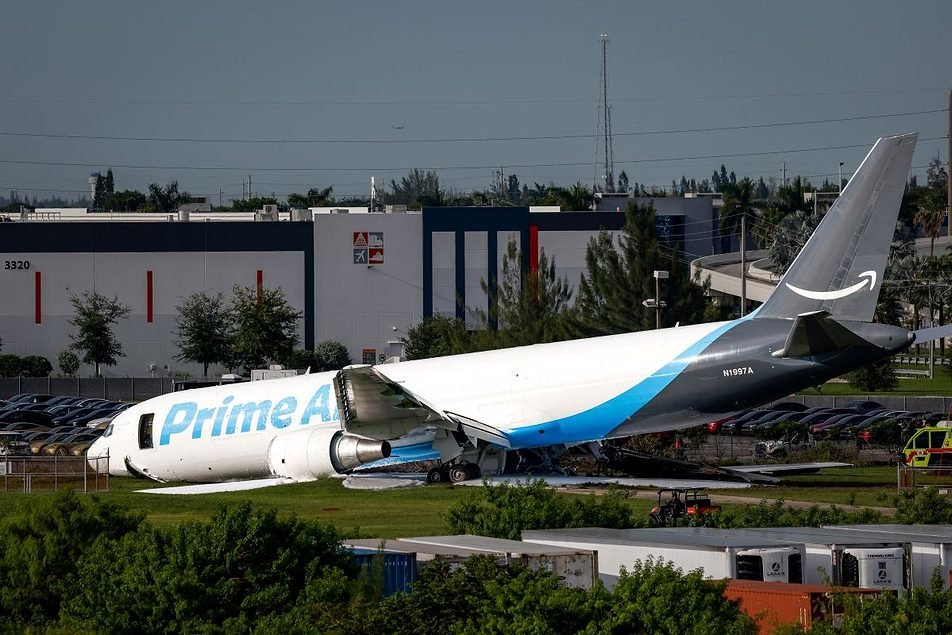
An Amazon.com Inc. cargo plane overran a runway at Miami International Airport and burst into flames on September 6, killing at least five people and temporarily shutting down the airport’s runways during the busy Labor Day travel weekend.
The Boeing Co. 767-300, operated by 21 Air as Prime Air Flight 7598, overshot the runway around 2 p.m. local time after arriving from Luis Muñoz Marín International Airport in San Juan, Puerto Rico, according to the Federal Aviation Administration.
The plane slammed into multiple vehicles near the airport, trapping some people inside, according to Miami-Dade Fire Rescue, which reported heavy flames and smoke when it responded to the incident.
Along with the five people who were killed, another five were injured, three of whom were in critical condition, Miami-Dade Mayor Daniella Levine Cava said at a news conference.
“Prime Air Flight 7598 overran Miami International Airport’s diagonal runway and is disabled at the northwest end of the airport,” Indira Almeida-Pardillo, a spokesperson for Miami International Airport, said in a statement. She said all runways and taxiways were closed as of 3 p.m. on September 6, and a ground stop was in effect.
Several hours later, at least two of the runways had reopened, said Greg Chin, another airport spokesperson.
As a major international cargo gateway, Miami is the busiest airport for total freight in the U.S., with a particular focus on Latin America and the Caribbean. Freight shipments reached almost 3.5 million tons in 2025, according to the airport. Other major hubs for freight in the country are Louisville in Kentucky and Memphis, global hubs for United Parcel Service Inc. and FedEx Corp.
There was “a very complex fire,” Ray Jadallah, the Miami-Dade Fire Rescue chief, said at a news conference, and the engine compartments were on fire through the “search and rescue of the pilot and co-pilot that were trapped in this aircraft.”
A total of 60 fire units responded to the scene. “They arrived within 30 seconds after getting a call,” he added.
Transportation Secretary Sean Duffy warned of significant delays and possible cancellations in a post on X.
21 Air, a Miami-based cargo airline, began operating Boeing 767-300 freighters on behalf of Amazon in 2024. In a statement on its website, 21 Air said it was cooperating with the FAA, NTSB and local authorities.
“Our deepest condolences are with the families and loved ones of those who lost their lives,” the company said.
Amazon confirmed that one of its planes, operated by 21 Air, experienced an incident when it attempted to land in Miami.
“We’re working closely with local authorities and officials to understand exactly what happened,” Kelly Nantel, an Amazon spokesperson, said in a post on X. “Right now, our absolute priority is the safety, well-being and care of everyone involved.”
The FAA said it will investigate the incident, and the National Transportation Safety Board said it is also starting a probe and will hold a media briefing on Monday.
Amazon’s in-house cargo airline has tilted its focus to larger aircraft that can handle longer distances and bulk shipping, with the 767 model that crashed in Miami now accounting for the biggest portion of its fleet. Amazon Prime also has 10 Airbus SE A330-300 freighters, as well as smaller narrowbody 737 planes for regional routes.
21 Air, which also provides dedicated transport for DHL Express, is owned by Jim Crane, the chairman of the Houston Astros baseball team, according to a 2021 letter to the Department of Transportation.
While the circumstances of the accident remain unknown, the crash stands to be the worst cargo-related incident since a UPS freighter was destroyed after it impacted the ground shortly after takeoff at Louisville Muhammad Ali International Airport on November 4, 2025. The incident killed the three crew members aboard the airplane and 11 people on the ground.
Freight planes make up only a small part of commercial air traffic, but cargo operations have been prone to proportionally more crashes over the years, partly because flights can be longer and planes are older. Cargo planes are often conversion of models previously flown as passenger variants.
In February 2019, a Boeing 767-300, operated by Atlas Air that had departed from Miami hauling packages for Amazon, abruptly dove and slammed into a bay at high speed as it was preparing to land in Houston, killing all three people on board.
The most common accidents in the aviation industry in 2025 were tail strikes, landing-gear malfunction, runway excursions, and ground damage, according to the International Air Transport Association 2025 Annual Safety Report.
According to Airbus, runway excursions during the landing phase represent one of the largest categories of accidents in air transport, representing about 20% of all reported occurrences. Causes can include unstable approaches, contaminated or slippery runways, or pilot error.
Some airports are kitted out with so-called Engineered Materials Arresting Systems that use crushable material placed at the end of a runway to help stop an overrunning aircraft. The installation will arrest most aircraft overrunning at 70 knots (about 80 miles per hour), and the FAA estimates that EMAS has safely held back 26 aircraft to date.
Others have barriers at the end of their runway to hold back runaway planes, though the installations are not without hazard. A Boeing 737-800 aircraft operated by Jeju Air Co. crashed in December 2024 after skidding down an airport runway in South Korea at high speed before slamming into a concrete wall at the end of the strip. The accident at Muan International Airport killed 179 of the 181 people on board.
The aircraft involved in the Miami crash was more than 32 years old, having first flown in June 1994. Over the decades, it changed hands, including operations for Air Europa, Kenya Airways and Atlas Air, a cargo specialist, after being converted into a cargo plane in 2016, according to data compiled by the Planespotters website.
The Boeing 767, of which more than 1,300 were made, is no longer in production as a commercial aircraft but is still widely flown, mainly for cargo services. The manufacturer still produces a small number as military refueling aircraft.
