

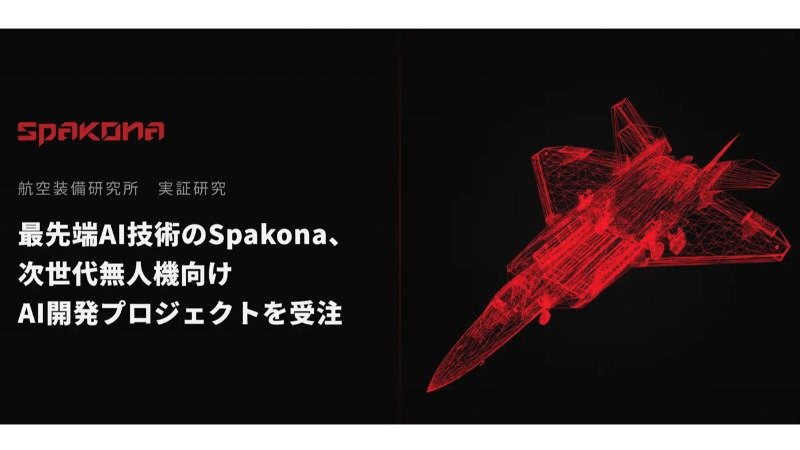
On April 7, Tokyo-based AI company Spakona Inc. announced that it will conduct research and development of onboard AI to enable flight demonstrations involving multiple unmanned aerial vehicles (UAVs) in collaboration with Japanese digital security systems firm Dodwell BMS Co., Ltd.
In a press release,[1] Spakona said the research will include testing AI in both simulated environments and on actual UAVs as part of a project led by the Air Systems Research Center of Japan’s Acquisition, Technology and Logistics Agency (ATLA), titled “Project for the Creation of Flight Demonstration AI and Support for Flight Tests”.
Dodwell BMS, a subsidiary of Ai Holdings Corporation, will collaborate with Spakona as a capital and business partner. The two companies have been jointly awarded a three-year contract worth around 503.5 million yen (approximately USD 3.2 million) to develop the flight demonstration AI for UAVs and conduct tests, including advanced verification using real aircraft.[2]
The news follows Spakona’s announcement a day earlier of its full-scale entry into the defense sector, where it aims to build on AI-powered decision-making technologies it first developed within civilian fields.[3]
The company recently won an ATLA-hosted competition that required participants to develop AI-powered decision-making systems for simulated fighter aircraft operating as coordinated agents in simulated aerial battles.
These developments align with ATLA’s broader efforts to develop collaborative combat support UAVs capable of operating alongside manned fighter aircraft. This includes Japan’s next-generation jet expected to be deployed by fiscal 2035 that is being co-developed with Italy and the United Kingdom under the Global Combat Air Programme (GCAP).
A key component of efforts to develop these Manned-Unmanned Teaming (MUM-T) technologies is ATLA’s research into multi-UAV collaboration enabled by AI-powered decision-making and situational awareness.
The Spakona Project into Flight Demonstration AI for UAVs
Spakona said it will develop an AI decision-making model trained through deep learning techniques in environments where multiple UAVs or simulated agents operate. The system is designed to help the drones determine how to act, including how to coordinate and respond to opposing actions in complex situations.
The company will also focus on edge AI by verifying how its decision-making model can be deployed on a UAV’s onboard computer systems while balancing computational efficiency and real-time performance.
The project will therefore involve performance verification in both simulated environments and on actual UAVs.
Testing will begin with Hardware-in-the-Loop Simulation (HILS), before progressing to flight tests with actual UAVs. The aim here is to enhance the AI system’s reliability and safety for operation in multi-UAV environments
To evaluate decision-making capabilities, Spakona will engage in tests that focus on tracking virtual targets, decision-making in simulated air-to-air scenarios that involve multiple aircraft, and cooperative and competitive behaviors.
Spakona, along with its business partner Dodwell BMS, is expected to deliver the flight demonstration AI system for unmanned aircraft to ATLA’s Air Systems Research Center by May 2029.
How the Spakona Project Fits with ATLA’s MUM-T Priorities
ATLA’s Air Systems Research Center is actively advancing AI research to support the realization of MUM-T capabilities, with a particular focus on coordination by combat support UAVs.
Since at least 2018, when around 500 million yen (approx. USD 3.1 million) was allocated, the agency has been developing AI for collaborative UAVs, including decision-making and intent inference.[4]

ATLA’s research has focused on automating the OODA loop (observe, orient, decide, and act) and on conducting simulations of AI-based behavioral decision-making models.[5]
This research is being developed into a pipeline in which AI models are trained in simulated environments and then validated through flight testing using actual UAV testbeds.[6]
To accelerate progress, ATLA also incorporates private-sector input. The Air Combat AI Challenge, first launched in 2022, is designed to advance R&D by tapping into innovative ideas generated through large-scale trial and error by a large number of participants.
The fact that Spakona won the fourth edition earlier this year and subsequently secured a contract with ATLA suggests that the competition increasingly functions as a means to transition promising technologies into projects.
Within this broader framework, Spakona’s project addresses a key technical bottleneck in ATLA’s program: refinement of AI decision-making for multi-agent operations using deep learning and a transition from simulated training to real-world validation using UAVs.
ATLA’s efforts are further complemented by international cooperation. In September of last year, Japan’s Ministry of Defense announced a partnership with the U.S. Department of Defense to pursue Runtime Assurance (RTA) to ensure the safe integration of these AI software in critical systems on board UAVs.
Conclusion
Spakona’s project into flight demonstration AI for multi-UAV operations alongside capital partner Dodwell BMS appears to directly contribute to ATLA’s ongoing research into establishing AI technologies for collaborative UAVs to operate alongside manned aircraft.
Most notably, the Japanese company’s successful contract for this project following its participation in the latest ATLA Air Combat AI Challenge highlights how the agency increasingly leverages the expertise and technologies of dual-use startups in support of key defense projects.
Notes:
**1 USD = 158.89 JPY
[1] Spakona Inc., “最先端AI技術のSpakona、次世代無人機向けAI開発プロジェクトを受注” [Spakona, a leading AI technology company, has won a contract for an AI development project for next-generation unmanned aerial vehicles]. PR Times, April 7, 2026, https://prtimes.jp/main/html/rd/p/000000013.000134977.html.
[2] Ai Holdings Corporation, “Notice Regarding Order Received for AI Development Project for Next-Generation Unmanned Aircraft at Our Consolidated Subsidiary”, April 7, 2026, https://www.aiholdings.co.jp/en/uploads/sites/3/2026/04/topic0407en.pdf.
[3] Spakona Inc., “最先端AI技術のSpakona、防衛テック領域へ本格参入” [Spakona, a leading AI technology company, makes a full-scale entry into the defense tech sector.]. PR Times, April 6, 2026, https://prtimes.jp/main/html/rd/p/000000012.000134977.html.
[4] Aerodynamics & Flight Control Research Section, Aircraft Research Division, “航空装備研究所における無人機研究最前線” [The forefront of unmanned aerial vehicle research at the ATLA Air Systems Research Center], ATLA Symposium 2022, March 2023, Slide 4, https://www.mod.go.jp/atla/research/ats2022/pdf/prog_rnd_01.pdf.
[5] Tsubasa Kawai, “Toward intelligent aerial combat”, ATLA Symposium, 2022, March 2023, Slide 4, ; “戦闘機と連携する無人機のコンセプトに関する研究” [Research on the concept of UAVs that work in conjunction with fighter jets], https://www.mod.go.jp/atla/kousouken.html.
[6] ATLA, “戦闘支援無人機へのAI実装に向けての取り組み” [Efforts toward implementing AI in combat support UAVs], ATLA Symposium 2024, November 12-13, 2024, https://www.mod.go.jp/atla/research/ats2024/pdf_oral_matl/1112_1500_ss09.pdf.
This article was originally posted on NSBT Japan, the first defense and security industry network in Japan. The publication provides the latest information on security business trends both within Japan and overseas. Asian Military Review began exchanging articles with NSBT Japan in April 2024.
Read the original article here.
