

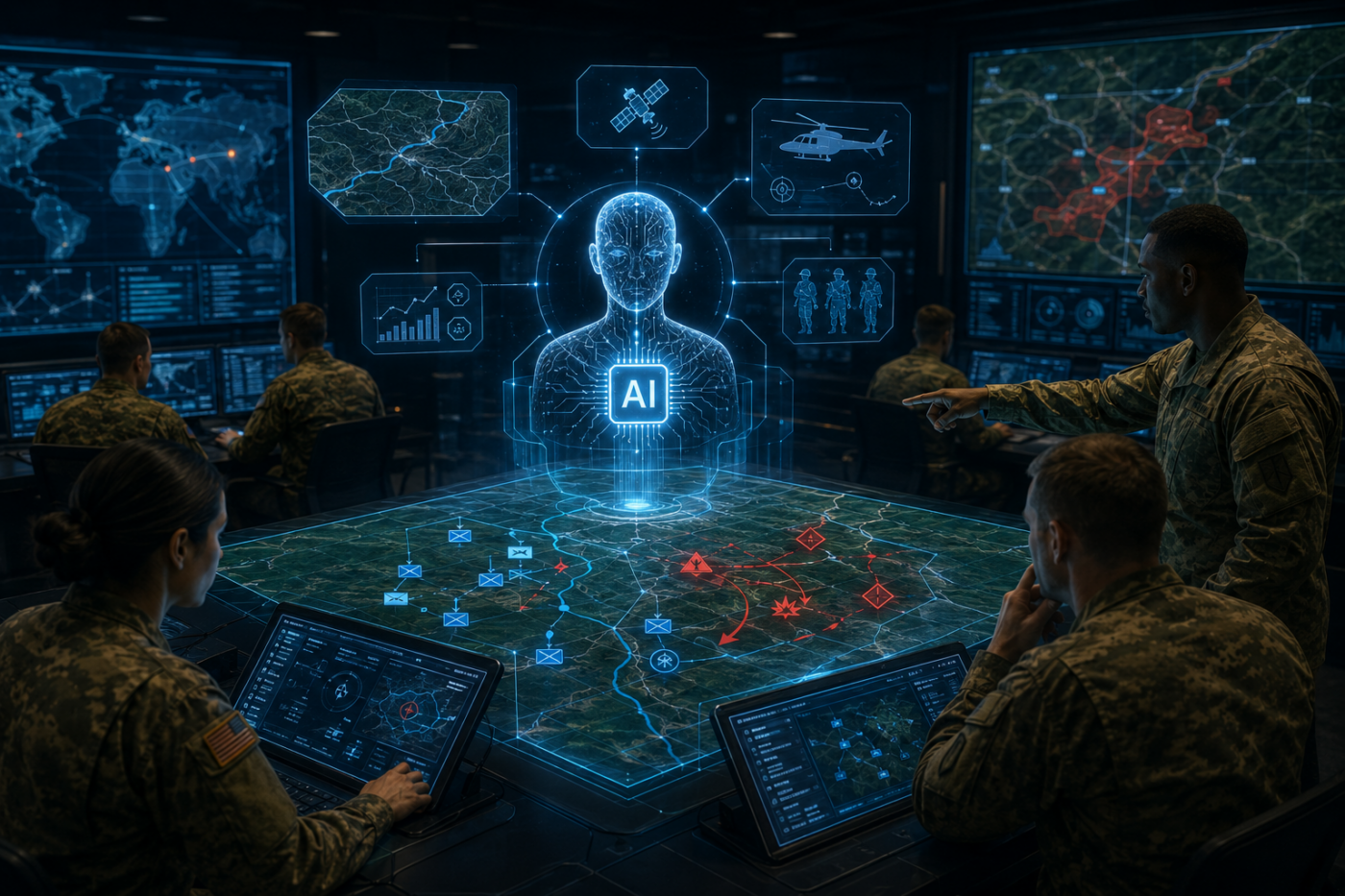
The character of warfare is in a state of perpetual evolution, demanding that the Army seek a decisive edge through technological superiority. For the FY25 school year, the Command and General Staff College (CGSC) faculty explored how to utilize artificial intelligence (AI) to achieve training objectives at echelon. The integration of AI into the execution phase of the Operations Process represents the next frontier in this pursuit. Recent practical applications during the Advance Operations Course capstone LSCO exercise at CGSC have provided a concrete blueprint for how Large Language Models (LLMs) can revolutionize simulations by acting as a virtual Higher Headquarters. This would enable units at echelon to increase staff proficiency at the pace and convenience of their own schedule without impacting adjacent or higher organizations.
This article outlines the findings from a two-week practicum involving 61 students representing the 25th Infantry Division staff during a simulation exercise. Our exploration demonstrated that when properly resourced, AI can serve as a powerful cognitive partner, bridging the gap between limited human resources and the complex demands of a Division-level simulation.
Building the Framework: Resourcing AI for the Operations Process
The initial phase involved preparing a digital battlespace where an AI agent could reason using the same doctrinal and operational documents as a human staff. Using the Vantage platform, we developed a pipeline utilizing two distinct ontologies. The Tactical Ontology consolidated all division-level information, from the Receipt of Mission through post-orders production products like the Combined Arms Rehearsal and various warfighting function running estimates. The Operational Higher Headquarters Ontology contained previous years’ intelligence and operations summaries to provide context.
To ensure doctrinal rigor, we validated the model’s ability to reference doctrinal manuals covering operations, the operations process, and Chinese tactics. By converting these manuals into structured ontology objects, we enabled the AI to parse complex operational inputs and simulate the cognitive load of a full planning staff.
Solving the Resource Constraint: The AI HICON
A significant challenge during the practicum was the limited capacity of the Higher Control (HICON) cell. Tasked with managing Corps-level deliverables for a Division Wet Gap Crossing and Forward Passage of Lines while inserting Master Scenario Event Lists (MSELs) throughout the operation framework, the cell consisted of a single Medical Service (MS) officer with limited experience in targeting or information collection integration. The challenge was the MS officer wasn’t a Subject Matter Expert (SME) in Information Collection (IC), targeting or combined arms integration between attack aviation, fires and M2. This created a friction point, as the division staff required constant feedback on Battle Damage Assessments (BDA) and Information Collection plans to maintain the training pace.
Using Vantage AIP as the virtual Corps headquarters, transformed this constraint into a capability. By creating an AIP with two separate ontologies, the AIP was able to provide the information needed for the Division staff to plan across time throughout the Plans, FUOPS and CUOPS cells. One ontology referenced Army doctrine and the original Corps base OPORD, while the second ontology integrated division-level briefing slides with map location, their IC plan, HPTL and HVTL. The AI generated updated information on the enemy situation and provided real-time BDA for the staff’s “kill contracts”. This allowed the faculty to dictate the pace of the exercise while the AI handled the immense cognitive load of processing data for the division staff.
Dynamic Adjudication: AI Deliverables at Echelon
Beyond basic feedback, the virtual headquarters assisted in providing updates, constraints, and new challenges specific to the Rear, Main, and Tactical Command Posts. This proved beneficial in training the entirety of the staff through several high-level deliverables:
- Operational Synchronization: The model provided 24-hour updates for all three divisions in the simulation, allowing the staff to see how their execution synced across time and space. In one instance, we simulated a sister division falling 12 hours behind, which prompted the AI to generate two new Priority Intelligence Requirements regarding a potential seam between unit boundaries. In addition, it allowed for the division staff to coordinate cross boundary fire missions and IC integration by confirmation of BDA and what it was shot by. This allowed the staff to see that properly placed resources support the Corps as a whole system.
- Multi-INT Updates: The system generated geospatial, open-source, and signals intelligence updates based on course parameters and refined them through the established ontologies. One example from the AIP was a mass migration that created civil unrest in the division rear area. This allowed for enablers to integrate their skillsets into the capstone, which allowed for the division staff to understand the whole Area of Operations (AO) and drive recommendations to the command team.
- Threat Assessment and Targeting: The AI assessed when enemy field artillery could mass fires and identified the presence of new rocket systems near the crossing sites. This forced the division intelligence cell to focus on specific areas of interest and successful targeting. We also tasked the AI to generate daily BDA for sister divisions to show how Corps was setting conditions across the entire area of operations.
- Significant Actions: The model facilitated current and future operations refinement by producing detailed reports on adjacent unit actions and recommendations for engineer support or obstacle reduction.
The Iterative Edge: Predictive Analysis and Depth of Production
The most significant discovery of the exercise was the compounding effect of the AI’s iterative learning. By day three, after feeding generated summaries back into the system for reference, the AI began providing an enemy order of march, tempo, and recommended key objectives projected five days out. This facilitated future operations planning while keeping the staff aware of how the enemy was operating in the deep, close, and rear terrain.
The depth of production also saw a radical shift. In years past, intelligence and executive summaries rarely exceeded three pages. With the use of the model, these products averaged 20 pages and included updated commander’s intent, reallocation guidance for close air support, and a magnitude of complex civil issues.
Lessons for the Force
This experiment in AI-augmented staff training offers several vital lessons for the Army:
- The Non-SME Multiplier: The AI enabled a single officer who was not a subject matter expert in fires or intelligence to produce high-quality, doctrinally grounded guidance across multiple warfighting functions.
- Repetition at Echelon: This concept is scalable down to the Battalion level. A staff could execute a wargame in garrison using a model to provide daily guidance, allowing for more repetitions and deeper analysis without being reliant on the availability of an actual higher headquarters.
- Training Independence: This allows units to train to the convenience of their own calendars. By using the AI to facilitate the flow of information, staffs can maintain a high training tempo and refine plans based on changing circumstances modeled by the AI.
The Risks of Over-Reliance on LLMs as Virtual Higher Headquarters
While the integration of LLMs as a virtual Higher Headquarters promises efficiencies in resource-constrained training, it carries significant risks to doctrinal fidelity and professional military judgment. LLMs remain prone to hallucinations that generate plausible yet erroneous outputs in battle damage assessments, threat projections, and priority intelligence requirements, even when supported by structured ontologies and doctrinal documents. Studies of LLMs in wargaming consistently demonstrate tendencies toward aggressive biases and escalation dynamics that diverge from human expert reasoning. The touted “non-SME multiplier” effect may foster automation bias, leading staff officers to uncritically accept machine-generated deliverables under time pressure and eroding the repetitive human deliberation essential for developing adaptive operational art. Consequently, over-reliance on AI-augmented exercises risks producing voluminous but shallow products that simulate analytical depth without cultivating the disciplined initiative and contextual judgment required for Multi-Domain Operations. Rigorous human oversight, validation protocols, and doctrinal safeguards are therefore essential to ensure AI augments rather than replaces the human element in staff training.
Conclusion
Integrating Artificial Intelligence into the decision-making process is a present-day reality with the potential to significantly enhance the speed and depth of execution simulations. By providing formations with properly resourced AI agents, the Army can ensure more repetitions and deeper analysis, leading to a more rigorously tested plan and a staff well equipped for the complexities of Multi-Domain Operations.
(The views expressed in this article are those of the author and do not necessarily reflect the official policy or position of the Department of the Army, the Department of War, or the U.S. Government.)
