

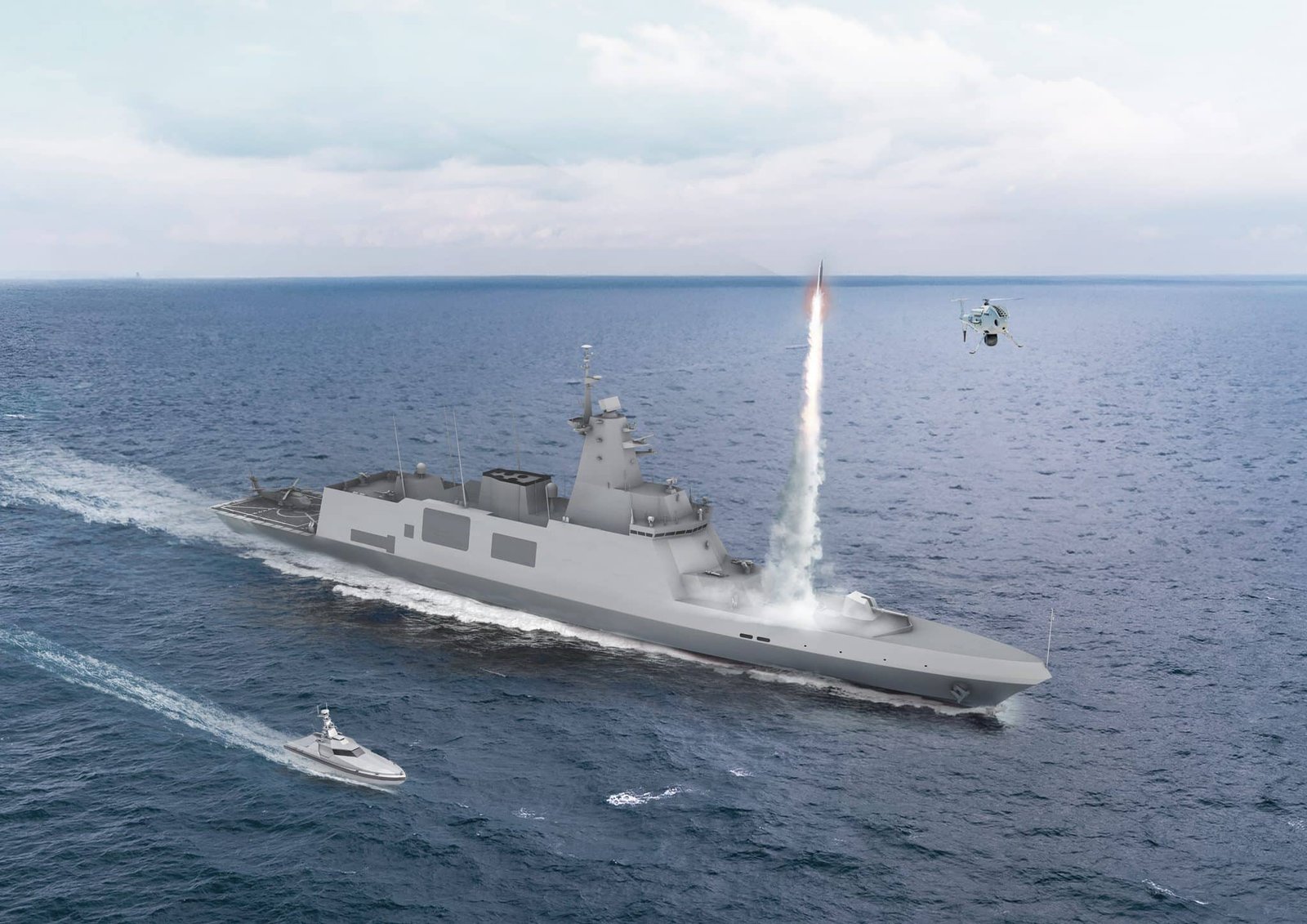
The Royal Thai Navy has been forced to cancel and retender its frigate programme after procedural flaws overturned Hanwha Ocean’s selection
Ever since the Thai government endorsed the selection of Hanwha Ocean’s 4,000-tonne Ocean-40F frigate design on 7 September 2026, the tender process has been beset by protests and complaints.
Finally, on 18 November, Royal Thai Navy (RTN) spokesman Rear Admiral Chanin Sriyaphai announced that the Appeals and Complaints Committee, under the Comptroller General’s Department, had ordered cancellation of the tender after one appeal was upheld regarding procedural flaws.
This tender that closed in April 2026 had attracted stiff competition from six international shipbuilders: ASFAT, Hanwha Ocean, HD Hyundai Heavy Industries, Navantia, ST Engineering and TAIS.
After Hanwha Ocean was declared preferred bidder as the only contender to pass qualification requirements, all the other contenders filed appeals when the project entered a statutory period allowing such submissions through till 18 September.
Hanwha Ocean was supposed to be formally declared the winner at that point. However, the contract worth THB16.73 billion (US$508 million) was never awarded because of this protracted appeals process.

Cancellation
The Appeals and Complaints Committee decided that arguments from four of the losing contenders did not carry weight, but it did put credence on a fifth complaint from the Thai Frigate Building Consortium, which had formed a joint venture with Navantia and was offering to build the warship entirely in Thailand.
The consortium’s material complaint was that the contract’s terms of reference did not properly specify monetary thresholds when bidders listed their past shipbuilding track records to prove their eligibility to participate.
The tender did not require them to give detailed financial criteria, despite Ministry of Finance regulations stipulating that bidders must demonstrate they had reached the threshold of a former project worth 50% of the project budget, or around THB8.5 billion.
This cancellation will force the RTN to entirely retender the frigate programme as per Article 119 Paragraph 2 of the 2017 Public Procurement and Supplies Administration Act. All members of acting committees would have to be replaced too.
Admiral Nares Wongtrakul, the RTN’s Commander-in-Chief, said the navy would respect the legal process, protect the public interest and pursue the capabilities that Thailand needs for its defence. He reiterated the need for a fair, transparent process that taxpayers could scrutinise.
A fresh tender process with reworded terms will take another six months to prepare, plus new committees will have to be set up. Furthermore, time constraints mean the Navy needs to sign the contract by the end of September 2027 in order to use its allocated budget for the current fiscal period.
Chanin admitted, “We acknowledge that the terms of reference were incomplete and did not comply with the regulations, and we respect the judgment.” In the navy’s defence, he noted that, “In reality, no frigate worth 8.5 billion baht exists.” He claimed that was why the navy simplified conditions to verify practical shipbuilding experience. He stressed this had nothing to do with corruption or favouring one bidder over another.

Fallout
Because no deal had been signed under the original tender, the RTN does not expect to be liable for damages.
However, in response to cancellation, local media reported that Hanwha Ocean filed a petition with Thailand’s State Audit Office on 18 November. The South Korean company apparently requested an investigation into potentially unlawful actions that have caused it hardship and unfair treatment.
Hanwha Ocean is eligible to enter the next tender, but it will hold no favoured status compared to any other contender. However, it is concerned that it is now at a disadvantage because details of its original proposal have already been disclosed. Hanwha Ocean therefore petitioned the ombudsman for the tender process to be suspended until this investigation is concluded.
Despite all this kerfuffle, the choice of the Ocean-40F frigate was somewhat logical given that Daewoo Shipbuilding & Marine Engineering – the forerunner to Hanwha Ocean – had delivered a similarly sized frigate to the RTN in 2018, HTMS Bhumibol Adulyadej.
The frigate price is likely to rise because of the passage of time, and such contractual rigmaroles leave a bitter taste in the mouths of would-be competitors. Following the RTN’s frustrating saga over the procurement of an S26T submarine from China, this is yet another bad look for Bangkok.
The first time around, long before the five appeals were lodged, the navy had stated, “The Royal Thai Navy recognises that the frigate procurement project has attracted considerable public and societal interest, as it concerns national security, the protection of Thailand’s maritime interests and the use of public funds. The RTN therefore places the utmost importance on ensuring that every stage of the process is conducted correctly, cost-effectively, transparently and in a manner that is subject to scrutiny.”
The renewed process will now come under even greater scrutiny. Nonetheless, Chanin said with confidence, “Please watch how the new tender process unfolds. In the end, everything will be proven by the results.”
Local involvement
The tender outlined a minimum level of 20% indigenous content and the transfer of technology. Eight domestic shipbuilders and the Thai Shipbuilding and Repairing Association hadsigned a memorandum of understanding in preparation for this frigate programme in March 2025.
They said their agreement “seeks to consolidate private-sector expertise and resources in preparation for complex naval programmes, including the potential construction of frigates for the Royal Thai Navy”.
The eight local companies include Asian Marine Services, Marsun, Seacrest Marine, Unithai Shipyard and Engineering, Thai International Dockyard, Mariart (Thailand), Lantacruz and Prakarnkonlakarn Shipyard. Marsun stated, “Their capabilities span ship construction and repair, advanced engineering, systems integration and specialised maritime services. By combining their strengths, the companies aim to build a coordinated national capacity capable of delivering complex, large-scale naval projects within Thailand.”
However, no Thai shipbuilder has ever attempted to construct a naval vessel as complex as a frigate before. The most sophisticated naval vessels built in Thailand to date are two 2,000-tonne Krabi-class offshore patrol vessels built in conjunction with BAE Systems.
The RTN shared in an 18 September statement that its new warship would be able to conduct surface warfare, anti-submarine warfare and air defence. It also said the frigate would be capable of conducting land attack missions and countering drones.
The navy also revealed that Hanwha Ocean’s offer included offshore patrol vessel and unmanned surface vessel designs, as well as technology transfer and development of a tactical data link and combat management system.
Programme scope
One reason that this competition is being fought so fiercely is that the Thai navy ultimately wants more than just one frigate. Under its 2026-32 budget commitment, the RTN has already sought THB35 billion for the first pair. Beyond that, it needs four new frigates by 2037.
Thailand needs these modern warships to help secure both its Andaman Sea and Gulf of Thailand coastlines.
Source: navalnews.com. Summarised by TBH Center; all rights to the original reporting remain with the publisher.
