

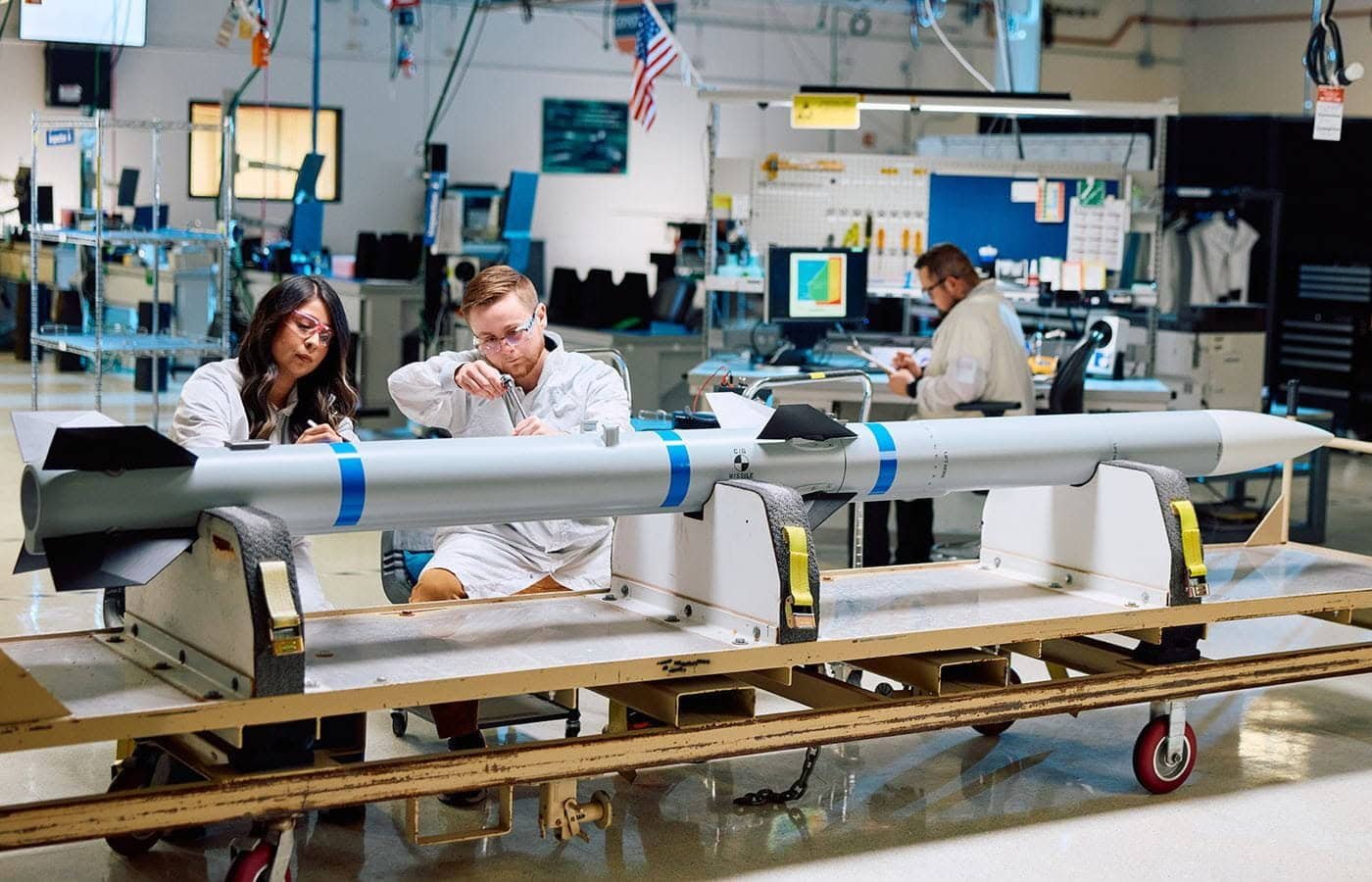
Japan and the USA have signed an agreement to establish a Raytheon AIM-120 Advanced Medium-Range Air-to-Air Missile (AMRAAM) final assembly and checkout (FACO) facility in Japan, a move that further boosts bilateral missile cooperation.
Japanese Defense Minister Shinjiro Koizumi made the announcement on 28 October 2026 on the sidelines of the ASEAN Defence Ministers’ Meeting-Plus in Cebu, the Philippines. This followed discussions with US Secretary of Defense Pete Hegseth.
“This is a ground-breaking agreement that will not only ensure the acquisition of equipment needed by both Japan and the United States, but will also strengthen Japan’s defence industry base,” Koizumi said
The AMRAAM FACO facility will form part of a joint initiative known as Operation Supercharge, aimed at accelerating the joint development and mass production of advanced missile systems.
The initiative was first announced following a meeting between Koizumi and Hegseth on the sidelines of the Shangri-La Dialogue security forum earlier this year, although discussions over Japanese participation in AMRAAM manufacturing have taken place for more than two years.
The missiles are considered essential to the Japan Air Self-Defense Force’s (JASDF) F-35 air-to-air combat capability, Koizumi said. Japan’s other two fighter types – the F-15J/DJ and F-2A/B – utilise the domestically developed Mitsubishi AAM-4 medium-range, active-radar-homing, air-to-air missile.
No further details were disclosed, including the timeline for establishing the FACO facility, the Japanese industrial partner involved, or which AMRAAM variant would be assembled in Japan.
In January 2025, the US Defense Security Cooperation Agency announced that Japan had been approved to acquire 1,200 new AIM-120C-8/D-3 AMRAAMs at an estimated cost of US$3.64 billion.
It remains unclear if these missiles will be included in the Japanese production arrangement, although it is possible a substantial proportion, if not all, could be assembled in Japan.
Mitsubishi Heavy Industries (MHI), which has been manufacturing Lockheed Martin’s Patriot PAC-3 surface-to-air missiles since the mid-late 2000s, would most likely be the local partner.
The agreement would make Japan the first country outside the USA to assemble the AMRAAM, a missile that Washington regards as sensitive defence technology.
However, the final assembly and inspection arrangement would limit Japan’s role to completing and inspecting missiles using components manufactured elsewhere, allowing the USA to retain control over sensitive technologies and critical components.
In addition to the AMRAAM agreement, Koizumi disclosed that the USA and Japan also “agreed to share the necessary technical information to achieve increased production” of the SM-3 Block IIA missile, although the extent of the planned production increase was not indicated.
The SM-3 Block IIA, a predominantly ship-based ballistic-missile interceptor, was jointly developed by Raytheon and MHI.
Expanded cooperation on the AMRAAM and SM-3 reflects growing concerns over regional security and the need to increase production capacity for advanced munitions.
For Japan, amid growing air and missile threats – particularly from China and North Korea – expanding domestic missile production will help sustain its air and missile defence capabilities. It will also strengthen the country’s defence industrial base and reduce its reliance on overseas supply chains.
For the USA, diversifying supply chains and broadening the defence industrial base have become priorities for its military in recent years. Concerns over the adequacy of US stockpiles of key missiles have grown amid a succession of global crises – including the war in Ukraine and conflicts in the Middle East – which have placed increasing demands on American munitions inventories.
In this regard, Japan represents a reliable industrial partner offering an established manufacturing base to support efforts to expand munitions production and strengthen supply chain resilience.
One example was Japan’s announcement in November 2025 that it had completed deliveries of domestically produced PAC-3 interceptors to the USA, helping replenish stockpiles with missiles drawn from JASDF inventories.
by Roy Choo
