

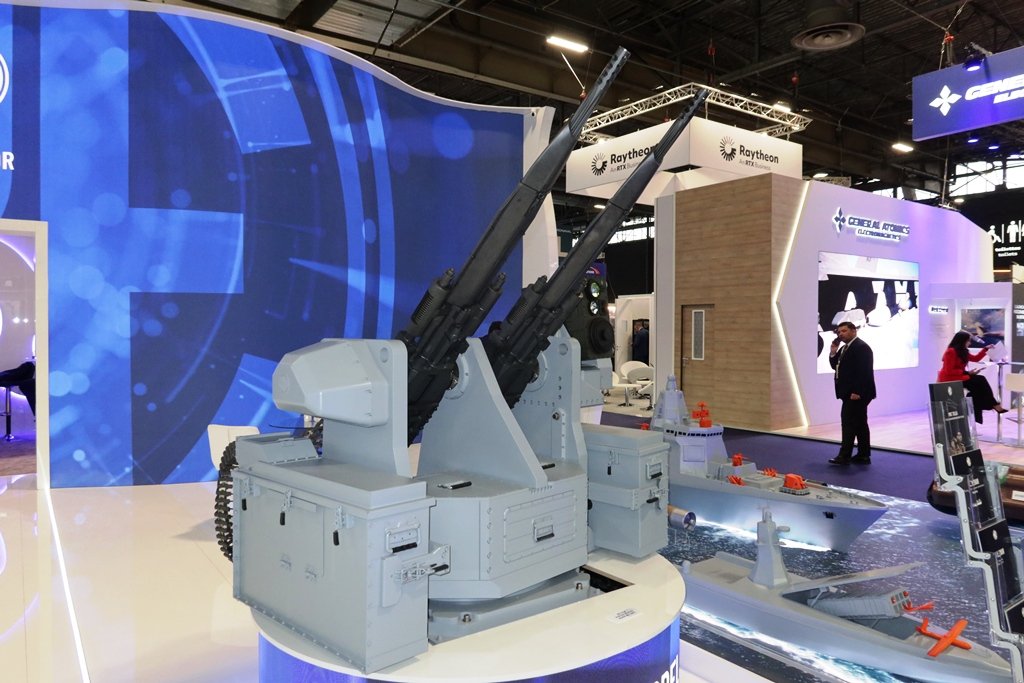
MKE of Turkey developed the Tolga, a land-based layered short-range air defence system capable to defeat drones at very short and short range with effectors ranging from 1.27 to 35 mm calibre machine guns and cannons, short range missiles, and directed energy weapons. At Euronaval in Paris the company unveiled the Tolga 20 mm Dual Revolver RCWS, a spin-off of land effectors, capable to generate a high-density layer of fragments in front of incoming threats thanks to its two 20 mm revolver cannons
The Turkish navy was looking for a solution against drones that could be embarked on several naval platforms, from small ones up to combatant ships, and one year ago MKE answered this requirement with a dual weapon station armed with the company gas-operated revolver cannon in 20×102 mm calibre, dedicated C-UAS ammunition with steel balls load being available.
The cannon has a rate of fire that can be adjusted between 1 and 1,600 rounds per minute (rpm), which means Tolga 20 Dual can reach a maximum rate of 3,200 rpm, twice that of the existing RCWS armed with a single cannon. The muzzle velocity is of 900 m/s while range is 2,000 metres, however with fragmented munitions, used in the C-UAS role, this is reduced to 1,000 metres. The weapon can be fitted with a soft-recoil system that reduces the impulse from 18kN to 5.2kN and has a mass of around 118 kg.
The Tolga 20 Dual turret sees the two weapons installed side by side at the centre, with ammunition boxes respectively to the left and right; one of the weapons needed a minor modification to switch the ammunition feed on the opposite side. On the left side we find the electro-optic sensor head which hosts a day channel, a thermal channel, and a laser rangefinder. The servomotors ensure an azimuth angular speed of 60°/s on the 360°, and the same elevation angular speed, elevation arc being 30°/+70°. The RCWS is connected to a console or can be integrated into the ship battle management system, each solution allowing to pre-set the rate of fire of the two weapons, also independently, eventually firing a single gun. Having two similar weapons on the same mount increases flexibility, as for example they can be loaded with different types of ammunition. The maximum depression, -30°, shows well that the new MKE RCWS is not intended only for defeating flying drones, but also to engage unmanned surface vessels, another emerging threat; dealing with those should require a different round. The Tolga 20 Dual mass is 842 kg with weapons and without ammunition, no information being provided on the number of 20 mm rounds contained in each case.
When used integrated into a major ship situational awareness suite the Tolga 20 Dual would exploit its capabilities for detection and targeting, however should the system be employed stand-alone, it can obviously be linked to a radar to increase detection and identification ranges, for example on of MKEs Gökbörü family radars. A jammer can also be added to provide a soft/hard-kill capability. Multiple RCWS can be controlled from the same console.
The Tolga 20 Dual is fully developed and available, MKE now waiting for a contract. The new RCWS was tested during the TURNAs-2026 exercise that took place 19-27 October in the Gulf of Antalya; here the turret was fitted onto TCG Beykoz, a D’Estienne d’Orves-class ship currently used by the Turkish Navy to test new weapon systems, which already saw on board the single cannon version of the Tolga 20. The exercise was aimed at testing unmanned systems and systems designed to defend against them, and according to MKE.
Alongside its military applications, the system is ready to protect commercial and civilian vessels
carrying out strategically important operations. The system can be integrated onto deepwater drilling ships, seismic survey vessels, cable- laying ships and floating power plants, as well as other commercial and civilian vessels, to provide protection against aerial and surface threats.
Photos by P. Valpolini
