

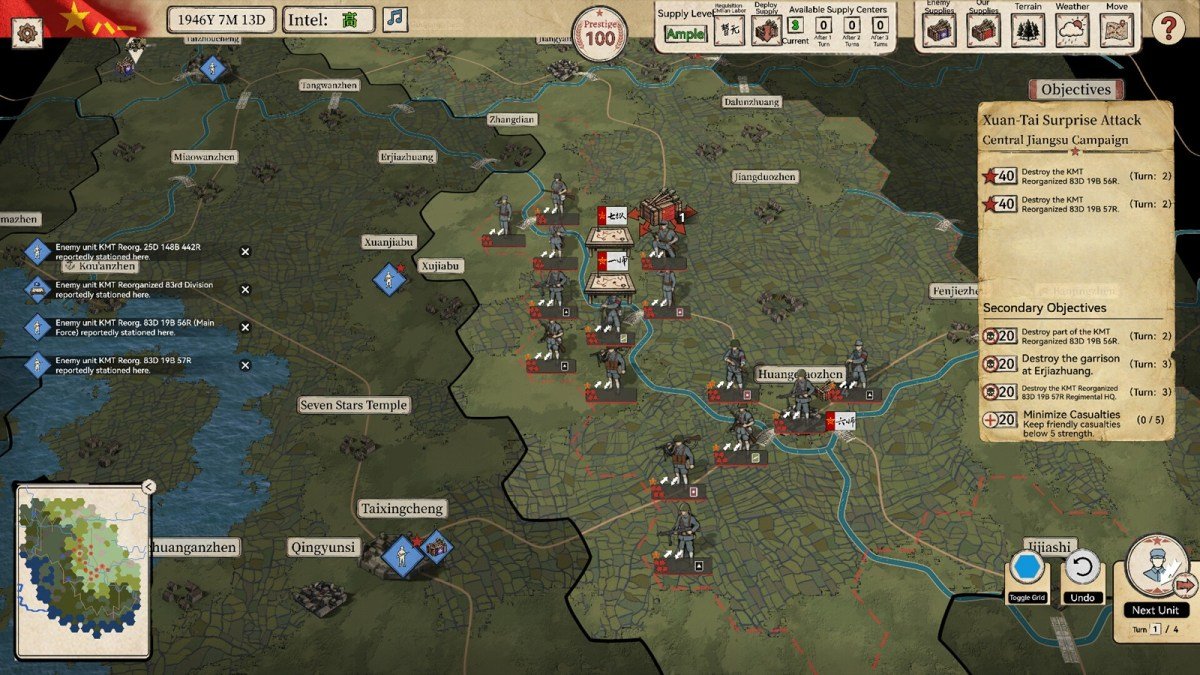
Last year, I wrote an article titled “Chris’s 15 Most Anticipated Strategy and Wargames of 2026” and placed Crimson Banner at #14. Out of all the developers on that list, the mind behind Crimson Banner was by far the most enthusiastic about sitting down to speak with me.
For a long time, I have lamented that the wargaming hobby desperately needs topics beyond the usual U.S.-centric or Napoleonic conflicts. We need coverage of different civilizations and lesser-known historical struggles from diverse cultures.
As I write this piece, I know some readers will accuse Strategy and Wargaming of being compromised by a “communist conspiracy” simply because I am covering a battle primarily from the Communist Chinese (PLA) perspective.
However, I am no stranger to the horror and tragedy of civil wars. A few years ago, I sat down for coffee with a Shia military doctor in Baghdad while strolling through the city’s famous night market. On another evening, I had tea with a Sunni journalist at a café that had been hit by the deadliest suicide bombing in its history, meeting the owner who had lost his sons in the tragedy. The pain of civil conflict was still raw in Iraq- the war against ISIS had ended only a few years prior, leaving an Iranian-backed Shia militia occupying regions and instilling a deep sense of humiliation among the local Sunni population.
When I studied and met with Chinese people across various political spectra, I recognized that same historical trauma.
To give you a bit of my background: I am an American Iraq War veteran married to a woman who earned her master’s degree studying Chinese history in Taiwan. Together, we have hosted friends whose families were directly connected to the Kuomintang (GMD/KMT) and were exiled from mainland China. Most Americans are predominantly familiar with the Taiwanese or Hong Kong perspective. But as a gaming journalist, I felt an obligation to put my personal background and cultural biases aside to cover this history from the developer’s perspective rather than my own.
I had previously studied Chinese communism during an East Asian studies course at university. Outside of standard reading, one of the most informative resources I encountered was Professor Richard D. Baum’s Great Courses series, The Fall and Rise of China.
That foundational knowledge proved invaluable during discussions with my wife and helped break the ice with a contact who was initially suspicious of American subversion. The breakthrough came when I brought up Mao Zedong’s military strategies as detailed in Xiaobing Li’s book, China’s Battle for Korea.
Impressed by my interest, the developer asked what I should study before our formal interview. He recommended I watch the nine-hour epic film trilogy Decisive Engagement (directed by Li Jun), which I did. Aside from some poor subtitles that made viewing take months longer than expected, it was an astonishing military film. In an era dominated by modern CGI, seeing vast military formations populated by thousands of real extras, equipment, and animals was incredible. I was particularly impressed by how accurately Chiang Kai-shek was portrayed compared to Mao. During that time, I also read Alexander V. Pantsov’s masterpiece biography of Chiang, Victorious in Defeat, while attempting to work my way through his biography of Mao. For a brief historical overview of the conflict itself, I turned to Michael Lynch’s The Chinese Civil War 1945–49.
I was able to see why these two larger-than-life personalities resonated so deeply with the core of Chinese society- an influence that still persists today. Both of their personalities are described in Nassir Ghaemi’s book A First-Rate Madness: Uncovering the Links Between Leadership and Mental Illness, revealing two colossal figures destined to set the country ablaze.
The Interview
Chris: I know you prefer to go by your pen name, HJF98, but could you tell us a bit about your background in game development?
HJF98: Oh, I guess you could say I’m primarily a gamer who loves military strategy games. My day job is a front-end web engineer- developing websites. In my spare time, I love tinkering with small mods. I’ve made mods for games like Civilization, Unity of Command, and Hearts of Iron. I really love those titles and enjoy modifying them with my own ideas.
Chris: What inspired you to make a standalone game about the Chinese Civil War?
HJF98: Speaking of the motivation behind making this game- a game about the Liberation War (which is how we refer to the Chinese Civil War on our side, so I’ll likely use that term moving forward)- the main reason is that I simply wanted to play one.
It was that straightforward: I had a strong urge to play a wargame focused on this conflict, but nothing existed. That desire became especially strong after logging extensive hours in Unity of Command 2 around 2024. As usual, I started by creating mods for it, and I attempted to use its scenario editor to build a Liberation War game. Unfortunately, map-making became an impassable obstacle; I was stuck using the existing European and North African maps, which look completely different from East Asia. So, I had to abandon that approach.
The idea, however, had taken root in my mind.

Shortly after, I was caught in a wave of tech layoffs. I took my severance package and entered the job market. To be honest, I was burnt out on my previous web development role- it required zero creativity, just mechanical execution. I felt I had a lot of creative energy that needed an outlet. Since my technical stack was fairly close to making light games (specifically web-based mobile titles), I officially made the leap into the games industry.
I quickly realized, though, that while I love playing and creating games, I didn’t actually enjoy making casual mobile titles. I wouldn’t even play them myself- I wasn’t the target audience.
Then in November 2025, that old idea came rushing back: I wanted to make a game about the Liberation War. A topic I truly cared about, in a genre I loved, as a proper PC game. I began development by studying the framework of Unity of Command 2, which I consider an outstanding design that abstracts the core realities of warfare in a highly refined way.
Chris: What key mechanical differences does your game design have compared to Unity of Command? I know you have over 900 hours logged in UoC2, so you clearly know the framework inside and out.
HJF98: Ha, I might be rambling a bit, but I’m happy to answer! When I hear “engine,” I usually think of game development tools like Unity, Godot, or Unreal, but I realize you mean the overall game framework and mechanical design.
I’ve spent hundreds of hours studying Unity of Command II, and I believe I mostly understand how its mechanics work- with the help of its detailed manual (a 60+ page PDF covering every aspect of the game). That said, I can hardly claim to fully grasp the underlying design motivations of 2×2 Games, the developers behind it.
I think those psychological motivations are even more worth studying. You can see the surface-level mechanics clearly: supply propagates along railways and roads, with supply hubs handling final distribution. But why did they design it that way? On the supply side, I see a simulationist mindset. Based on the WWII literature I’ve read, their system closely mirrors real-world military logistics- it is a remarkably accurate abstraction. I really admire their ability to identify core elements, trim away clutter, and translate key historical factors into clean game mechanics.
When I started developing my game, I initially copied the gameplay framework of Unity of Command II and built several classic Liberation War campaign scenarios as template levels. But when I put them side-by-side with historical data, I quickly ran into issues- certain mechanics failed to explain why historical events unfolded as they did.
For example, historical records show that certain PLA (People’s Liberation Army) units could march 50 to 60 kilometers per day, far exceeding what the existing engine framework permitted. Keep in mind, these were not mechanized or motorized infantry units- achieving such speeds on foot was extraordinary. Whenever the framework conflicted with historical reality, I chose to adapt the framework to serve the facts, rather than force history into a mismatched system.
My research revealed that PLA mobility relied heavily on extensive networks of civilian riverboats across waterway-dense regions, allowing troops to advance day and night without stopping. These small vessels across river systems were also vital for transporting supplies and evacuating casualties, so I couldn’t simply ignore them. Consequently, I modified the Unity of Command II framework- which originally restricted supply lines strictly to roads and railways- to allow supply propagation along rivers as well. I also introduced special rules allowing PLA forces in specific campaign scenarios to consume fewer movement points when navigating river networks.
Additionally, I overhauled the prisoner-of-war system. Because the Liberation War was a civil conflict rather than an ideological war of annihilation between distinct foreign nations (such as the Soviet-German front), it was common for captured soldiers to receive political education and quickly join the opposing side. This occurred primarily on the PLA side, where former Nationalist troops were integrated as “Liberated Soldiers.” Those who declined to join were given travel expenses and sent home, reflecting a remarkably lenient POW policy. In game terms, when PLA forces capture KMT (Kuomintang) troops, a portion of those prisoners directly enter your manpower pool, allowing you to integrate them into depleted frontline units over subsequent turns.
Chris: What WWII literature have you read? What research material are you privy to that a typical Western or English-speaking reader might not easily access? To Western military history readers, the Chinese Civil War is notoriously opaque- we lack standard wargaming materials like published Orders of Battle, and many readers reflexively dismiss mainland Chinese sources as state propaganda. How would you describe Chinese methods of accounting for troops and supplies to a Western audience?
HJF98: Apart from general WWII histories, my reading focuses heavily on the Eastern Front. I’ve read John Erickson’s The Road to Stalingrad and The Road to Berlin, Paul Carell’s Hitler Moves East (1941–1943) and Scorched Earth (1943–1944), as well as David M. Glantz’s When Titans Clashed. Beyond those standard Western texts, I read Chinese military historians, such as Zhu Shiwei’s Eastern Front series, alongside specific operational studies on battles like the Cherkasy Pocket.
Regarding research materials for the Liberation War, almost everything I rely on is publicly available- There are no top-secret archives off-limits to foreign scholars. However, because these documents exist exclusively in Chinese, accessing them requires proficiency in the language or robust translation tools. Key general reference sets include Wang Shuzeng’s Liberation War series and official histories published for individual PLA Field Armies (such as the New Fourth Army War History, Third Field Army War History, and Fourth Field Army War History).
For example, the Third Field Army War History provides granular operational accounts of the East China Field Army. For specific campaigns, I consult primary memoirs, which frequently offer clearer context. There are also compiled volumes of pre- and post-battle telegrams and staff communications, which help reconstruct the exact operational objectives and planning behind each phase.

From my experience reading military histories, I generally place the highest trust in casualty and supply reports filed by the side that retained physical control of the battlefield afterward, as they had the opportunity to tally metrics accurately. On the Eastern Front, German ten-day casualty reports were exceptionally accurate during 1941–1943 when unit administration was intact. By 1944–1945, as formations suffered catastrophic collapses, the accuracy of those same ten-day reports degraded significantly, requiring cross-referencing with Soviet records.
Regarding Orders of Battle, official PLA campaign histories are remarkably thorough. They map out unit structures down to the column level (a formation roughly equivalent to a Western corps), detailing individual constituent brigades, regiments, and often battalions. Third-party foreign records from this conflict are sparse, mainly because foreign observers were largely absent (aside from brief diplomatic missions like the U.S. Executive Headquarters/Marshall Mission).
This perception of an “opaque war” in the West stems from two primary factors:
- Record Loss & Exaggeration: Following their retreat to Taiwan, the KMT lost access to many original staff records. During the war, KMT field commanders frequently lost physical control of the battlefield and routinely inflated victory claims to higher headquarters. Before the Laiwu Campaign, for example, KMT command publicly declared they had crushed the primary PLA force when, in reality, they had not even made contact with it. Believing the threat was neutralized, KMT forces dispersed, allowing the PLA main body to surround and annihilate them.
- Language & Ideological Barriers: Due to ongoing geopolitical tensions and the lack of English translations, primary PLA records are often overlooked or dismissed out of hand by Western observers as political narrative.
As a game designer, my goal isn’t to take a political stance, but to cross-reference as many primary materials as possible and convert verified historical dynamics into functional mechanics.
Chris: That makes sense. How do you translate Mao Zedong’s strategic doctrine into gameplay versus Chiang Kai-shek’s?
HJf98: As an operational-level wargame focusing on campaign tactics, our engine lacks a grand-strategic management layer. I think the game inevitably falls short of reflecting the macro-level strategic differences between Mao and Chiang. Unlike Hearts of Iron or Warcraft III, there are no grand interfaces for managing national population, grand industrial capacity, or resource extraction. As a result, we cannot simulate macro-strategic philosophy through simple top-level passive “buffs.”
Instead, we reflect strategic differences at the operational level by modeling their physical outcomes:
- Logistics Dynamics: The PLA relied heavily on civilian logistics, pack animals, and river networks. The KMT relied on standardized rail lines, main road networks, and motor transport- closer to traditional Western industrial warfare. We mirror this directly by using fundamentally different supply rules for each faction.
- Manpower Dynamics: The PLA’s lenient POW policy allows player-controlled PLA forces to absorb captured KMT troops directly into their manpower pool, modeling the historical phenomenon of units “growing stronger through battle.” After the Huaihai Campaign, for example, the PLA’s total frontline strength actually increased despite heavy combat casualties due to mass prisoner integration.
- Operational Intelligence: Because the PLA operated with widespread civilian support in rural territories, they maintained superior intelligence and operational visibility on interior lines. In-game, this provides the PLA player with localized reconnaissance advantages.
Chris: Do you think watching the historical films you recommended helps players better understand the history behind the game?
HJf98: Yes, absolutely. I recommended the Decisive Engagement film trilogy, which dramatizes the Three Major Campaigns (Liaoshen, Huaihai, and Pingjin).
In the Liaoshen Campaign film, there is a sequence depicting the Battle of Tashan. “Tashan” translates to “Tower Mountain,” but the area was actually a flat, defenseless coastal plain. PLA units were ordered to hold this position at all costs to block KMT forces attempting to reinforce trapped garrisons in Northeast China. Despite heavy KMT assaults backed by naval gunfire, air support, and artillery, the line held.
The film demonstrates why: hundreds of thousands of local civilians mobilized to assist PLA engineers, constructing massive field works and trench networks overnight on flat ground. This visualizes Mao’s concept of “People’s War”- popular support translated directly into concrete defensive advantages, rapid fortification, faster casualty evacuation, and steady supply lines.
Similarly, the Huaihai Campaign is historically described as a “victory pushed on wheelbarrows.” Behind 600,000 PLA troops facing 800,000 KMT troops, over 5 million civilian laborers provided logistics support.
What makes the Liberation War unique compared to WWII is this human element. During WWII on the Eastern Front, neither side integrated captured enemy troops into frontline combat on a large scale. In the Chinese Civil War, entire formations were re-educated and integrated- many of these same soldiers later fought in the Korean War. It was an intense war of competing socio-political models, and the faction that secured popular support ultimately controlled the battlefield.

Chris: That’s a fascinating contrast with how historical films are produced in the West. I was struck by how much dignity the filmmakers gave Chiang Kai-shek and his wife, Soong Mei-ling, as well as the historical accuracy accorded to American diplomats and advisors. They weren’t depicted as cartoonish villains, which stands in stark contrast to Cold War propaganda films produced in places like Vietnam or Cuba.
In a typical Hollywood production, the narrative would likely dwell on sensational adulterous affairs or political scandal- much like how the film Charlie Wilson’s War highlighted Joanne Herring’s fictional high-society affairs (which later prompted her memoir, Diplomacy and Diamonds). Her dialogue with the director had him even read more American history, which inspired him to create the HBO series, John Adams. In contrast, these Chinese epic productions maintain a remarkably objective and dignified tone toward historical figures on both sides of the conflict.
Now in those movies, why was crossing the Yangtze River so important? Is this reflected in your game’s story?
HJf98: Yes, exactly. In fact, for figures of that caliber, the evil they committed doesn’t mean they had to look like monsters. They could be gentlemen, princes, or aristocrats. To caricature their appearance or demeanor would actually be historically inaccurate. From a Marxist perspective, these people participated in the making of certain systematic evils, but they might very well have been among the most noble, wealthy, and educated members of society. That’s precisely the most ironic and interesting part.
Crossing the Yangtze River actually carries a special significance in Chinese history. China has experienced several long periods of division- often called the “Northern and Southern Dynasties”- where the country was split into north and south along the Yangtze or Yellow River, creating prolonged stalemates. Our culture has always valued reunification, and in that context, the Yangtze River symbolizes division and fragmentation. It’s a massive river, over ten kilometers wide at its broadest, and militarily it has served as a natural fortress.
Before the Yangtze Crossing Campaign was launched, even though from today’s perspective it seemed like there was nothing really blocking the way, this historical and cultural weight still created a psychological burden- from the soldiers up to the commanders, everyone worried about whether they could truly get past that final hurdle (the threshold of reunification). That’s why the PLA issued the rallying cry: “Cross the Yangtze and liberate all of China!” Crossing the river was a historic moment. Militarily speaking, after the decisive Three Major Campaigns, most of the KMT mobile forces had been destroyed. Once they crossed that natural barrier, the war turned into a massive pursuit- there were no more strongholds that could stop the PLA. They pushed all the way from the Yangtze down to Hainan Island, China’s southernmost tip.
If I had to find a rough analogy- though it’s not a perfect comparison- it reminds me of the Vistula–Oder Offensive. After the Soviet forces broke through the Vistula River, they raced toward Berlin at full speed; victory was already in sight. The German army had been strategically shattered.
Chris: Did you have relatives who fought in the war? Have you served in the military before?
HJf98: No, my grandfather was just an old farmer; he spent his whole life working the land. And I’ve never served in the military either. But about ten years ago, when I was applying to universities, I put down the National University of Defense Technology- a PLA military academy- as my choice. Unfortunately, I didn’t pass the physical exam, even though my test scores were more than enough.
Chris: In Unity of Command 2, the basic attack options for infantry are feint attack, set-piece attack, and suppressive fire. How does Crimson Banner handle things differently with options like feint attack or night attack?
HJf98: In the actual development process, I found that the scale we’re working with is smaller- going from Unity of Command 2‘s division-level units down to our battalion/regiment-level units. Smaller combat units mean that some tactics and techniques that were overlooked at the division level can return to the stage- for example, ambushes. We’ve added an ambush capability to the game. In Unity of Command, it’s generally unrealistic for a division-sized unit to conduct an ambush, and historical examples are rare- after all, hiding such a large formation isn’t easy. Even though during Operation Bagration the Soviets did conceal some of their assault groups, that wasn’t lying in wait but rather a silent redeployment behind the lines to participate in deep penetrations of the breakthrough.
Beyond ambushes, we also have some unique abilities tailored to this war:
- “Persuade to Surrender” (can make enemy units lay down their arms en masse)
- “Boost Morale” (focuses on the tactical impact of political encouragement)
- “Rally Routed Troops” (active ability)
- “Direct Fire” (allows artillery to fire point-blank- this crazy tactic was common in this war, used to destroy fortified positions directly)
- “Forced March” (allows units to push through fatigue for extra movement)
- “Infiltration” (ability to move covertly through controlled areas)
- “Emergency Communication” (forcibly re-establish command)
- “Demolition”
And some others that come from the smaller scale:
- “Recon by Fire” (can reveal enemy firing positions)
- “Night Attack”
Overall, these complex new abilities were created to faithfully represent the historical record. Although there are many of them, in practice they also provide a variety of tactical options. At the same time, we’ve introduced several new “statuses”- like Fatigue, Disorganization, and Delay- which overall make the game more complex than Unity of Command‘s sleek elegance. But I think it’s worth the cost, because it allows the game to more accurately depict that particular war.
Chris: What inspired this passion for CCP history? Many Westerners would probably be interested in hearing this perspective. Americans, for instance, are passionate about what we define as freedom and democracy, so many have a hard time understanding how someone could be passionate about a one-party system. Having seen people in Baghdad who were still passionate about the Ba’ath Party, the concept isn’t completely foreign to me.
HJf98: I think this is essentially a matter of historical understanding. I’m deeply interested in modern Chinese history, which was largely shaped by the dual pressures of anti-colonialism and anti-feudalism- a chaotic era of exploration. For China after the late Qing Dynasty, countless patriots dedicated themselves to the goal of “national salvation and survival.” China at that time was arguably at a historic low point in relative power. These elites who wanted to save China proposed various solutions- from absolute monarchy to constitutional monarchy, from democratic
republicanism (parliamentary democracy) to the Communist Party. It was a very complex and turbulent history of exploration. Every idea was tried and tested, including even a fundamentalist Soviet-style communism that once long dominated the CPC’s line. Ultimately, what survived was Mao’s Chinese-style Marxism.
From an evolutionary perspective, there’s no such thing as “the best”- only what’s “most suitable.” So I think that’s just historical inertia. Questions in social science are always complex- “silver bullets” seem hard to come by, unlike in mathematics or physics. For me, telling the story of how the PLA won over China is very interesting. It also provides a perspective for people who don’t know much about this history- showing why things turned out the way they did under those circumstances. As for explaining this historical passion- it’s more about admiration for that vibrant revolutionary group at the time. The solution they offered wasn’t really about the form of a multi-party system versus a one-party system- it was about what suited China better and ultimately won the people’s support.
If you look at it from the perspective of the 1930s–1950s, perhaps you would also be impressed by this team that was more vibrant and had the support of the people. It’s not really about what they are like now- even though China has developed very well today, it’s still a different era from what our game focuses on.
Chris: Yeah, from what I’ve read, both the GMD and CCP were heavily inspired by Sun Yat-sen and his book.
HJf98: Yes, fundamentally speaking, Sun Yat-sen was an extremely important revolutionary pioneer. The Kuomintang, under his leadership and after receiving aid from Lenin, launched the Northern Expedition from Guangzhou in southern China, with military guidance provided by Soviet Marshal Vasily Blyukher- along with some guns, artillery, and funding. This important campaign overthrew the rule of the Beiyang government and brought the era into the KMT’s time. During this Northern Expedition, the CPC naturally participated as a partner throughout the entire process. However, the subsequent coup led to the complete rupture of the alliance between the KMT right wing, the KMT left wing, and the CPC. As the CPC embarked on armed struggle, and with the Japanese invasion, time gradually moved into the stories that our game tells.
Chris: Are you currently a one-man team, or do you have a full team?
HJf98: I started out as a solo developer, but I soon realized the power of having a team. I found partners for music and art, so right now we’re four people, including myself. I still handle everything other than music and art on my own. They really make the game much better- especially since I’m absolutely terrible at art and music.
Chris: From what I’ve played of the demo- which I really enjoyed- the translation feels a bit rough, and the language seems somewhat biased. For example, calling the enemy “Blowhards” sounds strange to an English reader. Do you plan on improving the English text?
HJf98: Of course- our current translation is done by machine, so there are probably a lot of issues. We haven’t had the time to invest in a proper proofreading effort yet. I don’t want to deliberately belittle the enemy- I just want to present them in the plain language of the historical records. However, some of the in-game text is taken directly from original historical sources- for example, certain telegraphs and dialogues- so their wording might come across as partisan. By the same token, the enemy side also speaks, and the things they say are naturally from their own perspective, since they’re quoted from what they actually said in history.

Chris: You can tell I’ve read too many English books on the subject since I used “GMD” instead of “KMT.”
HJf98: Haha, yeah, you’re definitely in the know! “GMD” is actually the Hanyu Pinyin abbreviation, while “KMT” is theoretically better known to outsiders- it’s based on the Wade–Giles romanization system that was more popular back then.
Chris: What challenges do you face when creating an AI for the game?
HJf98: I have two requirements for the AI. First, it has to be smart enough to provide an enjoyable experience for the player – nobody wants to fight a wooden opponent, so it needs to be reasonably intelligent. Second, it has to stay close to history – since this is a campaign simulation, the AI’s overall plan should follow the historical trajectory; otherwise, it would be hard to recreate the actual course of the war.
But sometimes these two goals come into conflict. History only shows us one possible outcome – it doesn’t tell us how the AI should react when the player does something that wasn’t done historically. That gap requires constant adjustment and fine-tuning to bridge. There’s also the question: when historical behavior wasn’t exactly rational, should the AI be smarter, or should it stay more historical? I’ve thought about this, and eventually I decided to lean toward keeping it more historical. A more historically grounded AI gives the player a near-authentic campaign simulation experience.
Currently, my AI still isn’t smart enough. The good news is that it does follow historical objectives – but it’s just not very intelligent. For example, it doesn’t pay enough attention to supply lines, and sometimes even abandons them entirely. I think that’s unrealistic, so I’m still tweaking it to give the AI some basic military common sense. After all, these enemy forces weren’t incompetent in history – they wouldn’t just sit back and watch their own supplies get cut off without doing anything about it.
Chris: Do you plan on getting the AI to a reasonable standard before release?
HJf98: Yes, I think it’s necessary. I will bring it up to a standard that I’m satisfied with, because I’m also part of the target audience for this game. I can’t stand things that are done poorly. If I were just a player, I would have already cursed the developer out loud, haha.
Chris: A lot of people in America think wargaming is dying in America and in Europe. How is the interest in wargaming in China? Is there a market for it? Do you think developers should make more games in a Chinese setting?
HJf98: From what I’ve observed personally, wargaming is a very niche hobby in China. The most well-known wargame publishers here- the ones putting out physical board wargames- typically sell at most around 10,000 copies per title (as far as I know- I could be slightly off). But I think it’s hard to put digital games and physical board games in the same bucket. If we’re talking about PC games, the situation is completely different. The niche nature of physical wargames is limited by their high barriers to entry, expensive price tags, and the scarcity of opponents- playing solo usually gets boring pretty quickly.
PC games are a whole different story. Even in the wargame genre, with AI opponents and much lower price points, the audience is significantly larger- though you can’t go too hardcore, since the more complex it is, the fewer people will stick with it. From what I know, a game set in 1920s China during the Warlord Era- Rising Sun by a French developer- actually sold quite well (at least for a small studio). I think Chinese players are definitely hungry for more titles set in Chinese contexts. There is a market for it.
Since I’m also in the industry, I came across a report before- a Chinese gaming market report published by the Polish government for Polish developers. One of the key takeaways was that China has so many gamers that even the most niche titles can find their audience. I don’t think that’s too far from the truth. As of now, Chinese-language users are the largest group on Steam- I think they only surpassed English users sometime in 2025. But obviously, the vast majority of those players are playing games with foreign settings made by overseas studios. And as one of them, I definitely long for more games set in China. I played Total War: THREE KINGDOMS by Creative Assembly- a Chinese-themed game in the Total War series- and I thought it was fantastic.
That said, I’m not going to flat-out say “everyone should make games with Chinese settings”- because maybe my judgment is off, and this is just my personal opinion.
Chris: My last question is going to be: do you still plan on having a multiplayer element? This will definitely put it ahead of Unity of Command. And what do you plan to do to avoid the biggest criticism of Unity of Command– how to make it less like a puzzle?
HJf98: I can say very clearly that I will be making a multiplayer mode- both PvP (two players facing off against each other in any given scenario) and PvE (two players teaming up against the AI). There’s no real taboo or personal objection here. Our current game can be seen as a “historical mode,” where players follow the historical trajectory to achieve the goal of “liberating China.” Multiplayer, on the other hand, offers a more traditional wargaming experience- you can find like-minded friends and play through individual scenarios against each other. It doesn’t involve fictional or alternate-history content; it’s simply about contesting the outcome of a single battle.
I think Unity of Command is a great game. I’m not trying to “surpass” it- I’d be perfectly happy if I can just make a game that accurately reflects the real conditions of the Chinese battlefield.
As for the criticism that it feels “like a puzzle game”- I felt that too when playing Unity of Command on greater difficulties. With tight time limits, you’re often forced to take the optimal path, combined with some save-loading to get the right dice rolls. That experience really does feel like solving a satisfying puzzle. It’s a complex issue and not easy to solve, because the nature of historical campaign simulation means the initial setup is fixed- every unit starts at its historical position, and its stats are as historically accurate as possible. I think the progression system that Unity of Command introduced helped alleviate this somewhat- each player’s units develop differently through earlier campaigns, which changes the initial conditions and offers “more ways to solve the puzzle.”
That’s why I’m also planning to do something with the progression system- allowing players to develop different playstyles across campaigns. Since we have a wide range of tactical abilities, whether it’s frontal assault, encirclement and division, or suppressing then persuading surrender, some pre-campaign upgrades can shape specialized tactical styles, opening up more solutions to the puzzle. That’s what I’m doing right now- but I can’t say for sure how effective it is yet; it’ll take more player feedback to test that.
Chris: Okay, one last question. Do you think Chinese wargame enthusiasts will read this article? Or Chinese readers interested in military history?
HJf98: Yes, overall, China has such a huge population that almost any niche group has a considerable audience. Chinese military history enthusiasts will definitely be interested. If this article gets published, I’d be happy to translate it and share it around. I also see this kind of sharing as part of my promotional efforts- because the current indie game market is very competitive, I have to balance development with marketing at the same time. The goal is to get people to wishlist the game and help with sales.
Chris: Thanks very much. I’ll conclude this interview and let you sleep.
The demo for Crimson Banner is now available!
Support Strategy and Wargaming
I do what I do in Strategy and Wargaming because I love to do this, and I’m never going to stop. If you would like to support me with that, you can buy me a coffee for a dollar if you’re feeling generous. If you can’t, no worries, Strategy and Wargaming will always be free, and I’d love to have you around!
