

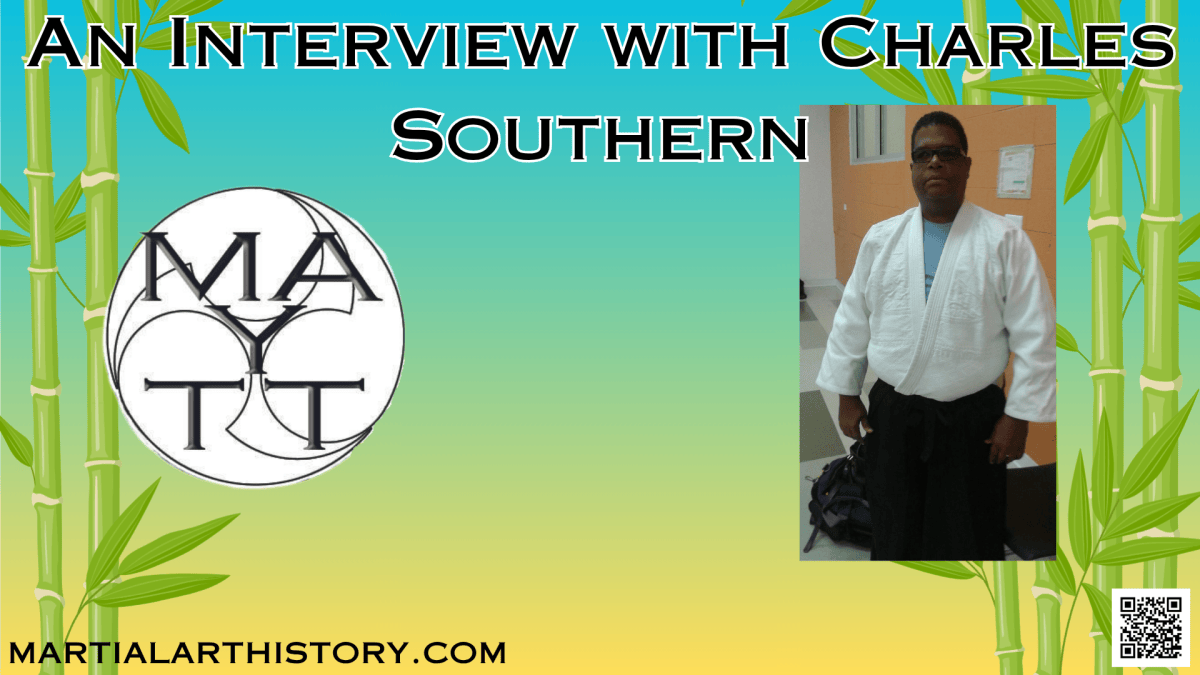
Charles Southern began studying Yoshinkan Aikido in 1982 while attending college after his sister told him about a class near her workplace. He began training under Robert Hackett and Gilbert James, two early Yoshinkan practitioners in Chicago, who had studied under Robert “Commander” Cramer and helped establish the Midwest Yoshinkan Aikido Association in the late 1950s. Today, Southern took some time to discuss training under Hackett and James, the uniqueness of Yoshinkan Aikido, and trying to maintain the tradition passed down from his instructors. All images provided by Charles Southern. This is the second part of a two part interview. Read the first part here.
MAYTT: What do you think Hackett and James were trying to accomplish with the Midwest Yoshinkan Aikido Association?
CS: To propagate the art as much as they could. They did a very good job of that. They taught at YMCAs, universities, high schools, and grammar schools. When I first started aikido, I met so many students. I’d ask, “How come you don’t have a black belt?” They’d tell me that life got in the way. Everybody had basically stopped somewhere between third kyu and first kyu. But I met a lot of people during that period. Even now, I still get phone calls from people trying to track me down and see how the organization is doing. They ask, “Is aikido still going strong?” I’m like, “Yeah, I’m still holding it down.”
That was never really my fulfillment, though. My thing was that I just wanted the black belt. I wanted to be able to accomplish something in my life that I stuck with. I got up to second dan, but Sensei James passed away in 2002, and I was nidan. I didn’t test for another seventeen years. My thinking was, “Oh, he’ll [James] always be around. I can test anytime.” Then he passed away. He had a senior student, Richard Essex, but his health failed him, so he couldn’t teach or do anything. I thought, “Well, I guess that leaves me by attrition.” So, I figured I’d have to take over and try to keep everything going.
Since around 2005, I had to start from scratch. I had to know the techniques. I had to be able to demonstrate them, and I had to be able to talk. I’m not really a talker. I’m a pretty quiet guy. But I just became alive when I got on the mat. Everybody would see me get on the mat and say, “You’re like a totally different person.” I’m like, “I know, right?” But I got that from my teachers. We could be the best of friends, but once we bow in, it’s all business. I’ve been like that all my aikido life.
MAYTT: After James passed away, who did you look to for guidance and continued training?
CS: I started teaching in the church basement, and then I spent several years at the community college. That’s when I picked up a lot of students. My students were getting up to black belt level, and I thought, “Wow.” I never really had a teaching certificate, so I went to a seminar. I believe Amos Parker was there, and I met Fred Haynes. He asked me, “How’s the club going?” I told him I had taken over Richard Essex’s group, but I needed to get promoted to third dan in order to promote my students to shodan because you could promote two belt levels under your own present level. He said, “If you need me, just call me.”
When I came back to Chicago, I thought about it. I sent him an email and said, “Hey, I want to take you up on that offer. What do I need to do to be promoted?” It had been almost seventeen years since I was promoted in the late 1990s. This was around 2006, I believe. He tested me for third and fourth dan.
MAYTT: Did you ever develop a connection with Parker after that seminar?
CS: Yes, from time to time, if he was in the city. He took on some students, including Steven Miranda and a couple of other black belts from Chicago and Indianapolis. They gravitated toward Amos Parker. If he was in the Indianapolis area, I would go to their seminar for the weekend, Friday to Saturday. I was jumping along, trying to see where I could fit and get better and get promoted. But it wasn’t a good fit for me.
When I had the opportunity to bring Fred Haynes in, I had him up for a couple of seminars down through the years. People from Minnesota and Indianapolis would come down and help me out so I could defray the cost. You have to wine and dine people and put them up and take care of their housing, so that helped me pay for everything. It worked out quite well. That way, I could get more information about what he wanted to see in testing and everything, so I went that route.
My fifth and sixth dan came later. Steven Miranda, who I mentioned earlier, did my fifth dan because he was seventh dan. For my sixth dan, I had to petition the Hombu Dojo in Japan. I filled out the paperwork and had to get recommendations from some of the high-ranking instructors, including letters of recommendation. That’s how I received my sixth dan.
MAYTT: You received your sixth dan relatively recently, correct?
CS: Yes. Around 2023, right around the end of the pandemic.
MAYTT: Going back to Hackett and James, what was the most important or impactful lesson they imparted to you, whether aikido-related or otherwise?
CS: They used to always say that they thought alike and worked together. But one thing they taught me was that aikido is always part of your life. Whether you’re on the mat or off the mat, you’re still representing somebody. I thought that was awesome. I was like, “Well, what does it matter what I do off the mat?” But your name follows you, and your name means a lot. Just hearing that, and learning how to carry yourself in a certain way, stuck with me.
They also taught me how to be an instructor. Don’t just touch your students. Ask them for permission: “Can you do this?” There was a book that James had – I can’t remember the name of it – but it was about people who were teachers or preachers, and how they have a certain level they need to hold themselves to. People latch onto you, so you have to be careful about that. That stuff has stuck with me throughout my whole adult life. There were great things that helped me along the way.
MAYTT: What do you feel are the respective legacies of Hackett and James within the Yoshinkan community, both in Chicago and throughout the United States?
CS: There’s a book called Men of Steel, and they interviewed Sensei James for that. They were known all over the world. I have a very good buddy who’s like a brother to me and lives in Ukraine. He came here from Ukraine to study with Sensei James until he got his black belt. So, James was known worldwide.
I went to Japan in 2023, and when I mentioned his name to some of the older aikido people, everybody knew him. I met Jacques Payet for the first time and told him I was from Chicago and was one of Gilbert James’s students. His face just lit up. Everybody knew him. I thought, “How could somebody around the whole world just know this one guy?” He was a myth and a legend worldwide. I also met Joe Thambu, and their paths had crossed in the early 1990s. Everybody knew Gilbert James.

MAYTT: It sounds as though James may have been more of an organization builder than Hackett, who seemed content simply teaching. Would you agree with that characterization?
CS: When they started the Midwest Yoshinkan Aikido Association, they both put their heads together. That’s probably the best thing to say. It wasn’t that one person just took over. They both let each other know what they were doing. There were no secrets. James had gone to Japan a couple of times as well. There was a difference in age between them, so I guess in your mind it may have seemed like James changed things more, but they did everything together.
MAYTT: What makes Yoshinkan Aikido unique compared with the other aikido styles offered in the Chicago area?
CS: Like I said in the beginning, Yoshinkan Aikido was built around the six basic movements, which are the foundation of aikido. If you’re doing techniques and you’re messing them up, you’ve got to go back to your basics. Maybe you need to do a 95-degree pivot and see what the mechanics are. You need to work that into your technique because all these basic movements are in your techniques. It was that teaching style that was adopted throughout the whole system.
I always hear jokes that Yoshinkan Aikido is “aikido by the numbers” because it’s so militaristic. You’ve got to stand up strong. Your back can’t be hunched over. Your chest has to be sticking out. Shioda was in the armed forces, and everybody had to serve. On the other hand, I’ve been to other aikido styles where they don’t really get into the meat of the technique. They’ll get up, say the name, demonstrate it, and it’s like, “Okay, get up and copy what you saw.” I think Yoshinkan gives you a better teaching footprint into the art. If you follow those six basic steps or fundamentals of Yoshinkan Aikido, you will learn. I think that’s one of the vast differences in Yoshinkan.
MAYTT: So Yoshinkan gives both the practitioner and the teacher a structure to base everything around?
CS: Yes. There are six basic fundamental movements, and you learn those before you even learn a technique. Back in the day, kamae means defensive posture. Sensei James would have you working on your kamae for a whole month. You know how many students we lost? I’m like, “Dude, why are you doing that?” He’d say, “That’s the basis. You can’t do aikido without kamae.” I’m like, “Oh, okay.”
Everybody would ask, “How long am I going to do this?” Sometimes I would get the new students and he would say, “Go over there and help them out.” I’d tell them, “If you can just bear the first 3thirty0 days, I say it’s going to change your life. But you’ve got to learn this and understand the basics of what this kamae entails.” To this day, I work on kamae. I don’t care if you’re third dan or you’ve been here three days. We’re all going to work on kamae, and I still work on it myself. It has a commanding presence in Yoshinkan Aikido.
MAYTT: How would you define kamae? It sounds like it is much more than simply a defensive stance.
CS: Your kamae is the foundation of aikido. If you’re in a kamae stance, he would push you from the front, the back, or the side. He’d say, “Your kamae is weak. We need to work on it.” It made you a stronger person as you developed yourself in aikido. Even if you pull somebody’s hand, I do that today. I’ll grab their kamae and pull their hand, and I can jerk it out. I’ll tell them, “No, your arm should be locked in. I shouldn’t be able to play with your arm like that.” I should be able to stand on one leg and one hand and push against you, and you should be able to hold your kamae. That’s just how I check it because I learned that way. It is the stance that the samurai needed when they were fighting with their sword. If you didn’t have a good stance, were you going to be able to move your sword?
All that developed with me through both instructors. They told me, “This is what you need to do.” Hackett Sensei was always saying, “Practice a hundred times a day.” If you really want to learn it, you would do it 200 times. As a young man, I was working on my kamae, doing it a hundred times a day. It’s funny because I hear this idea that to be proficient at something, you have to put in 10,000 hours. I was like, “Oh my God, that’s awesome.” So, I’m thinking, “I put my 10,000 hours in.”
MAYTT: With that in mind, is kamae supposed to be rigid and stiff, or is there also an element of relaxation?
CS: There’s relaxation. The word that comes to mind is orenai te – the unbendable arm. It doesn’t need to be too loose or too far out where you could flex and mess your arm up. You bring it in just about an inch, and I demonstrate that to everybody. I’ll put my arm on their shoulder and say, “Take both hands and try to bend my arm.” If I’m using strength, they can fold my arm. Then I’ll put it into the unbendable arm position. I bring my elbow in maybe about an inch, with my fingers out and pointed. They try to pull my arm down, and it’s like, “I can’t even move your arm.” That is your kamae through the unbendable arm. Even your stance has specific mechanics. Our front foot is at a 45-degree angle. Seventy percent of your weight is forward, and your back leg is straight. Those are all the mechanisms of kamae that I picked up from my instructors, and I try to pass that on to my students.
MAYTT: Yoshinkan Aikido remains relatively small compared with Aikikai. Based on your experience, why do you think Yoshinkan has not experienced the same level of growth?
CS: I’m going to go with Yoshinkan being known as the harder style of aikido. There have been many spin-offs of aikido. Tohei created the Ki Society, but their techniques were totally different. It was a derivative of what O-Sensei taught, but he took it from another aspect of the path he wanted to follow. You have Tomiki-style Aikido, and Tomiki was a judo expert, so he mixed those two together. Shioda just stood strong and firm with what he learned from O-Sensei. Even today, the Tokyo Riot Police are trained by the Yoshinkan Dojo. So I guess it’s the rigor of Yoshinkan. Maybe some people don’t like that, and they go for a different style.
How many different styles of aikido are there now? Probably a hundred. I make the analogy that martial arts are like religion. Somebody gets mad and starts their own religion. It’s the same thing with martial arts. Somebody gets mad at an instructor, they can no longer stay together as student and teacher, so they break off and start their own. I really don’t have a definitive answer, but that’s about the best way I could explain it.
I’m not knocking anybody. I’ve gone to Aikikai dojos and seminars, and I was totally lost because it’s completely different. You can’t mix the two. I’ve seen people mix the two, and I’m like, “No, that’s not right. I know you weren’t taught that.” But when I’m in Rome, I do as the Romans do. I do it the way they want you to do it at that seminar. I’m not here to badmouth anything.
You go with what you like. If you like the harder style of aikido, people go to that. Maybe Aikikai doesn’t have as much punching in it. Some people may like that. We used to use the term “flowery.” If you want flowery aikido, then you go to the Ki Society and do it for aesthetics and balance in life. There’s something for everybody. Maybe you either like Yoshinkan Aikido or you don’t. That’s what I’ve found out.

MAYTT: Are there any initiatives, either regional, national, or international, to grow Yoshinkan Aikido further in the United States?
CS: It’s interesting you should say that. Since the death of Shioda, there have been a lot of changes. He wanted everybody to learn aikido all over the world and be able to demonstrate it and teach it at a very high level. But it seemed like after his death, things just kind of fell apart.
I don’t hear much from Hombu. They put out a quarterly letter to let you know what’s going on there, but they don’t send anybody here to North America to do seminars. I used to chase them. Whenever they were giving something, I would go to another state just to be a part of it. But nobody is traveling much from the Hombu Dojo. They’re just there, existing. That’s one thing I don’t really like.
Some of the higher-ranking Yoshinkan black belts have left. They gave their letters of resignation because they felt there wasn’t enough leadership. That helped form the Yoshinkan Fellowship Aikido. Then everybody just kind of does their own thing. In 2023, I went to Japan for the Yoshinkan Fellowship, and you had all these masters under one roof for a whole weekend. Every hour, they were changing and teaching techniques from the top-ranking instructors of aikido. It was really great. But Hombu never came up with any ideas like that. I think the communication has gotten less and less. That’s my opinion.
MAYTT: Does that make it difficult to try to build Yoshinkan Aikido in the United States?
CS: You’re pretty much on your own. It’s not like Taekwondo, where you have an association and different things that keep it going. You have to come up with all kinds of different ways to pay everybody. They make their money through testing and buying certificates, but there’s no leadership saying, “I’m going to do a North American tour. We’ll be in these cities and these states, or we’ll be in Canada. Come and join us.” That’s what we did a couple of times. I had the great pleasure of seeing Shioda come to Ann Arbor in the late 1980s. It was awesome. Just to see him and be in the same space with him, and the respect that was there, was incredible.
MAYTT: Before we finish, is there anything else you would like to say or expand upon that we didn’t adequately cover?
CS: I think I pretty much covered the history – how they got started. They were remarkable men. I couldn’t ask for better martial arts instructors. Sometimes it seems like a TV show in my head, but these things actually happened. I’m glad they did, and I’m glad I was able to witness them and be a part of them. I feel like I’m a spin-off of those guys, instead of trying to do something today and keep it going without that connection. I’m real blessed to have had that. In the beginning, I didn’t think I would be going this far. All I wanted was a black belt. I just wanted to be proficient. That’s all I wanted. But to go to sixth dan and have a shihan grading me, that’s awesome. I thank those who helped me along the way.
MAYTT: Thank you so much for taking the time to speak with us, Southern Sensei. We really appreciate you sharing your experiences and memories of the early Yoshinkan community in Chicago.
CS: I appreciate you giving me the opportunity.
This is the second part of a two part interview. Read the first part here.

