

This exclusive Cogs of War interview is with Brig. Gen. Steven P. Carpenter, the commanding general of Multi-Domain Command – Europe, the U.S. Army’s first multi-domain operations command, headquartered at Clay Kaserne in Mainz-Kastel, Germany. Multi-Domain Command – Europe serves as the premier multi-domain fires headquarters for U.S. Army Europe and Africa. We spoke with Brig. Gen. Carpenter, following the conclusion of Arcane Thunder 26, the command’s fourth annual multi-domain exercise, which ran from April 6 to April 29 across Germany, Poland, Fort Irwin, and the Nevada Testing and Training Range. The exercise’s objective was to qualify multi-domain company teams to execute and synchronize operations in line with the Eastern Flank Deterrence Initiative.
Sign Up for Our Newsletter
The fact sheet for exercise Arcane Thunder lists seven “firsts.” Which of those firsts do you consider most operationally significant?
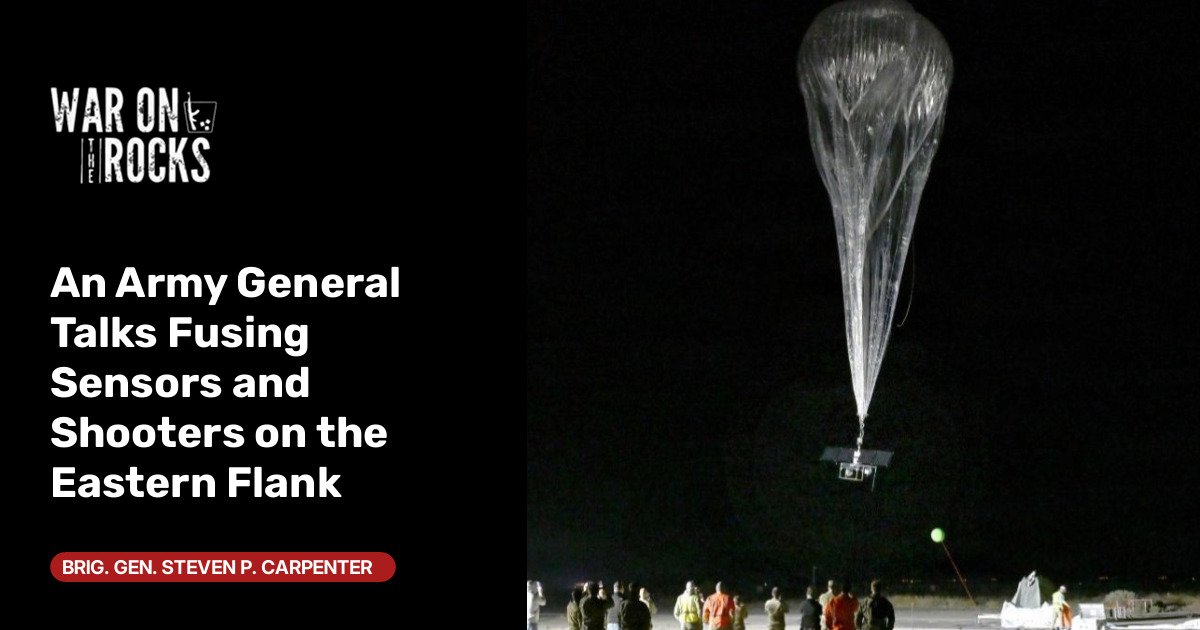
The most significant “first” was our ability to demonstrate the entire kill chain for high-altitude balloons within my command. High-altitude balloon platforms provide commanders with a cost-effective, responsive, launch-on-demand capability. They carry sensors and communications equipment to support multi-domain operations and inform how commanders understand the battlefield. The balloons carry payloads that support electromagnetic warfare, including navigation warfare, communications extension, and various types of intelligence, surveillance, and reconnaissance. This provides organic coverage — coverage a commander “owns,” versus that he or she needs to request from other units — of complex terrain above weather and congested airspace. Most importantly, high-altitude balloons augment the space layer: satellites pass overhead on a predictable schedule, while balloons are both persistent and maneuverable.
Our soldiers in the Multi-Domain Effects Battalion handled everything from mission planning and launch to flight control and recovery. During the exercise, the team coordinated complex airspace with varying regulatory agencies and gained an understanding of stratospheric wind and weather patterns. We launched and piloted over 20 balloons, including simultaneous launches from geographically dispersed locations. The important part of the story is that it was our soldiers, not contractors, who weaponized the stratosphere. Specifically, we deployed the new Aerostar Lightning high altitude balloons, which were actually designed with our direct input after last year’s Arcane Thunder. It’s a fundamental step towards transforming the stratosphere from a passive transit corridor to a weaponized maneuver space we own.
Arcane Thunder 26 centered on validating the multi-domain company team construct, which merges drone operators, electronic warfare specialists, and space operations specialists into a single unit. What problem does this construct solve that a combined arms team couldn’t, and what challenges did you face?
A traditional combined arms team is built to synchronize kinetic effects, such as missiles or artillery fire. The multi-domain company team is different: It’s designed to synchronize kinetic and non-kinetic effects, such as exploitation of the electromagnetic spectrum. We do this across domains, so an effect in one domain complements and enhances an effect in others. The team fuses electronic warfare and information operations with long-range fires at the smallest, most basic units. Its purpose is to find, fix, and finish a target using whatever tool is most effective, whether that’s a high-altitude balloon, one-way attack drone, missile attack, or a combination of all four. During the exercise, the team was able to locate a target using high-altitude platforms and unmanned aerial systems and engage it with kinetic and non-kinetic effects. We did this on the back of a unified data architecture that we built to fuse these disparate command-and-control systems and sensors.
Where did it fall short? Our biggest constraint was training area policy. In a real conflict, we would use our full suite of capabilities. But on a training range, we are often limited in how and where we can employ electronic warfare or kinetic effects. For example, electronic warfare effects rely on the use of the electromagnetic spectrum. However, the electromagnetic spectrum is limited and strictly regulated. As a result, access is controlled to prevent interference between uncoordinated users. During training, we always adhere to regulatory policies and rules to prevent inadvertent interference with the spectrum that supports everyday life and emergency services. We’ve proved the concept works, but we have to continue to work with our hosts and partners to ensure our training environment can replicate the complexity of the multi-domain battlefield.
Multi-Domain Command – Europe is developing the capability to execute reconnaissance at extended distances. What’s the hardest unsolved problem in moving sensor data from a high-altitude balloon or long-endurance unmanned aerial system to a fires battalion?
The hardest problem is the tsunami of data itself, rather than moving the data. We are drowning in it. Our challenge is processing and prioritizing that data, so the right shooter gets the right target at the right time.
An artillery battalion doesn’t need raw signals intelligence: It needs a refined target location. We need AI and machine learning that can perform that translation automatically, filter out 99 percent of noise, and push a quality target into the network. AI is currently capable of processing large volumes of raw data. However, the challenge lies in creating adequate workflows to ensure the warfighter still validates the targeting data.
A close second is coalition interoperability. Getting targeting data to pass seamlessly from a U.S. sensor to a Polish or Dutch fires system is still a major friction point. Standardizing our networks and data formats is an absolute necessity. While we haven’t reached perfection and pure seamlessness, the team has a considerable amount of experience integrating sensors and data into our mission partner network. We can now ingest sensor data and, through a federation of networks, send it to the NATO Mission Partner Network. Data formats are now well understood, and we are able to ingest most, if not all, NATO platforms into our architecture.
The exercise included the first multinational cyber range integration, with U.S., Dutch, and Polish teams conducting combined offensive and defensive cyber operations in a live, force-on-force virtual environment. What barriers had to be cleared to make that happen, and how replicable is it at a larger scale?
This was the first time our command hosted a multinational cyber range that allowed our battalion’s Information Defense Company to train with NATO allies in a virtual cyber training environment. The key to success was treating our Dutch and Polish allies as true partners from day one. Instead of just inviting them to a U.S.-built range, we co-developed the virtual training environment based on their specific training objectives. We had to work through different technical requirements and classification levels, but the effort was worth it.
It is absolutely replicable. By doing the hard work of coordination on the front end, we have now created a blueprint that will allow us to scale this to larger and more complex cyber ranges, with additional partners, in the future.
What happens to a capability that performs well at Arcane Thunder? How does it survive contact with the budget cycle?
Arcane Thunder is a data-generation engine as much as an exercise. We embed data scientists from the Army’s research and development community to produce a detailed final report filled with empirical, objective data that includes technology requirements and performance assessments, warfighter observations and operational feedback, and insights for the Army modernization enterprise.
That report is our ammunition. We send it directly to the requirements and acquisition communities — the program executive offices and cross-functional teams. It provides hard evidence that a capability, such as tactical-level additive manufacturing to support operations and maintenance, solved a validated operational problem. The report and associated data are integrated with the other data points that the requirements and acquisition communities consolidate from across the force to inform the Army capabilities development and procurement process and associated budget. The data is our demand signal, and it’s how we arm our partners in the “Big Army” to fight for a capability as it navigates the budget process.
What do defense technology companies consistently get wrong when they come to brief you? What capability gaps are you not seeing adequately addressed in what’s being offered?
The biggest mistake is ignoring the price-to-performance ratio. Companies will brief an exquisite, multi-million-dollar platform, but they can’t explain how it survives in an environment where attrition is guaranteed. We are on the wrong side of the cost curve. I need capabilities that allow me to impose costs on the enemy, not the other way around. If you force an adversary to fire a $2 million interceptor at our $50,000 drone, we win that exchange.
The biggest challenge I see is a lack of attritable, reliable, and scalable Group III unmanned aerial systems, which are essentially medium-range tactical drones. The current Group III unmanned aerial system field is filled with numerous platforms and capabilities. However, existing platforms that meet our requirements are too expensive to be attritable, while low-cost platforms fail to meet our performance requirements. Don’t show me a pamphlet or PowerPoint. Come to Arcane Thunder. Put your capability in a contested environment, get direct soldier feedback, and prove it works in the dirt.
In practice, what does the feedback loop look like between a soldier’s hands-on experience with a new technology at Arcane Thunder, and a subsequent change to how that technology is built or employed?
Arcane Thunder is the feedback loop. It’s not a trade show or a scripted demo, because we design it to create operational friction. Soldiers and industry engineers work side-by-side in the mud, in a contested electromagnetic spectrum, trying to solve problems in real time.
When a piece of gear fails, the engineer is right there to see why. When a soldier discovers a new way to use a tool, the developer is there to document it. For example, during the exercise, when an operational component on a drone failed to perform in the manner that we expected, on-ground subject matter experts consisting of soldiers and industry partners were able to troubleshoot and resolve the issue within 14 hours. This type of collaborative problem-solving would have historically taken much longer and allowed us to achieve technical objectives with minimal impact on the mission. In addition, industry partners were able to approach our members to quickly resolve platform and payload integration challenges through rapid and additive design and manufacturing.
During the exercise, our team used their physical and software engineering experience to design, 3D print and manufacture, and integrate the supporting hardware and software configurations for electromagnetic support payloads on several unmanned aerial systems. This was accomplished in several hours and would have traditionally taken several weeks, via industry processes, at considerable expense.
We want to move beyond reports that take months, if not years, to travel through the requirements process. Instead, we want a culture of urgency where a soldier can turn to an engineer in the command post and say, “This user interface is terrible, can you fix it?” and the engineer can push a software patch that night.
Write for Cogs of War
Brigadier General Steven P. Carpenter is a 1996 graduate of the U.S. Military Academy who currently serves as the Commanding General of Multi-Domain Command – Europe. A career field artillery officer, his previous leadership assignments include commanding the 7th Army Training Command, the 75th Field Artillery Brigade, and 3-13 Field Artillery Regiment, alongside multiple operational deployments to Iraq and the broader Middle East. He holds advanced degrees in international relations, defense studies, and national security strategy.
Image: Capt. Victoria Connell via DVIDS.
