

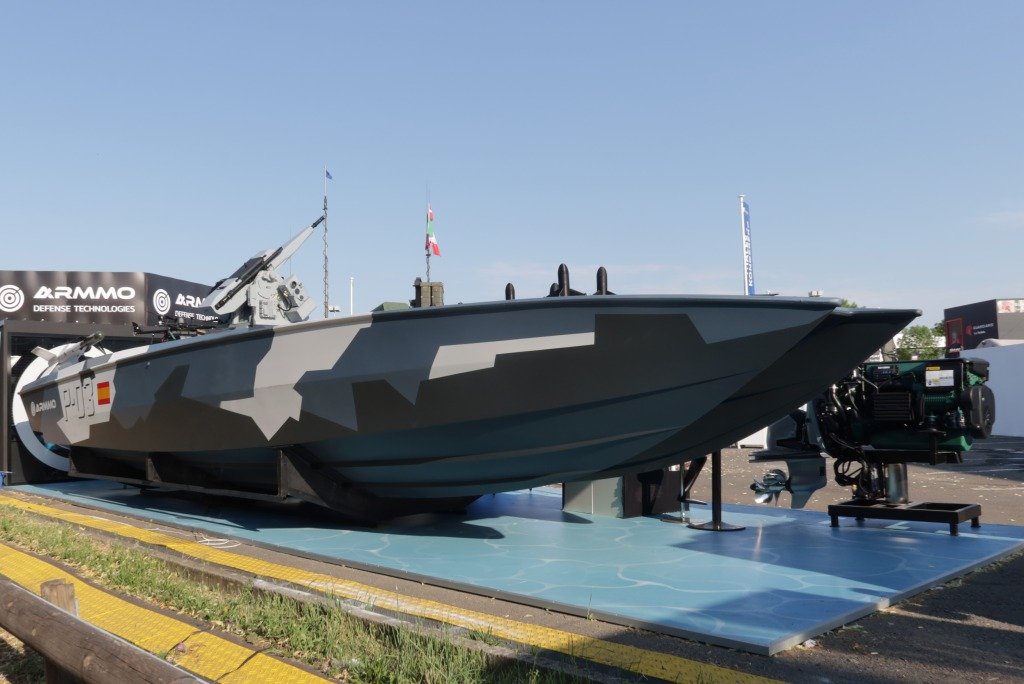
Specialised in uncrewed systems, ARMMO Defense Technologies of Spain unveiled at Eurosatory its ARW39CAT-A armed catamaran USV which among other effectors carries the company Bandit-X, an interceptor drone with a range of up to 15 km, as well as short-range air defence missiles and a remotely controlled weapon station
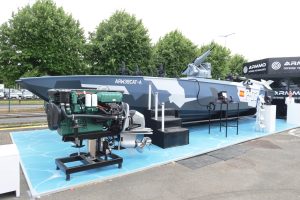
The ARW39CAT-A by ARMMO Defense Technologies was one of the many unmanned surface vessels (USVs) visible at Eurosatory 2026, a sign that the Paris event is not anymore a solely “land” exhibition. The company started from an existing catamaran hull used in powerboat racing; the composite twin-hull solution allows high speed as well as good stability, the boat being 12 metres long, with a 3.8 metres beam, draft being very limited. Payload is between 800 and 1,200 kg. The boat is powered by two 5.5 litres Volvo Penta D6 DPI Diesel Aquamatic Sterndrive common-rail diesel engines with double overhead camshafts, turbo, and supercharger, providing 324 kW (440 hp) crankshaft power each at 3,700 rpm. Engines are fitted with Volvo Penta’s Duoprop twin counter-rotating propellers which ensure optimised pitch, chamber distribution, and torque distribution, and reduce vibrations. The powerplant ensures a maximum speed of 45-50 knots, depending on payload, however EDR On-Line understood that in optimal conditions and reduced payload the ARW39CAT-A can get close to the maximum speed of the original racing hull design, which is around 70 knots. Fuel on board allows a 420 to 520 nautical miles operational range, with an endurance of 24 to 36 hours.
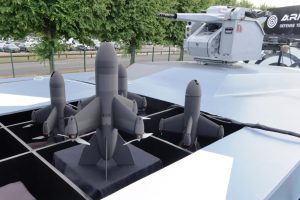
The prototype seen at Eurosatory was fitted with three different types of hard-kill effectors. At mid-ship we could find a Trakon 30 remotely controlled weapon station (RCWS) provided by Unirobotics of Turkey, armed with a Venom LR 30×113 mm cannon produced by Canik, both part of the SYS Group. The Trakon 30 is fitted with an optronic package on the right of the mount, which hosts a day camera, an uncooled thermal camera and a laser rangefinder, the ammunition magazine being on the left, hosting 150 ready rounds. Elevation is between -20° and +60°, sufficient to deal with air threats, the overall mass without ammunition being under 550 kg, a full ammo load having a mass under 70 kg.
At the rear, on each side, two short-range air defence missiles were visible. The single-missile ramp is raised at 30°-40° angle before firing. No details were provided about the missile, however EDR On-Line understood that ARMMO Defense Technologies is working with a major European missile producer while talking to others, the aim being keeping the whole package ITAR-free.
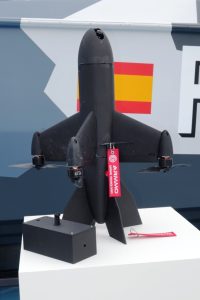
Last but not least come the interceptor drones. Also unveiled at Eurosatory, the Bandit-X was designed since inception as a system capable to operate both from land and naval platforms, manned or unmanned. With the typical interceptor drone architecture, it features a cylindrical fuselage with an aerodynamically shaped front, X-wings carrying at their extremities an electric motor operating a two-blade propeller, X-ailerons at the rear rotated 45° compared to the wings allowing the drone to stand and take-off from a plain surface. At the front we find the sensor, which can be day or thermal, digital or analogue. This is used in the final phase of the flight, when the Bandit-X goes into attack mode, locking the drone to the target once this has been validated by the operator. The analogue option is maintained as it is less prone to jamming compared to digital solutions, while inertial navigation combined with the terminal optical lock-on allows operation in GNSS-denied environments. Behind the sensor we find the payload bay; this can host up to two fragmentation warheads, each having a mass of 400 grams between explosive and ball fragments, detonation being ensured by a proximity fuse. The Bandit-X can reach a maximum speed of 350 km/h, an operational range of 15 km, and an altitude of 5,000 metres, flight time being 12 to 15 minutes.
The Bandit-X is produced using 3D printing; to be able to mass-produce the drone ARMMO Defense Technologies invested heavily in a new facility in Zafra, Extremadura, hosting multiple 3D printers. The production system also allows easy delocalisation in customer countries, a plus when dealing with export contracts.
The company is working on a modular launch system, this containerised solution being visible in mock-up form on the ARW39CAT-A exhibited in Paris, the boat carrying 20 Bandit-X on board. No more details were available; however, it is probable that a base module carrying a reduced number of drones has been developed, which is compatible with smaller platforms such as UGVs or land platforms, EDR On-Line understanding that an interest for such solutions has already materialised.
The configuration seen at Eurosatory might not be the final one for the Bandit-X; EDR On-Line learned that a version with the motors activating pulling propellers located at the front and with a more aerodynamic fuselage is under development, which may well increase maximum speed. A longer-range derivative of the Bandit-X, fitted with swept wings and a longer fuselage, is already in development according to company sources.
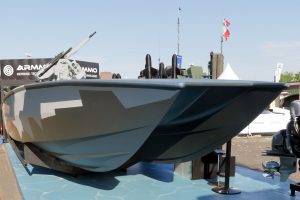
Coupling its USV with its Bandit-X effector ARMMO Defense Technologies is proposing a platform capable to operate alongside naval formations, with typically a frigate as mother platform providing target cueing thanks to its radar, sending information on targets via data link (at Eurosatory the catamaran USV lacked the mast carrying optronics, SATCOM and other data-link antennas). In its current form factor the catamaran seems slightly too big for being hosted in the boat bays of current frigates; the current 39-foot boat may be scaled down to a 36-foot configuration, fully compatible with most boat bays and davits. According to information gathered at Eurosatory, the company aims at starting sea trials of the prototype before year end.
Photos by P. Valpolini
