

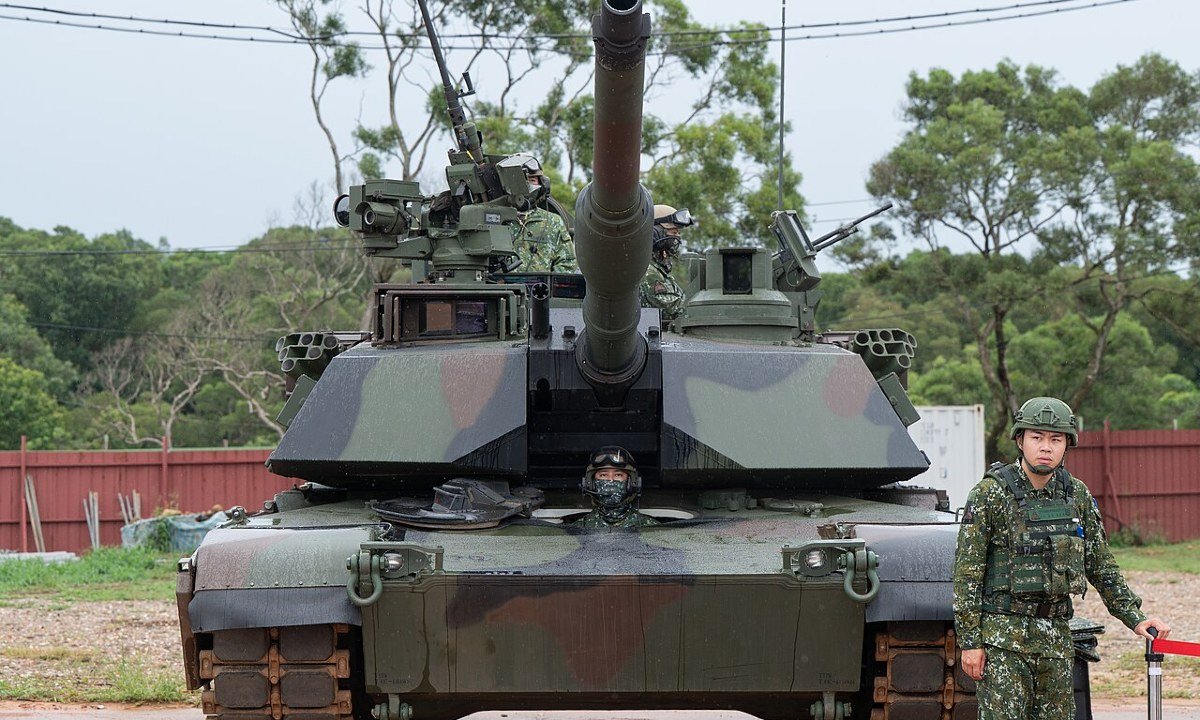
On August 14, Han Kuang 42, the field phase of the latest edition of Taiwan’s largest annual wargame, drew to a close. For many military hardware enthusiasts, the sight of recently delivered US-built M1A2T Abrams tanks practicing concealment, movement, and refueling near Taiwan’s main international airport, Mirage 2000-5 combat aircraft being rapidly loaded with air-to-air missiles while their base was under simulated attack, and Taiwanese navy and coast guard ships conducting antiblockade operations will have been an encouraging sign of serious defensive preparations.
Others will have been more skeptical. In the past, such flashy displays have been the source of criticism from analysts, who have, with justification, claimed that such Taiwanese exercises have been heavily scripted media events that do little to prepare Taiwan’s military for the reality of modern war. Yet the recent evolution of Han Kuang tells a more important story of the kind of war Taiwan is preparing to fight. For decades, Taiwanese defense planning placed overwhelming weight on stopping an invasion force before or around the point at which it reached the island. However, the most recent exercises have pointed toward a desire to ensure that a successful landing does not, by itself, decide the war. This has potential implications for any US intervention in the event of an attack.
Han Kuang began in 1984, after Washington’s 1979 derecognition of Taiwan and the subsequent termination of the Sino-American Mutual Defense Treaty pushed Taiwan toward a more conservative defensive strategy. Taiwan was then an authoritarian state with a large conscript military and a qualitative edge over China. Today it is a democracy with a smaller, largely professional full-time force facing a vastly stronger opponent on the mainland. Such is Beijing’s military overmatch at present that Taipei’s prospects for sustained success in conventional air and sea battles can be largely discounted.
Taiwan’s response to Beijing’s growing power has evolved over time. At the turn of the century, it was proposed that the weight of defensive effort be put into destroying an enemy force before it reached the island as part of a “Decisive Battle Offshore” strategy. Subsequently, the “Hard ROC” strategy, formalized in the 2009 Quadrennial Defense Review, envisaged that while an invasion force would still be attacked while it crossed the strait and at the beachhead, there would be a greater focus on force survivability and the defense in depth of the main island to prevent the consolidation of any forces that landed. In 2017, the asymmetry-focused Overall Defense Concept (ODC), which placed an emphasis on force protection, decisive action in the littoral zone, and destruction of landing forces at the beachhead, emerged. 2019’s Han Kuang 35 tested this approach, first as a computer-simulated exercise that has historically comprised the initial phase of Han Kuang, and then in the field. Institutional inertia within Taiwan’s armed forces limited the ODC’s implementation—a military’s desire for traditional weapons and tactics often dies hard—but asymmetric warfare still became embedded in Taiwan’s defense plans.
Asymmetric operations on the scale needed to defend territory from a conventionally superior opponent require mass to be sustainable. Taiwan’s professional military of around 170,000 personnel could never be adequate alone. While its army is centered on seven combined arms brigades wartime mass is dependent on a core of around twenty brigades split between conscript-heavy standing garrison formations and mobilized reserve brigades that would be made ready in a crisis, with an overall theoretical pool of over 2.85 million reservists—although in practice this number is smaller, with the Pentagon giving a figure of 1.5 million.
Han Kuang 36 in 2020 incorporated reservists into artillery live-fire exercises for the first time, but the reduction of conscript service from twenty-two months to twelve months between 2000 and 2008, and then to four months of military training in 2013, as well as poor refresher training, badly eroded the pool of military personnel that would be available in a crisis. To help counter this, compulsory military service of one year was reintroduced in 2024, although the ramp-up is slow. Reservists are now liable for up to four fourteen-day training periods within eight years of discharge from service to bolster readiness. A restructuring of the armed forces went into effect the same year to more effectively allocate responsibility between regular personnel, conscripts, and reservists.
A major attack by China would not produce a simple front line: Beijing would seek full-spectrum paralysis, making decentralization and wider societal resilience essential. Han Kuang 37–39 increasingly practiced force dispersal and command survival. By Han Kuang 40 in 2024, decentralized command and less scripted scenarios had taken firmer hold, including a command-post scenario in which a Chinese military exercise masked preparations for a real attack, although Typhoon Gaemi ended the field phase of the exercise early.
After these marginal shifts, 2025’s Han Kuang 41 saw major changes. The duration of the command-post and field exercises were doubled—the latter from five to ten days. As foreshadowed in the 2025 Quadrennial Defense Review, instead of the standard phases of dispersal, live-fire, internal security, and antilanding operations, a new phase model featured a sequence of responding to gray-zone provocations, transition to war force deployment (including force protection and preservation), antilanding combat, littoral and beachhead operations, defense in depth, and “protracted warfare.” While the original ODC framed the postlanding resistance as the fallback layer behind the preferred decisive battle at the littoral and beach areas, it was now at least rhetorically coequal. The objective is no longer merely to prevent a landing; it is to make a landing insufficient to end the war and prevent Beijing from taking political control.
Reservist participation also expanded: The supporting Tung Hsin 35 drill mobilized a full infantry brigade as part of the largest ever reserve participation, while the parallel Urban Resilience exercise tested evacuation, shelters, and civilian support. The 2025 Quadrennial Defense Review similarly stressed whole-of-society defense, mobilization, and civil-military integration, coordinated in part through the All-Out Defense Mobilization Agency, formed in 2022.
This year’s Han Kuang 42 modified the exercise sequence: The overall architecture of the exercise is now year-round, with an immediate combat readiness exercise (held for the first time in March 2025) now covering the gray-zone element and, together with the joint defense drills in July, feeding into the main event. Han Kuang itself began with a Chinese military exercise that masked invasion preparations, which triggered Taiwanese mobilization, dispersal, and force preservation measures. President Lai Ching-te participated in an “anti-decapitation” drill, traveling in an armored vehicle to a protected command location—a measure designed to prevent the capture or killing of Taiwan’s leadership. US-sourced Patriots were among the air and missile defense systems kept on the move to avoid being targeted.
While US forces do not directly participate, Taiwan’s drills increasingly feature procedures adopted from the US military. Military command decentralization has been further built upon with expansion of the mission command concept in which subordinates are left to accomplish missions as they judge appropriate based on the commander’s intent rather than through following detailed instructions from above. A “back brief” model in which subordinates inform their commanders how they intend to accomplish their assigned mission was also introduced.
As part of measures to interdict the transiting landing force, the recently inaugurated Littoral Combat Command, bringing together truck-launched antiship missiles, mobile radar, and uncrewed systems, sought to provide a survivable counter to Chinese naval surface ships. Shoreline antilanding drills also took place, including on the frontline island of Nangan and the mid-strait Penghu Islands. Around Taipei and Taoyuan International Airport, Taiwanese army units rehearsed defense against airborne seizure and amphibious assault via a river estuary.
Postlanding defense in depth and protracted warfare formed a critical component of the exercise. This included the denial of infrastructure such as bridges, roads, and tunnels to the enemy, cross-island reinforcements, and logistics and maintenance support of forces in the field. This year has seen two reserve-dependent brigades mobilized under Tung Hsin 36 rather than one. Civilian assets were utilized for wartime tasks, including the use of commercial trucks to transport tanks and distribute artillery shells, and civilian ships to block access to port facilities. There was also industrial dispersal and conversion, maritime resupply under escort, communications disruption, evacuation, and mass-casualty response.
There are still problems with the exercise. For all the breadth of activity types, the depth was limited relative to the scale of the actions that would be required in wartime. While it is impossible to fully replicate the conditions of a conflict, the gap between what this year’s Han Kuang demonstrated and what would be required in a real contingency—including millions mobilized into wartime roles, access to vast munitions and supply stockpiles, and maintenance of resistance in the face of mass infrastructure loss, supply chain breakdowns, and Chinese infiltration—needs to be closed. Rehearsing protracted warfare does not mean Taiwan is in a position to sustain it.
This brings us back to the potential role of the United States. There is a well-established, if small, US military presence in Taiwan for advisory and training purposes, and photos indicate a US Marine Corps general participated in the planning for last year’s Han Kuang. Protracted resistance gains much of its strategic value by buying time and preserving options for outside assistance. Yet US strategic ambiguity means Taiwan cannot base its defense plan on intervention being guaranteed. Taipei may well seek to prolong a conflict to buy time for outside intervention, but it is not clear whether that intervention will be forthcoming. This does not in and of itself invalidate forcing a protracted war: Ensuring that China is aware that it will pay a high price even if it is ultimately successful still has deterrence value. But the uncertainty of US involvement risks feeding back into how willing the island’s inhabitants are to sustain the high price of resisting Beijing.
Rowan Allport is a deputy director at the Human Security Centre, a London-based foreign policy think tank. He has previously worked as a senior analyst for RAND Europe. Rowan is the author of the book War Plan Taiwan: OPLAN 5077 and the U.S. Struggle for the Pacific (Naval Institute Press). He holds a PhD in politics from the University of York.
The views expressed are those of the author and do not reflect the official position of the United States Military Academy, Department of the Army, or Department of Defense.
Image credit: Office of the President of Taiwan
