

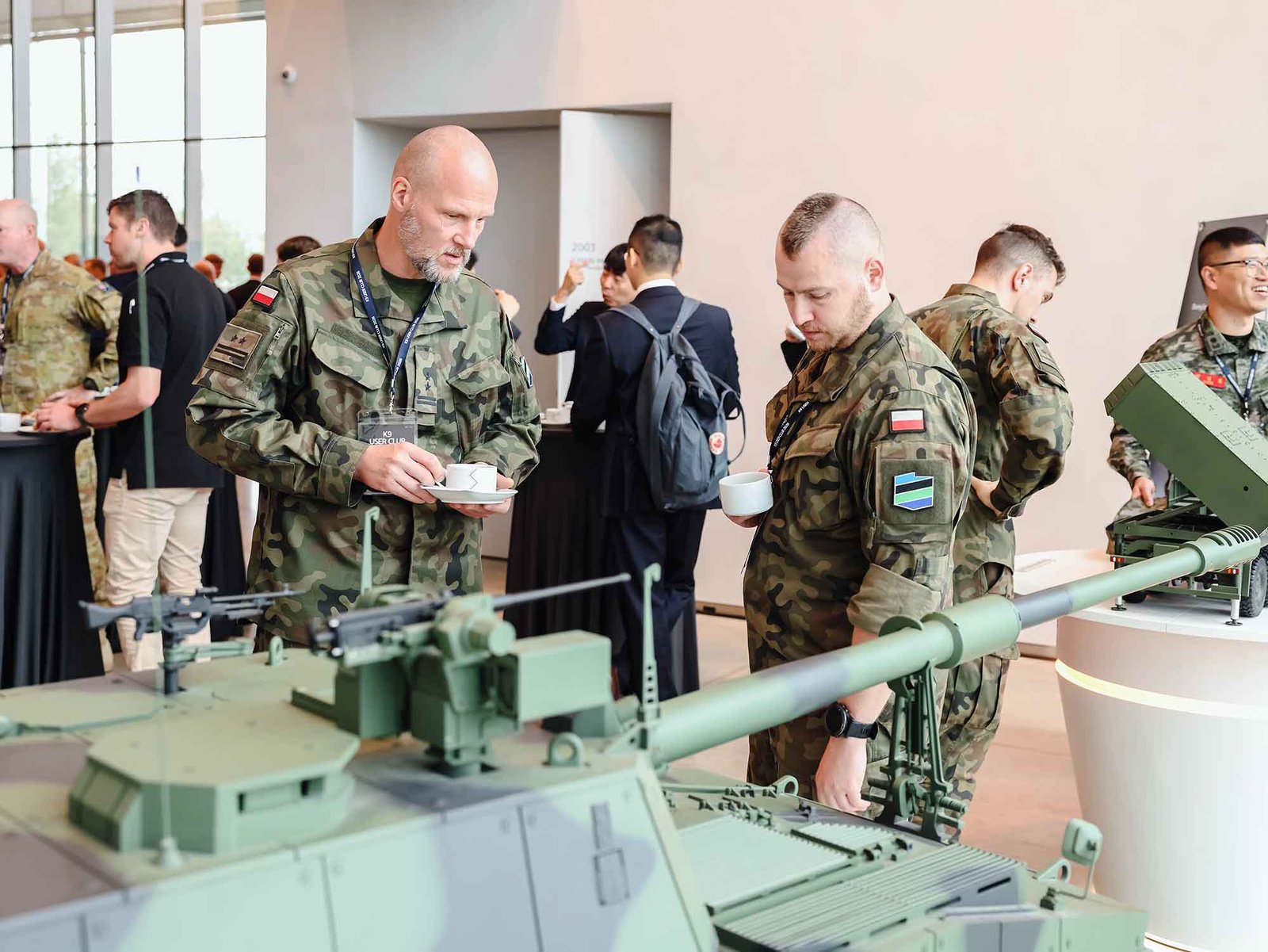
Hanwha Aerospace unveiled its vision for the next evolution of the K9 Self-Propelled Howitzer at this year’s K9 User Club in Estonia, demonstrating how the globally proven artillery system is evolving beyond its traditional role through next-generation operating concepts, platform expansion and smarter sustainment to meet the demands of the future battlefield.
The three-day forum brings together more than 200 military and industry representatives from seven K9 user nations—the Republic of Korea, Estonia, Poland, Norway, Finland, Romania and Australia—alongside observer delegations from Spain and Sweden.
Hosted by the Estonian Defence Forces at the Estonian National Museum from Sept. 2–4, the annual forum provides a platform for K9 operators to exchange operational experience, strengthen partnerships and help shape the future of artillery capabilities.
“The K9 has established itself as an outstanding and highly capable artillery system. Its performance, reliability, and operational capabilities have earned the trust of a growing number of NATO allies and partner nations,” said Major General Viktor Kalnitski, Deputy Commander of the Estonian Defence Forces. “The K9 User Club brings together commanders, artillery officers, operators, technical specialists, and representatives of industry. It provides an opportunity to exchange practical experience and to discuss the challenges that each of us faces.”
Building on the operational experience accumulated by K9 user nations, this year’s discussions focus on how artillery capabilities should evolve to address increasingly dynamic battlefield environments. Participants discuss operational lessons learned, maintenance best practices, ammunition interoperability, training and future capability requirements while identifying opportunities for deeper collaboration among K9 operators.
Giving K9 Eyes in the Sky
One of the key highlights of this year’s User Club is the next-generation K9 operating concept, which integrates fire-guidance drones directly into the artillery fire mission. Rather than focusing solely on improving the performance of the gun, the concept redefines how artillery units detect, engage and assess targets by significantly shortening the sensor-to-shooter cycle.
Hanwha presented the concept employing a vertical take-off and landing (VTOL) fire-guidance drone capable of detecting and tracking targets, generating target coordinates and transmitting them directly to the fire-direction system for K9 fire missions.
The drone remains over the target area throughout the engagement, supporting target acquisition before firing, observing impacts during the mission and conducting battle damage assessment after engagement.
Continuous aerial observation enables artillery units to engage moving or time-sensitive targets more effectively while reducing reliance on forward observers operating in exposed positions.
The concept demonstrates how the K9 is evolving beyond a conventional self-propelled howitzer into a more connected, responsive and networked battlefield system.
Expanding K9 Beyond Tracks
The next evolution of the K9 extends beyond how it fights—it also redefines what the platform itself can become. Building on decades of operational success, Hanwha Aerospace is demonstrating the K9 platform’s scalability and adaptability, positioning it as the foundation for a broader family of future artillery capabilities.
Hanwha is leveraging the proven technologies, operational experience and continuous innovation behind the K9 to extend the platform into new artillery solutions tailored to evolving operational requirements. This approach enables new capabilities while preserving the reliability, survivability and firepower that have made the K9 one of the world’s most successful self-propelled howitzers.
To illustrate that vision, Hanwha outlined new wheeled artillery concepts incorporating advanced technologies—including the K9A2’s fully automated turret—to deliver greater operational mobility, deployment flexibility and responsiveness. The concepts demonstrate how proven K9 technologies can be applied beyond the traditional tracked configuration, enabling more agile and flexible fire support while leveraging the platform’s mature technology base and operational experience.

Hanwha’s recent selection for the U.S. Army’s Mobile Tactical Cannon (MTC) prototype program further reinforces the company’s growing expertise in next-generation mobile artillery and demonstrates the global competitiveness of its advanced artillery technologies.
Together, these developments demonstrate that the K9 is no longer simply a tracked self-propelled howitzer. It is evolving into a scalable and adaptable artillery platform capable of supporting multiple configurations, integrating emerging technologies and meeting diverse operational requirements for the battlefield of the future.

Smarter Sustainment for the K9 Fleet
Hanwha Aerospace’s TOMMS Sustainment Portal also drew significant attention from participating K9 operators as they explored ways to enhance fleet readiness and long-term sustainment.
Designed to digitize spare-parts procurement and logistics, TOMMS integrates requests for quotation, quotations, purchase orders and delivery tracking into a single platform, providing greater visibility and efficiency throughout the sustainment process.
The system includes a digital catalogue covering 700–800 frequently requested spare parts, enabling operators to identify required components more efficiently while improving procurement visibility.
Hanwha also plans to connect TOMMS with its spare-parts warehouse in Poland to further strengthen support for European K9 operators.
Looking ahead, the company aims to leverage maintenance and operational data to forecast spare-parts demand and position critical components before they are needed, moving from reactive logistics toward predictive sustainment.
The initiative is expected to improve fleet readiness, maximize operational availability and reduce lifecycle support costs, supporting K9 operators throughout the system’s entire lifecycle.
Senior Executive Vice President Peter JK Bae, Head of MRO Business Division, said:
“The K9 User Club has become much more than an annual gathering. It is a collaborative platform where users, operators and industry work together to transform operational experience into future capability development. Every lesson learned in the field helps shape the next generation of K9 capabilities—from new operating concepts and mobility solutions to smarter sustainment.”
The K9 User Club is hosted by participating user nations on a rotating basis, with Australia set to host the next K9 User Club in 2027.
Source: Hanwha Aerospace
Click here to read the latest issue of ESD.
